Fumiyo Kōno, A Life in Drawings
The creator of the manga ‘In This Corner of the World’ reflects on her career in an interview marking her first retrospective in Japan.
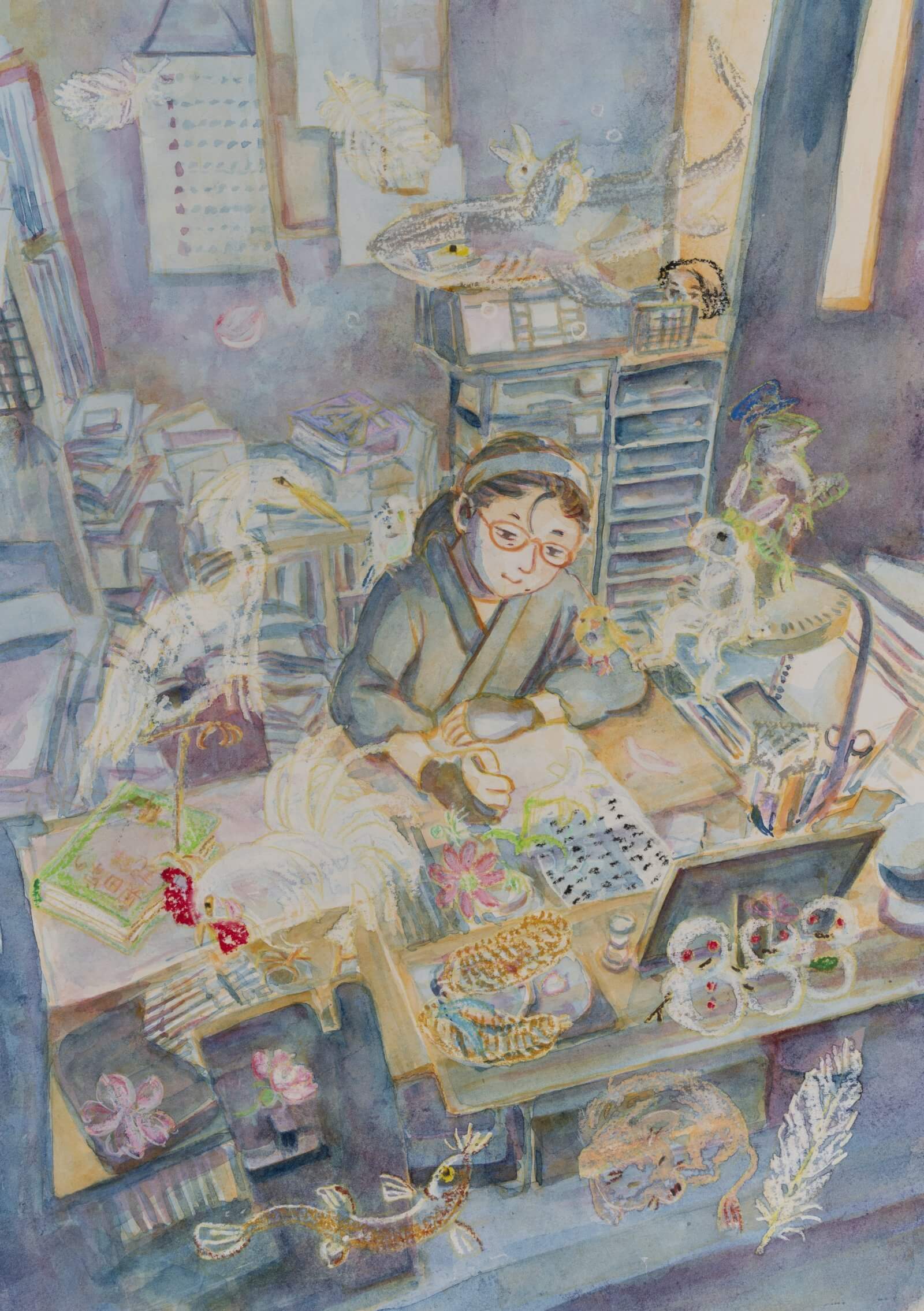
‘The One Who Draws’, original illustration created for the exhibition catalogue. Characters drawn by Fumiyo Kōno over the years gently watch over her as she works on her manga. © Fumiyo Kōno
With Town of Evening Calm, Country of Cherry Blossoms (2004) and In This Corner of the World (2007), Fumiyo Kōno established herself as one of the leading voices in contemporary manga. To celebrate her thirty-year career, the Sakura City Museum of Art in Chiba Prefecture has organized a major exhibition featuring over 500 original panels. It offers a chance to trace her journey and, through her words, to understand what drives her work.
From Early Works to First Recognition
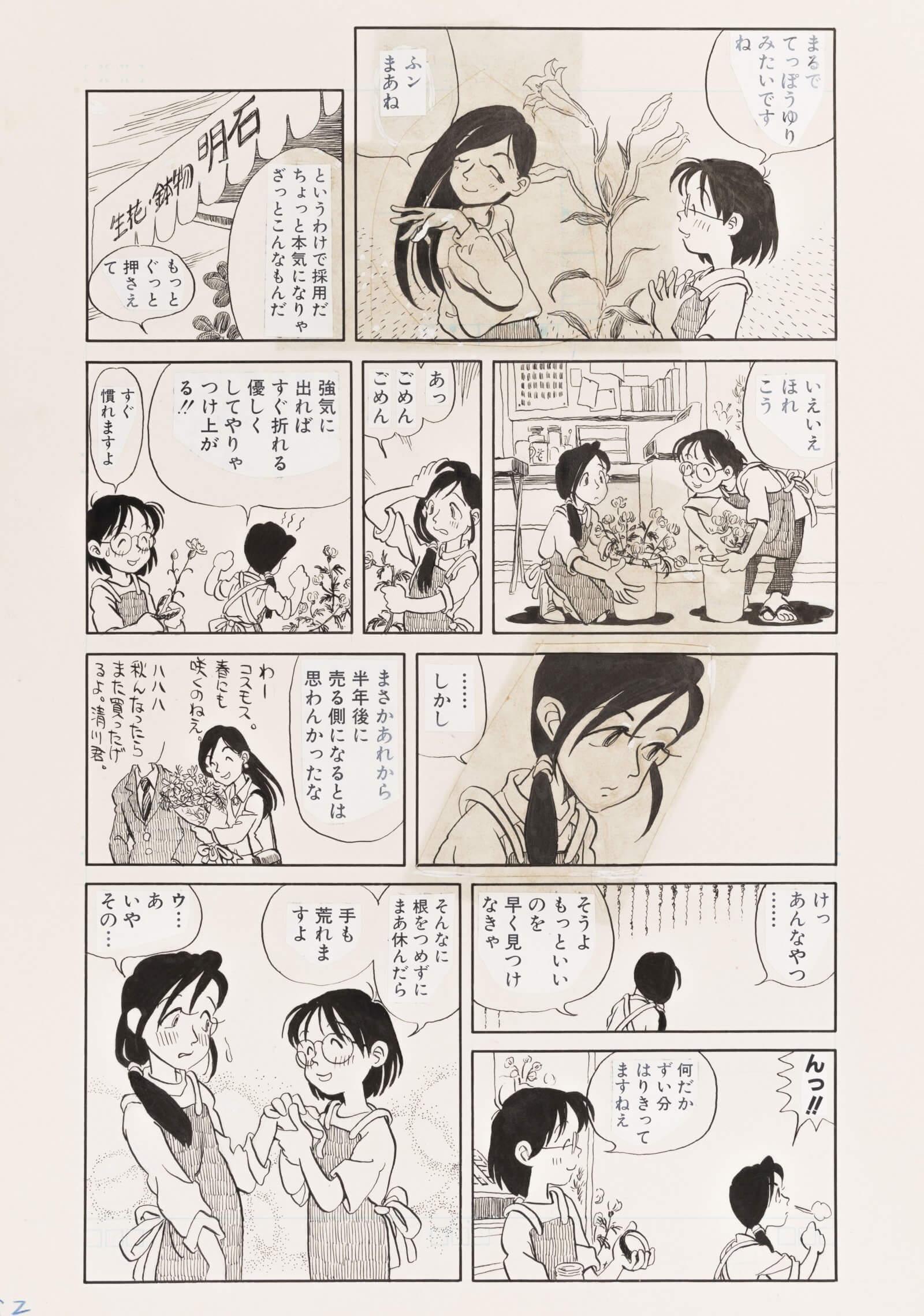
‘Street Corner Tidings of Flowers’, 1995 © Fumiyo Kōno / Coamix
Born in Hiroshima in 1968, Fumiyo Kōno made her debut with the series Street Corner Tidings of Flowers (untranslated), before finding success with the humorous strip Pippira Nōto (untranslated), which chronicles daily life shared with a pet parrot. Her first major recognition came with Town of Evening Calm, Country of Cherry Blossoms, a story exploring the aftermath of the atomic bomb, which earned her the 9th Osamu Tezuka Newcomer Award and was later adapted for both cinema and television.
‘I feel roughly the same attachment to each of my works,’ she explains. ‘But Town of Evening Calm, Country of Cherry Blossoms was a first turning point. Up until then, manga for me was like a lover. I felt that as long as I continued drawing enjoyable manga, that would be enough.’
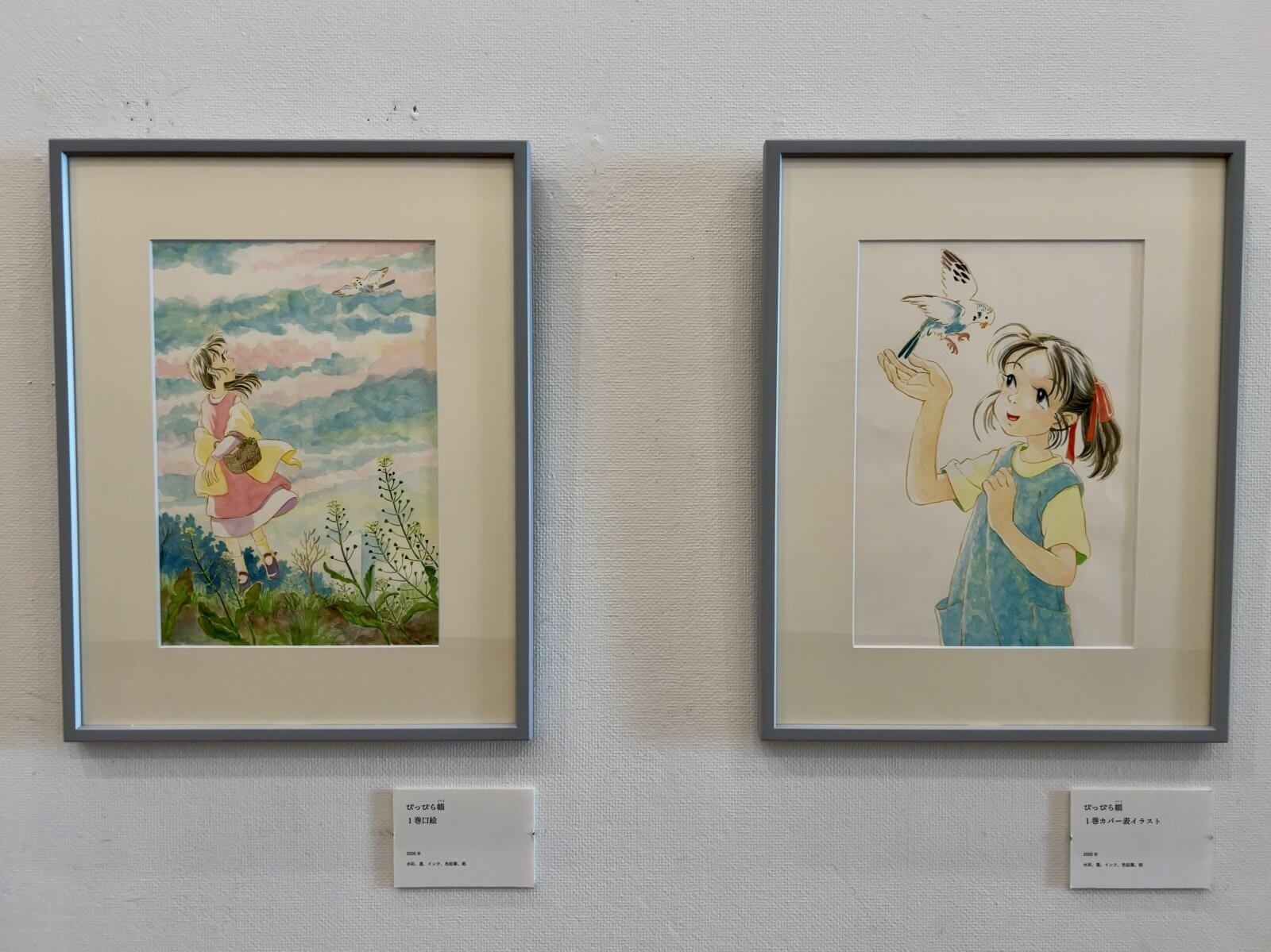
From the exhibition ‘Fumiyo Kōno: 30 Years as a Mangaka’, ‘Pippira-nōto’. Right: cover illustration, vol. 1, 2000. Left: illustration at the beginning of the work, vol. 1, 2000.
‘When my editor suggested that I draw Town of Evening Calm, Country of Cherry Blossoms, I wondered whether it was really necessary to read a manga about such a painful and tragic topic as the atomic bomb. But once I started, I discovered that there were many people who had been waiting for exactly that kind of story. I was happy to have been able to meet that expectation.
And above all, this work didn’t make me hate manga. That’s when I realized that manga wasn’t just a lover, it was a lifelong companion.’
The Phenomenal Success of ‘In This Corner of the World’ and Why War Became Her Theme
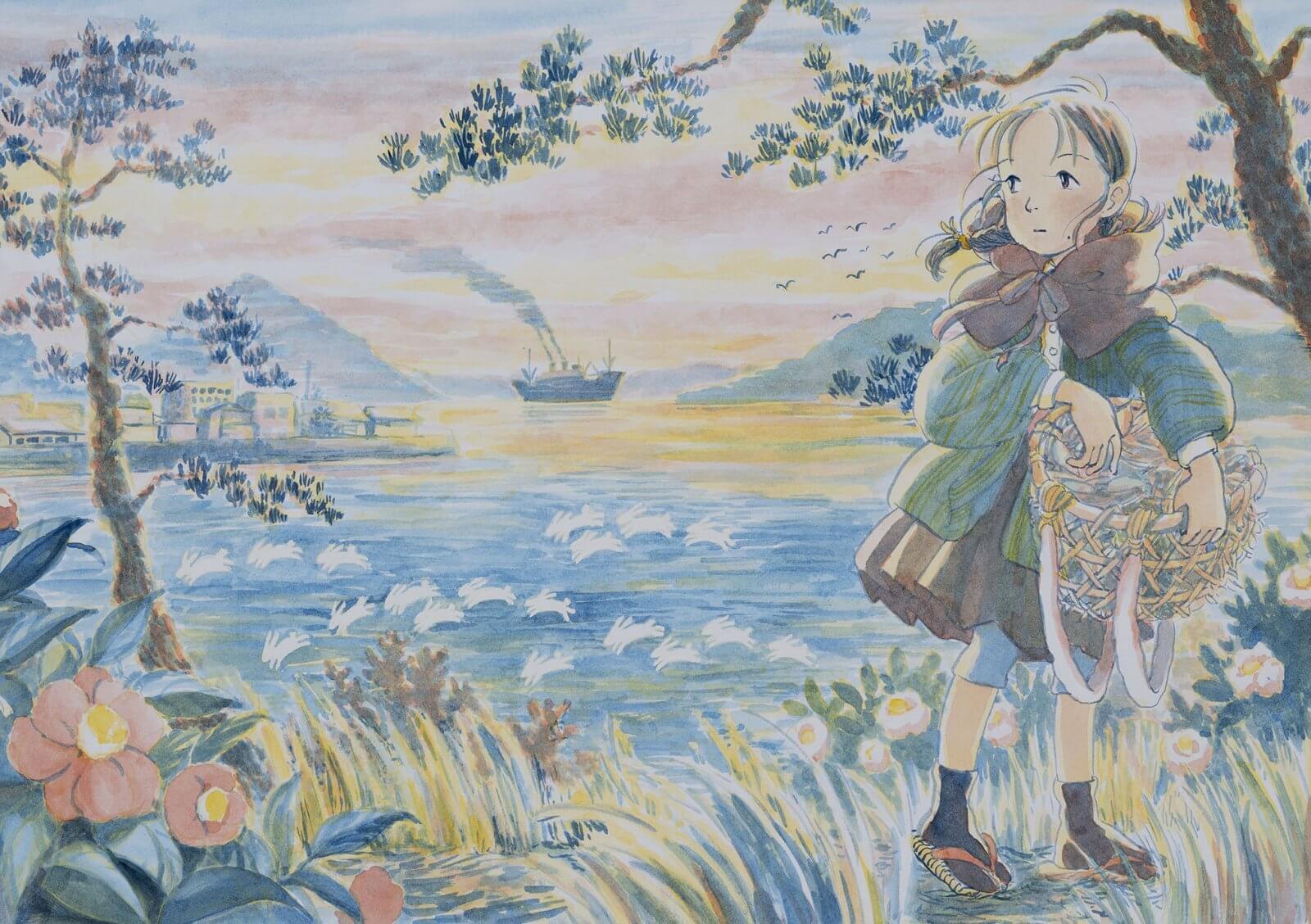
‘In This Corner of the World’, 2007 © Fumiyo Kōno / Coamix
In This Corner of the World, which follows Suzu and those around her in Kure and Hiroshima during the Pacific War, represents a culmination of Fumiyo Kōno’s artistry. The animated adaptation by Sunao Katabuchi enjoyed a long-running success, and the manga is regarded as a career-defining work. Yet initially, Kōno felt almost unworthy of portraying the war and the atomic bomb.
‘I was born in Hiroshima, but I didn’t have relatives who were directly affected by the bomb. I didn’t experience it myself, nor did my family. So I wondered whether I had the right to depict it.’
‘In Hiroshima, television broadcasts about the atomic bomb are frequent in the summer. As a child, I tended to avoid them, probably because the content was too painful to confront directly. There was also a sense that people who hadn’t experienced the bomb themselves weren’t really qualified to talk about it.’
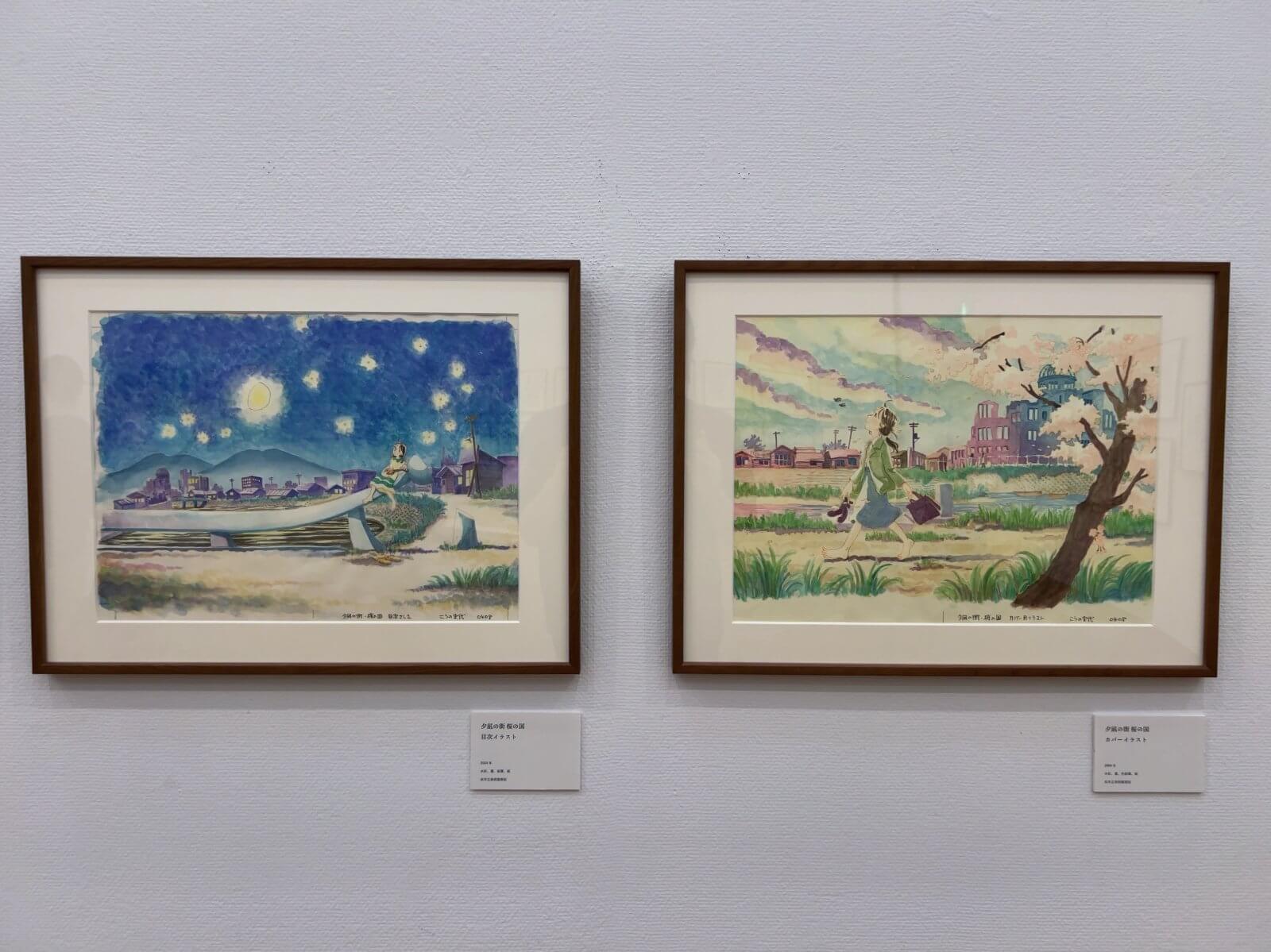
From the exhibition ‘Fumiyo Kōno: 30 Years as a Mangaka’, ‘Town of Evening Calm, Country of Cherry Blossoms’. Right: cover illustration, 2004. Left: contents page illustration, 2004.
After discussing it with her family, who simply encouraged her with ‘just try drawing it,’ she decided to take the plunge. She embarked on extensive research that culminated in Town of Evening Calm, Country of Cherry Blossoms and In This Corner of the World.
‘For me, a work about war can’t just end with ‘that was sad’ or ‘I read it and that’s it.’ A painful story might be enough for a single reading, but I want to create works that make readers want to return to the characters again and again. That feeling is something I strive never to lose.’
A Fully Handmade Practice, Without Assistants
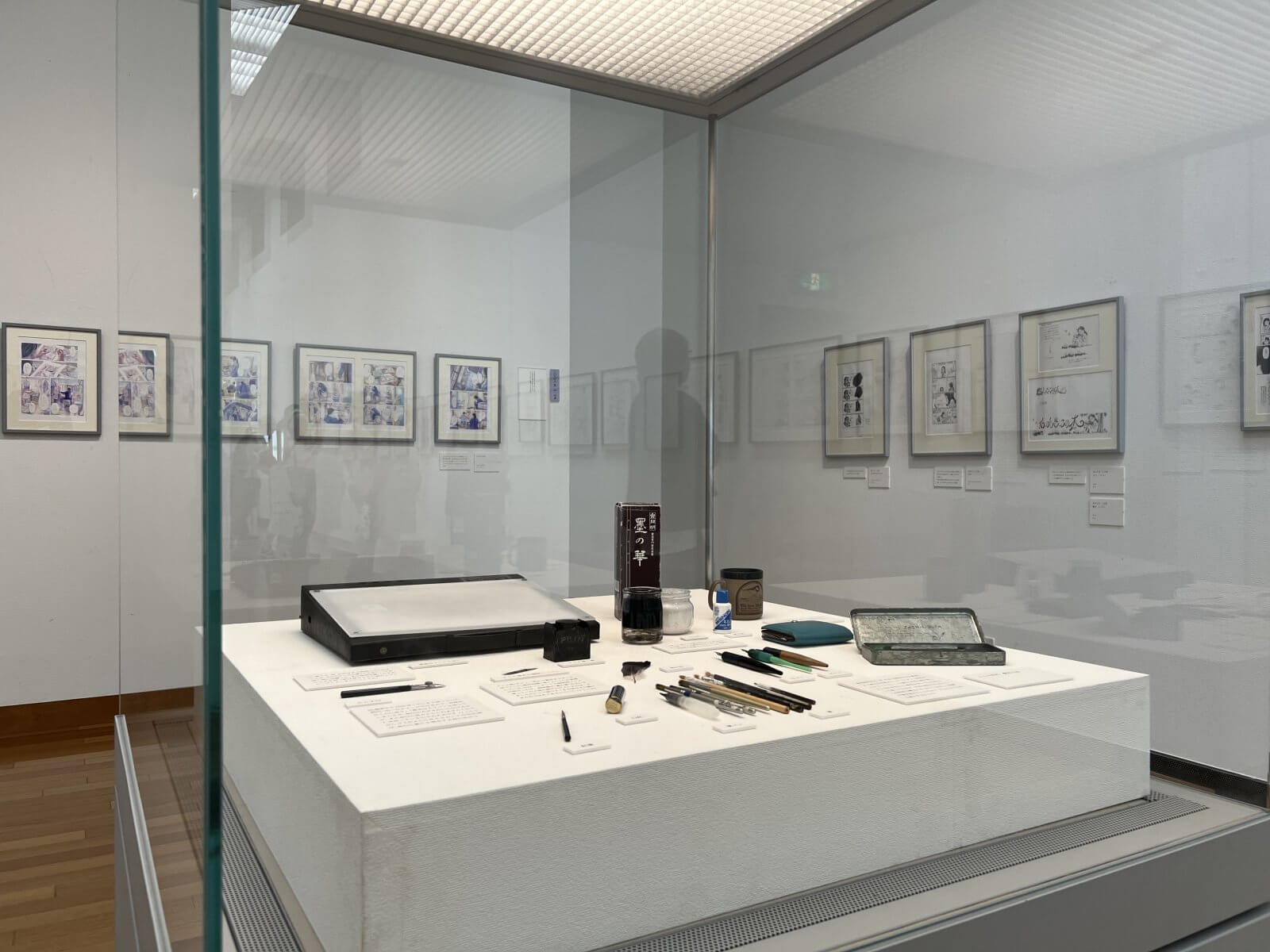
From the exhibition ‘Fumiyo Kōno: 30 Years as a Mangaka’. In the foreground: Fumiyo Kōno’s favorite tools, including brushes, dip pens, and ink bottles.
From her first drawings at age ten to her latest works, over 500 original panels are displayed chronologically in the exhibition. From the beginning, Fumiyo Kōno’s work shows characters and backgrounds drawn with a delicate, endearing touch, serving themes ranging from the lightness of daily life to the gravity of war, and including retellings of Japanese mythology. Each work reflects Kōno’s unique voice, yet none resembles another—a diversity that continually surprises.
‘I think it’s important to have two passions: drawing manga, of course, and also something else. For me, I love making manga. And when I find a subject I want to explore, I research it until I truly love it. Essentially, there are always two things I love: one is constant, the other stays open and changes over time. That’s how I’ve continued my career as a mangaka.’
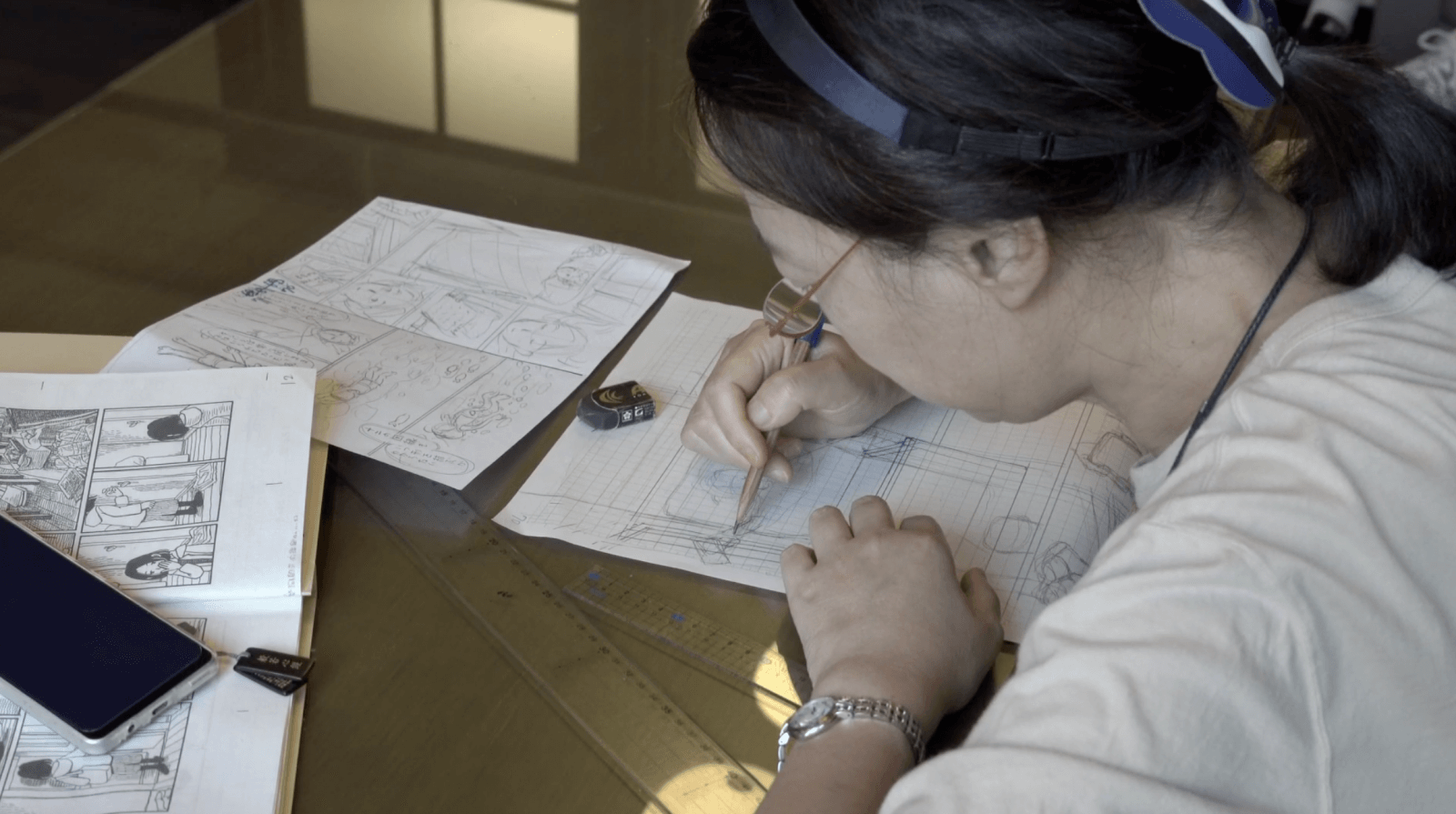
Creative process, video excerpt from the exhibition (directed by Akane Shirai).
Never employing assistants, Fumiyo Kōno draws, inks, and colors each page herself, barely using screentone. Viewing her originals, one is captivated by the softness and warmth of her line and the subtlety of her colors.
‘I’ve never been comfortable with screentones… applying them takes more time, so I’d rather draw meticulously by hand, which I enjoy far more. I used to try writing scripts on a computer before drawing, but it didn’t work. Ultimately, I prefer to create storyboards with sketches, thinking as I move my hand. I cherish that feeling of the hand and brain being directly connected.’
‘With digital, everything can disappear instantly. But when drawing by hand, even lines I thought were mistakes can later turn out to be interesting. That’s why I prefer analog, where nothing ever fully disappears.’
Drawing to Affirm Life
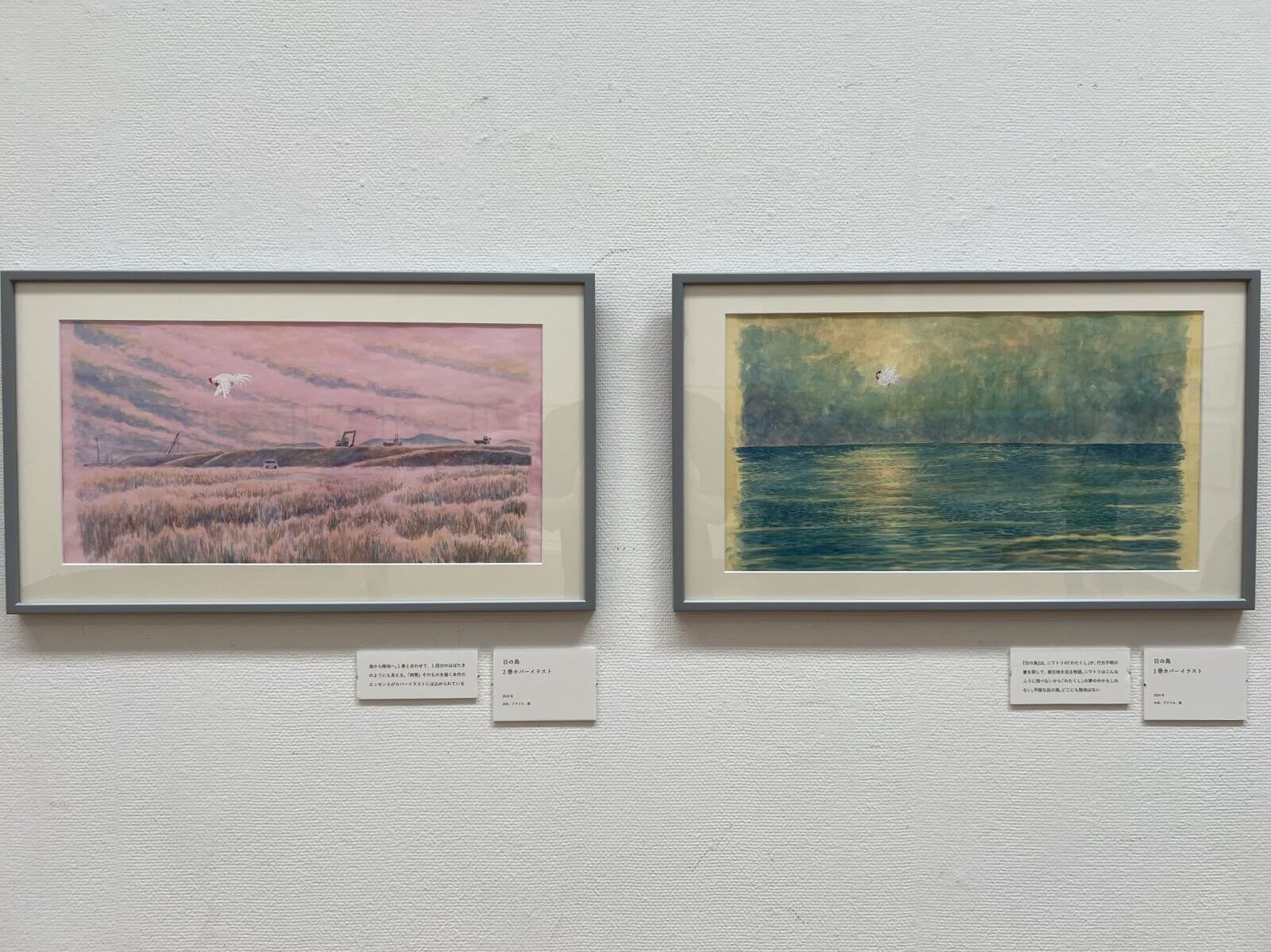
From the exhibition ‘Fumiyo Kōno: 30 Years as a Mangaka’, ‘Hi no Tori’. Right: cover illustration, vol. 1, 2014. Left: cover illustration, vol. 2, 2016.
Begun in 2012, the year after the Great East Japan Earthquake, the series Hi no Tori (The Bird of the Sun, untranslated) follows a rooster searching for his lost wife, conveying the passage of time in post-disaster Tōhoku. The landscapes Fumiyo Kōno draws are directly inspired by her visits to the affected regions.
‘At that time, I lived in Tōkyō but felt Tōhoku was very close. I wasn’t in what’s called a disaster zone, but friends in Hiroshima worried about me… And the images of the tsunami I saw on television never left my mind. Through that experience, I wondered what I could do as a mangaka, and that’s how I began traveling to the region.’
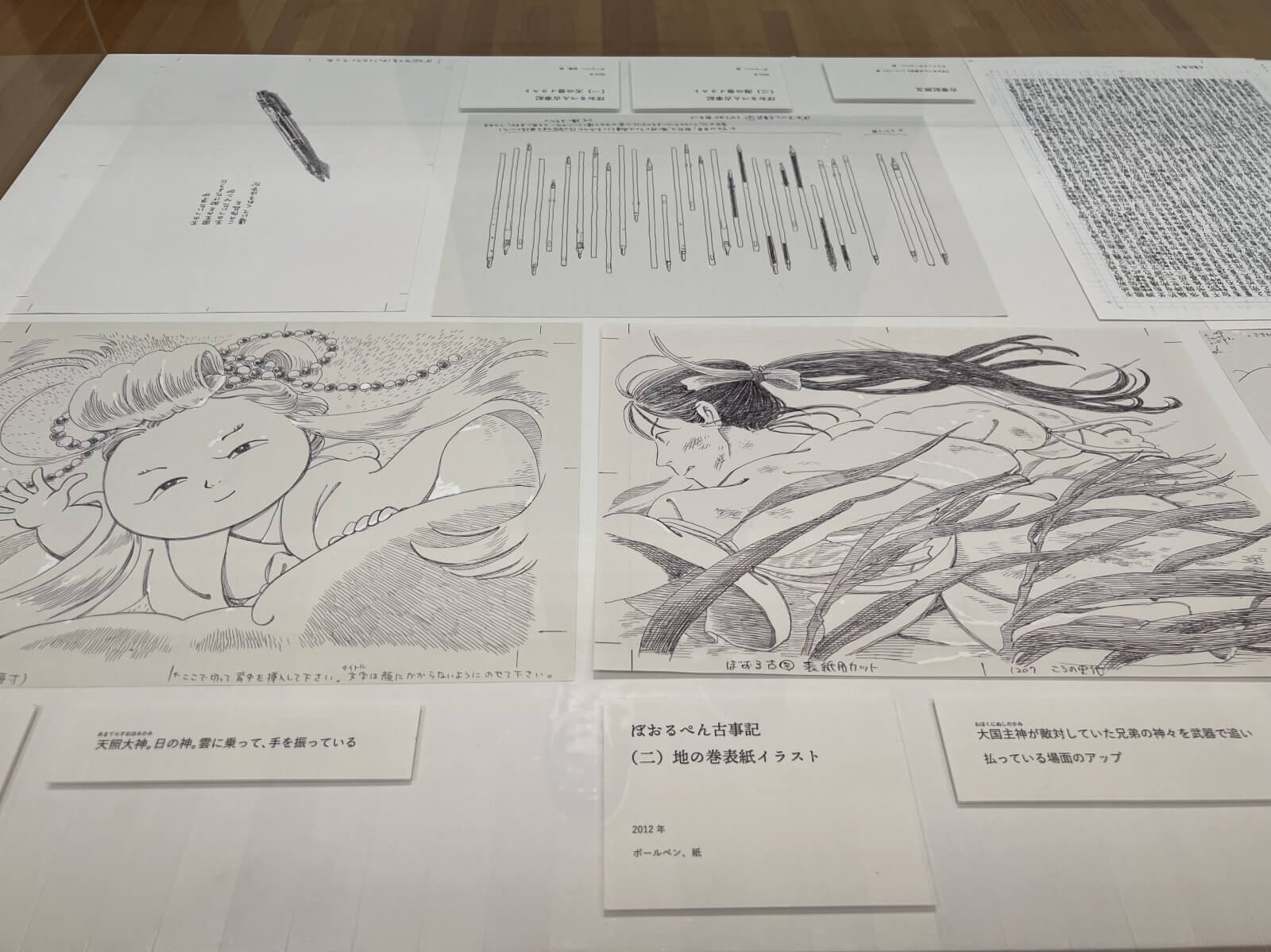
From the exhibition ‘Fumiyo Kōno: 30 Years as a Mangaka’, ‘Bōrupen Kojiki’. Cover illustration, first two volumes, 2012.
‘It was also a period of uncertainty, as I was considering whether to start serializing Bōrupen Kojiki (untranslated), a pen-and-ink adaptation of myths from the Kojiki. Ultimately, I found myself drawing both manga simultaneously while visiting various disaster sites. With Hi no Tori, I felt I was affirming my life through drawing, checking that I was alive now and would continue to be. In that sense, it may have been a second turning point for me, after Town of Evening Calm, Country of Cherry Blossoms.’
‘I Wanted an Ordinary Character as the Heroine’, ‘Sora-iro Shingyō’, Her First Long Work in Twelve Years
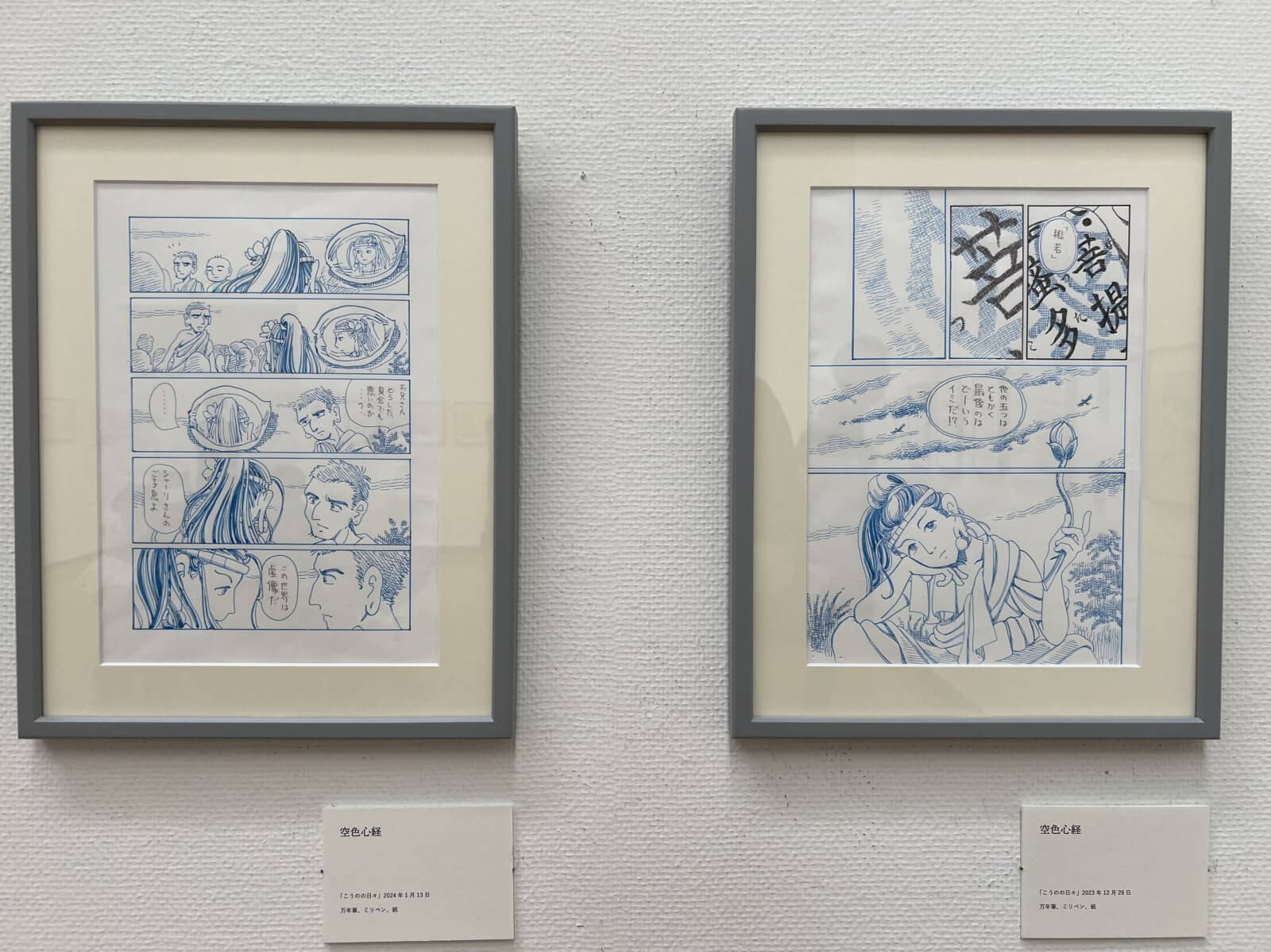
From the exhibition ‘Fumiyo Kōno: 30 Years as a Mangaka’, ‘Sora-iro Shingyō’. Right: ‘Kōno’s Days’, 28 December 2023. Left: ‘Kōno’s Days’, 13 January 2024.
Published twelve years after her previous long-form work, Sora-iro Shingyō (The Heart Sutra in Sky Blue, untranslated) uniquely blends the Heart Sutra with the reality of the COVID-19 pandemic, connecting a timeless universe with the everyday. The exhibition presents the cover illustration, selected original pages, and a handwritten manuscript, serving as a blueprint for the story.
‘More than the Heart Sutra itself, I wanted to try adapting a sutra into manga. When we read a Buddhist text, it’s often hard to grasp the meaning at once. But if the text comes with images, with visual scenes, it enters the mind more easily and can even become enjoyable. Like with Bōrupen Kojiki, adding illustrations changes the dimension, creating a kind of three-dimensional expression.’
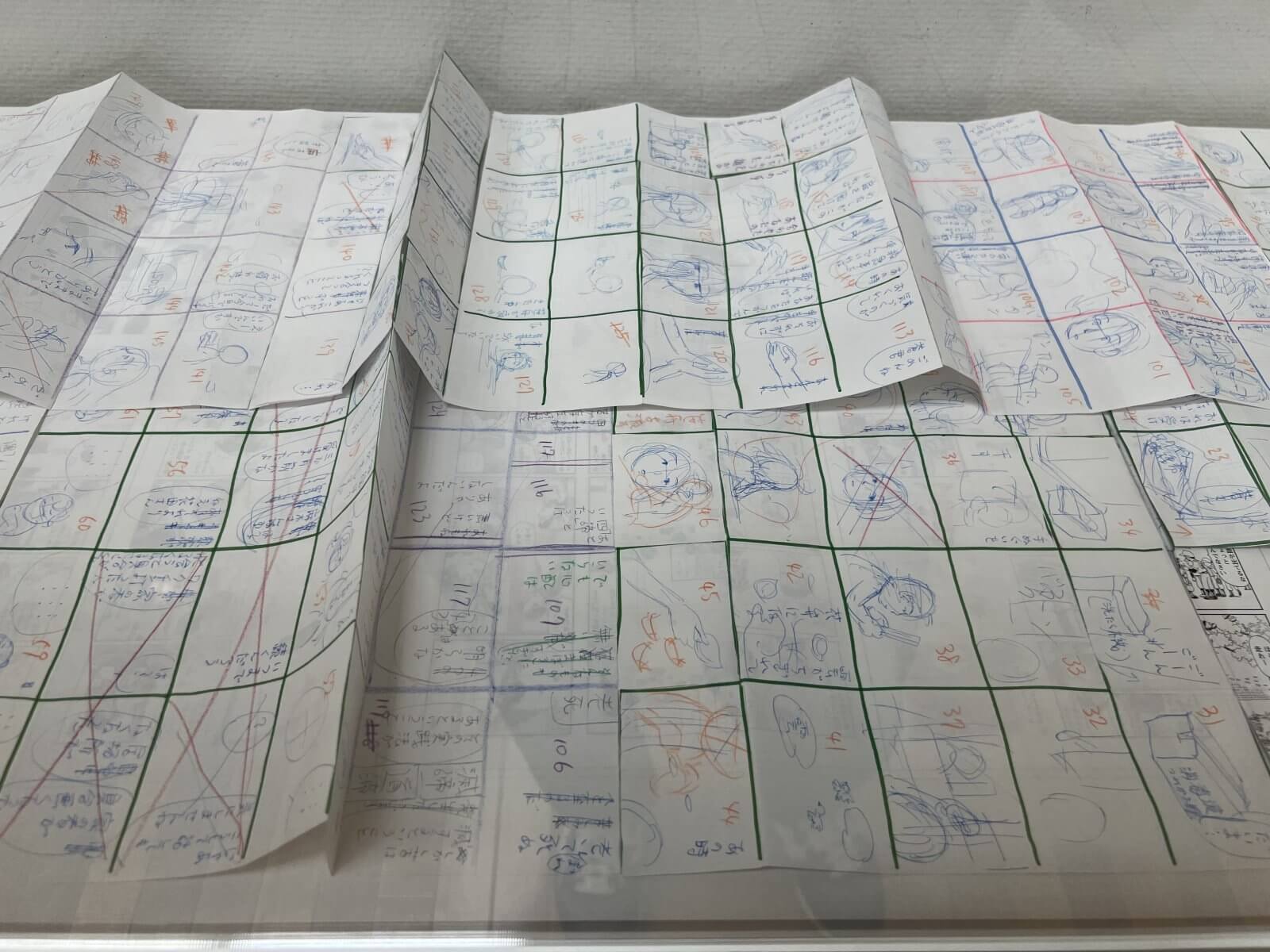
From the exhibition ‘Fumiyo Kōno: 30 Years as a Mangaka’, handwritten script for ‘Sora-iro Shingyō’.
Set in Fukuchiyama, northern Kyoto Prefecture, where Fumiyo Kōno has lived since 2016, the story follows Ai Asaki, a supermarket worker weighed down by a deep worry. Her encounter with the Heart Sutra changes her perspective and allows her to carve a new path in life.
‘I wanted an ordinary character as the heroine. I’m not fond of stories dominated by a genius who drags everyone along. My characters, like Suzu from In This Corner of the World, are always benign figures. In Sora-iro Shingyō, I incorporated the pandemic, something everyone experienced, to depict a protagonist who is relatable yet faces a dramatically changed everyday life.’
Revisiting the Story of Lise Meitner, the Physicist Who Discovered Nuclear Fission
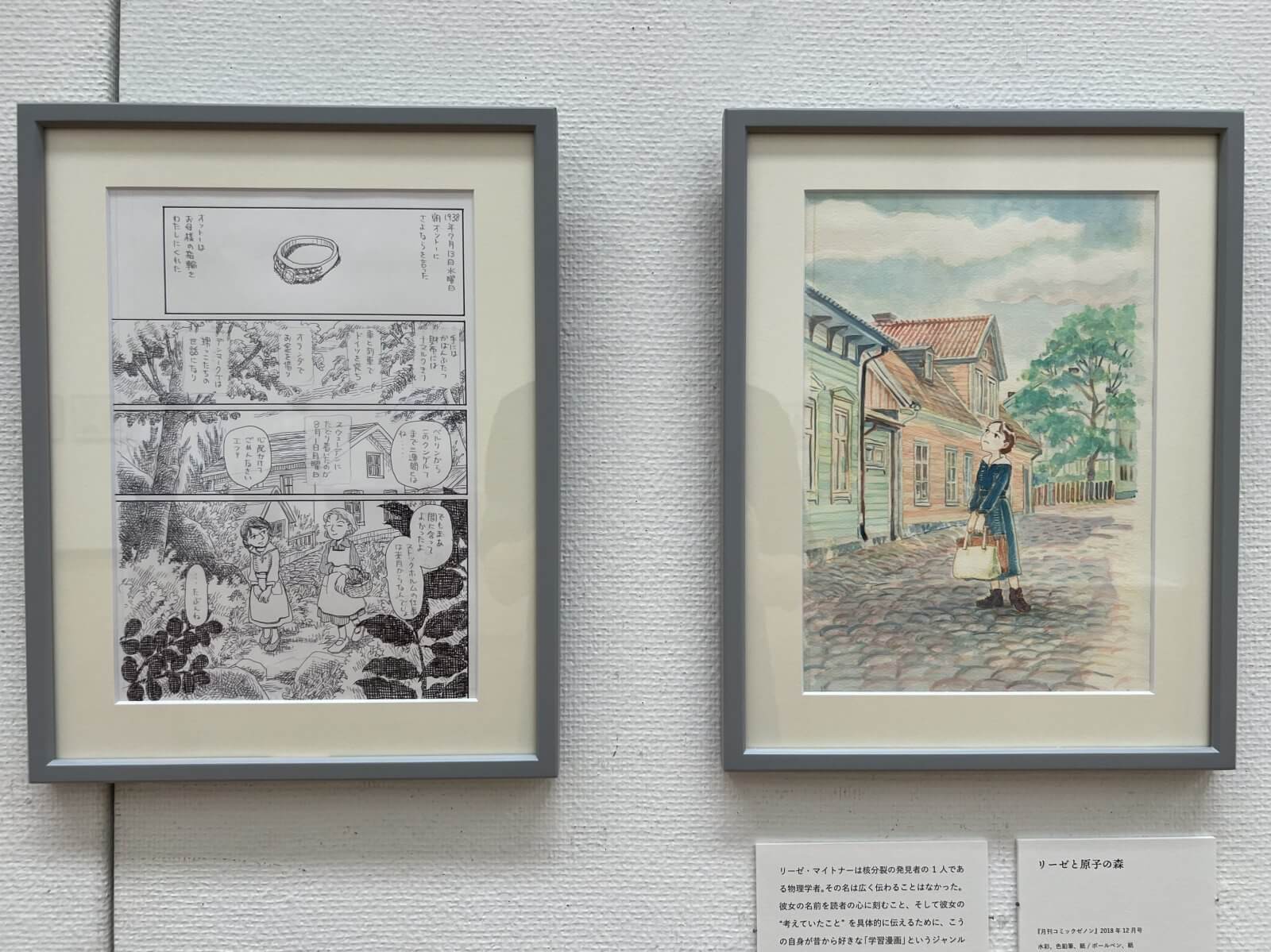
From the exhibition ‘Fumiyo Kōno: 30 Years as a Mangaka’, ‘Lise and the Forest of Atoms’, ‘Monthly Comic Zenon’, December 2018.
Fumiyo Kōno is currently working on a narrative inspired by the ‘millennial tsunami’ of the Great East Japan Earthquake, only set a thousand years ago. She also plans to revisit another theme.
‘I would like to tell the story of Lise Meitner again. For this exhibition, we are also presenting the original pages of Lise and the Forest of Atoms (untranslated), which depicts her life, but it was a short story. This time, I would like to create a longer work.’
Lise and the Forest of Atoms centers on Lise Meitner, the physicist who discovered nuclear fission but refused to participate in the development of weapons. The story begins with her fleeing to Sweden to escape Nazi persecution of Jews.
‘She deserves much more attention. She was a scientist who recognized the dangers of nuclear power at a very early stage. And radiation, though invisible to the eye, is something whose dangers I think can be expressed effectively in manga. Researching for Lise and the Forest of Atoms was extremely demanding, but I have always wanted to revisit this story in depth.’
‘I Cannot Bring Myself to Create Disposable Manga’
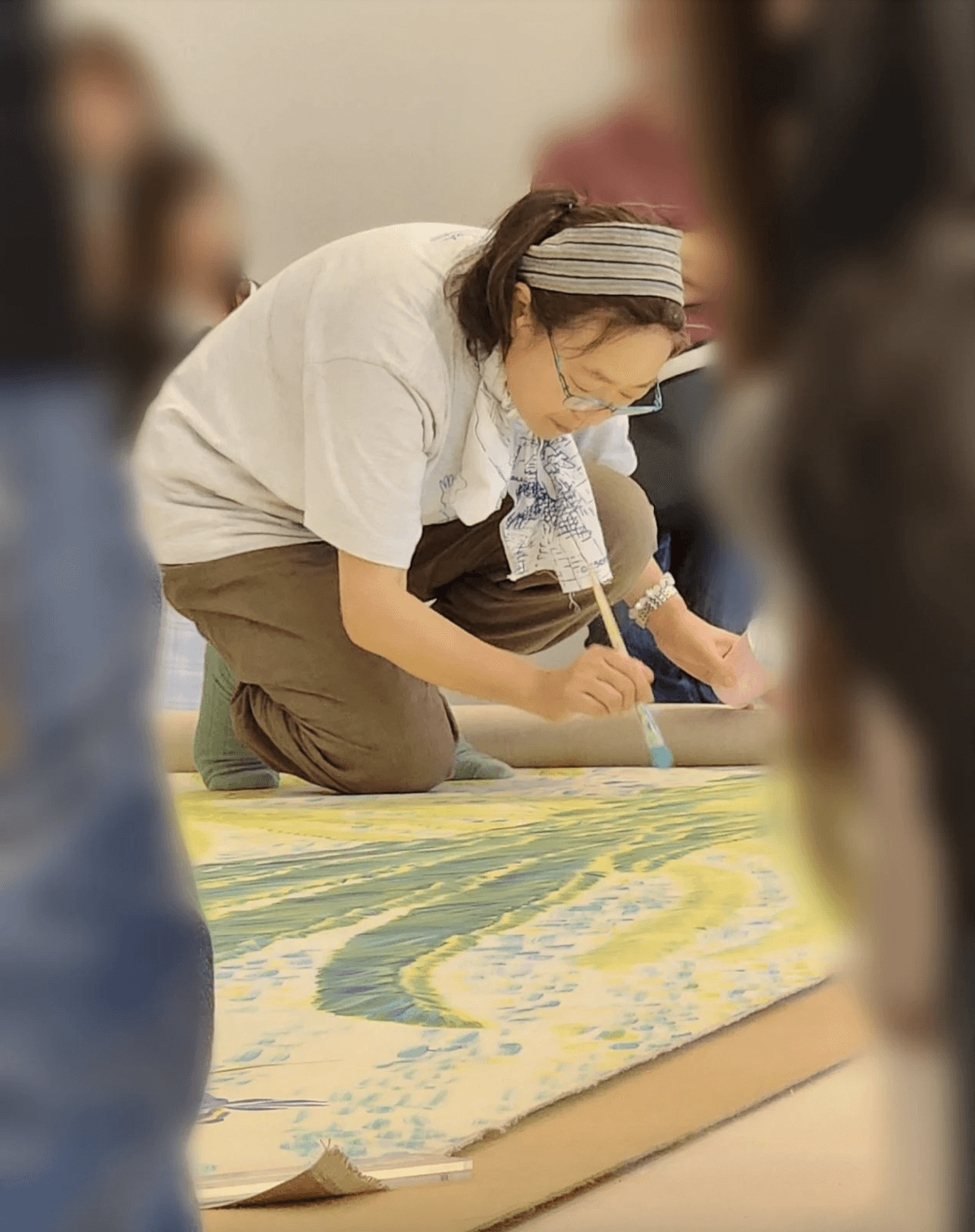
From the exhibition ‘Fumiyo Kōno: 30 Years as a Mangaka’, live painting by Fumiyo Kōno, 3 August 2025.
The exhibition offers a rich panorama: manga Fumiyo Kōno drew in high school under the pen name Mai Nakaita, sketchbooks from her blog Kōno’s Days, and previously unseen footage of her working process. During the opening, she performed live painting, continuing the next day surrounded by a large audience, exceeding the scheduled time and demonstrating the intensity of her commitment.
‘I’ve had several opportunities to exhibit my originals before, but they focused on In This Corner of the World and a few other titles. This is the first time almost all my works are presented in a single exhibition. For me, the book is the final form of my stories, and I was a bit worried whether visitors would find the panels engaging… But I’m happy to see that many of them do.’
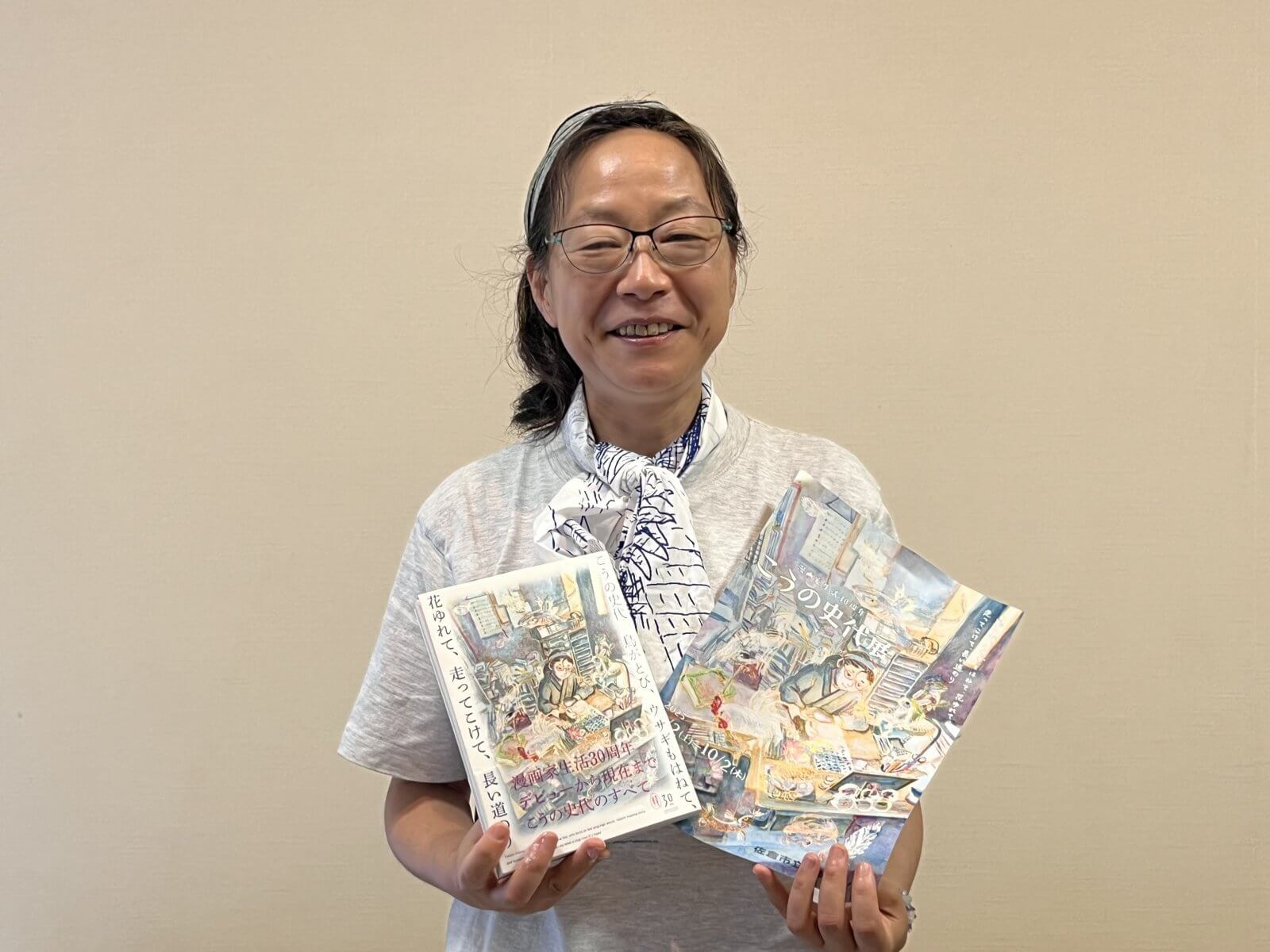
Fumiyo Kōno, Sakura City Museum of Art, 3 August 2025.
‘Paper comes from trees, and the book carries the life of the wood and nature. As a child, my siblings and I devoured every manga so thoroughly that we read them until they fell apart, even memorizing the dialogue. I was starving for manga.’
‘That’s why I cannot bring myself to create stories that are read once and discarded. I want to continue making manga that can be cherished and passed down, generation after generation.’
Fumiyo Kōno: 30 Years as a Mangaka — Birds Take Flight, Rabbits Leap, Flowers Sway, Running and Falling, a Long Journey
Exhibition period: Until 2 October 2025
Venue: Sakura City Museum of Art, 210 Shinmachi, Sakura, Chiba
Opening hours: 10:00–18:00 (last entry 17:30)
Closed: Mondays (open 15/09, closed 16/09)
Admission: 1,000 ¥ (adult)
www.city.sakura.lg.jp/section/museum/exhibition/2025/202508KounoFumiyo.html