Genki Kawamura, The Emergence of a New Japanese Cinema Rooted in the Theatrical Experience
Recipient of the Pen Creator Awards 2025, the filmmaker looks back, in an interview, on ‘Exit 8’, the film that electrified Cannes.
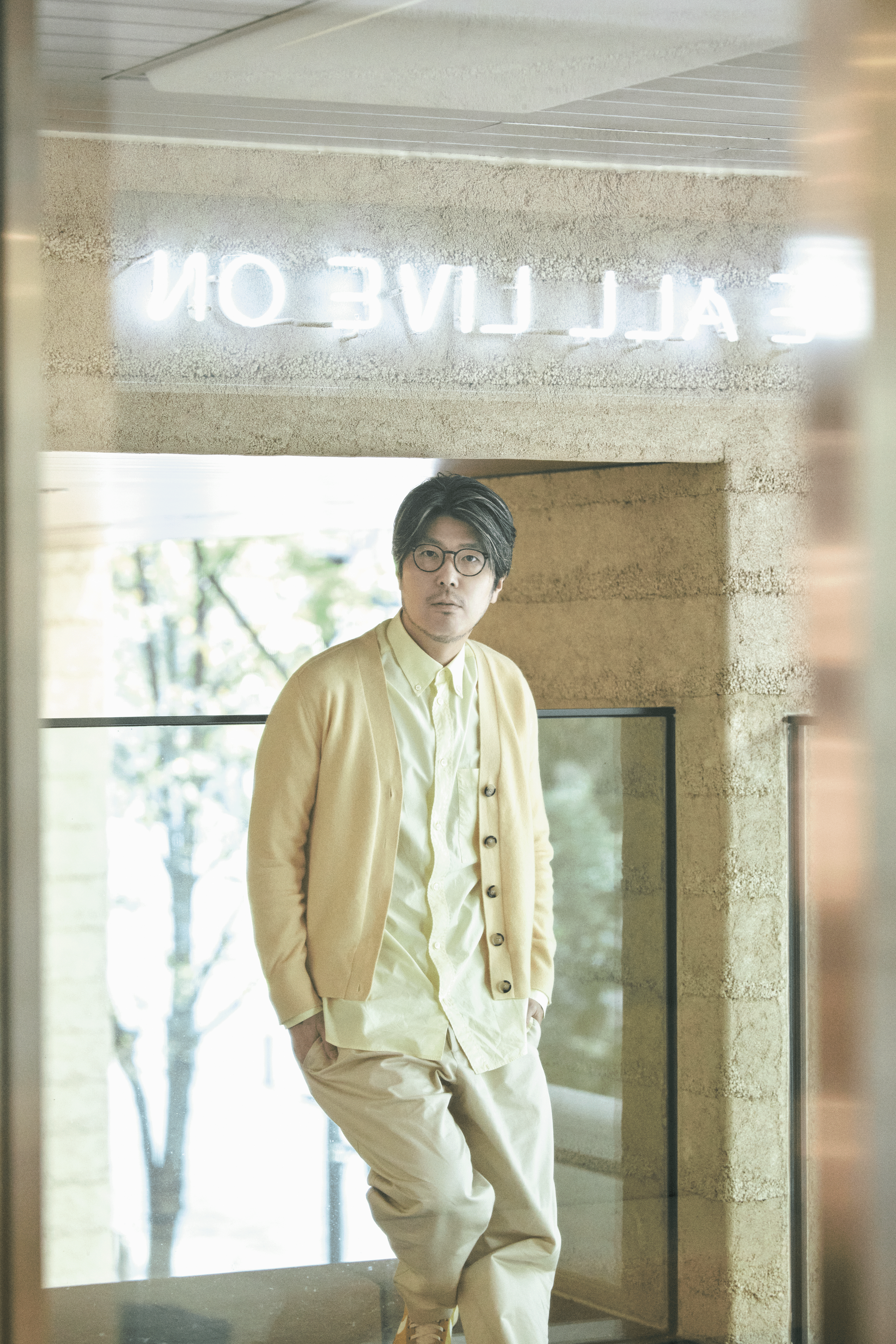
Genki Kawamura was born in Yokohama in 1979. A producer of films such as ‘Confessions’, ‘Villain’, ‘Moteki’, ‘Your Name.’ and ‘Monster’, he is also the author of novels including ‘If Cats Disappeared from the World’, ‘April, Come She Will’ and ‘My Horse’, among others. In 2022, his first feature film as a director, ‘A Hundred Flowers’, received the Best Director Award at the San Sebastián International Film Festival.
Since 2017, the Pen Creator Awards have paid tribute to creators across a wide range of fields, recognising their achievements. For the ninth edition, held in 2025, five recipients were selected. Among them is filmmaker Genki Kawamura, who has infused Japanese cinema with renewed vitality through the singularity of his vision.
Confessions, Villain, Moteki, Wolf Children, Your Name., Monster… As a producer, Genki Kawamura has been behind an impressive succession of hits, bringing together with remarkable precision the talents of authors, technical crews and performers. In 2010, he was selected by the American trade magazine The Hollywood Reporter as part of its ‘Next Generation Asia’, before receiving the following year the Fujimoto Prize, awarded to outstanding producers—becoming the youngest recipient in the award’s history. At the same time, he established himself as a writer, publishing bestselling novels and illustrated books including If Cats Disappeared from the World, Okuotoko and April, Come She Will, revealing the breadth of his creative range.
In 2022, he stepped behind the camera for the first time by adapting his own novel, A Hundred Flowers. The film earned him the Best Director Award at the San Sebastián International Film Festival, notably for its distinctive visual approach. Drawing lessons as well from the film’s overseas box-office reception, Genki Kawamura approached his second feature, Exit 8, with careful reflection.
‘Video game adaptations are almost always doomed to fail. Starting from that premise, I wanted to imagine a “new cinematic experience” in which the boundary between game and film would become blurred,’ he explains. He chose to adapt the hit game by KOTAKE CREATE through an unconventional screenwriting process, and offered the lead role to Kazunari Ninomiya. A devoted gamer, Ninomiya contributed alternately as an experienced player and as a seasoned actor—known for his collaboration with Clint Eastwood—bringing forward ideas that were as unexpected as they were decisive.
Around them, a resolutely cross-disciplinary team took shape: producer Yuto Sakata, well versed in the game industry; Kentaro Hirase, a director with a keen mathematical sensibility, who co-wrote the screenplay; and the young and gifted cinematographer Keisuke Imamura. Together, they worked with flexibility and an experimental mindset, moving beyond traditional professional boundaries and embracing repeated trials and adjustments on set.
Starting from a minimal setting—a familiar metro underpass punctuated by yellow signs—Exit 8 transforms into an infinite, claustrophobic corridor, confronting the viewer with the reflection of a dead-end everyday life. The film electrified the midnight screenings at the 2025 Cannes Film Festival, surpassed ¥5.1 billion in box-office revenue in Japan, and continues its long theatrical run. In North America, distribution is handled by NEON, the company behind Parasite and Anora. Remake offers are already pouring in from abroad, and the momentum shows no sign of slowing.
Harnessing the Viewer’s Uninterrupted Attention
You often cite Steven Spielberg and Hayao Miyazaki among the directors you admire.
Genki Kawamura — Their films are profoundly cinematic works, layered from the most accessible to the most profound. At a time when AI can provide answers to almost any question, the ability to create a work that makes people feel they must go to a cinema to experience it physically is, to me, a matter of survival for a filmmaker.
What prompted you to adapt the game ‘Exit 8’?
G. K. — I was looking for a subject that would allow me to draw on my entire background—live-action cinema, animation and the novel—while extending the formal approach of A Hundred Flowers, which was recognised for its ability to connect, in a near-magical single take, times and spaces that were not meant to meet. When I encountered Exit 8, I was immediately drawn to its design and to rules that are both simple and deeply layered. I saw in it the possibility of making a singular film, one that could also speak to Western audiences.
You describe the underground passageway of ‘Exit 8’ as a ‘purgatory’.
G. K. — My mother is a devout Christian, so I grew up reading the Bible to the point of knowing long passages by heart. The notion of ‘purgatory’ is intuitively understood by a large part of Western audiences. If I often return to themes such as sin and punishment, or the relationship between father and son, it is because these biblical images are deeply ingrained in me. It is not a calculation, but something natural, almost organic. Even with an extremely Japanese motif like that of Exit 8, I believe communication with international audiences remains possible—perhaps because, in my mind, all stories connect to the Bible in one way or another.
This biblical dimension also seems well suited to horror cinema.
G. K. — Absolutely. I was also deeply influenced by Ugetsu by Kenji Mizoguchi, by Stanley Kubrick’s The Shining—where the ego disintegrates within the enclosed space of a hotel—and by David Lynch’s Eraserhead. All three films carry a strong biblical charge, and I wanted to revisit this horror lineage through a contemporary aesthetic.
The end credits include special thanks to Yōji Yamada, Hirokazu Kore-eda and Sang-il Lee. Why these figures?
G. K. — I sought advice from directors who seemed, at first glance, the furthest removed from this project. Master Yamada, while saying he did not understand this kind of game at all, agreed to read the script from beginning to end. On the day the film was completed, he came to the screening and said to me, ‘There’s no real story, but it’s a fascinating film’ (laughs). An invaluable compliment. Hirokazu Kore-eda gave me decisive ideas regarding structure, and Sang-il Lee regarding the characters. I realise I may have been somewhat audacious in consulting my seniors like this… but Yōji Yamada once took me to visit Shinobu Hashimoto, the screenwriter of Seven Samurai, to listen to his memories of Akira Kurosawa. He spoke of how, when he was young, he himself would regularly bring his scripts to Hashimoto for feedback. I simply wanted to follow that example.
The opening, dominated by subjective shots from Kazunari Ninomiya’s character, is particularly striking.
G. K. — We were looking for the precise tipping point: the moment when the prolonged absence of Nino’s face would begin to unsettle the viewer. Just as the audience starts wondering how long this will last, the film shifts to an objective viewpoint. Then, when another anxiety emerges—‘Is he just going around in circles?’—a major narrative transformation takes place. We have become too impatient because of smartphones: at the slightest pause, we feel the urge to scroll or fast-forward. In a cinema, however, phones are switched off. I wanted to make use of that specificity: waiting, anticipating, remaining in uncertainty. An experience that can only exist in a movie theatre. Many children who are mainly accustomed to YouTube or animation came to see the film. It must have surprised them. But perhaps, in ten years’ time, some of them will remember Exit 8 and think it was that film which made them want to make cinema. It’s a small hope I nurture—quietly.
Exit 8 (2025), a film directed by Genki Kawamura. The Blu-ray and DVD release, with English subtitles, is scheduled for 4 February 2026.
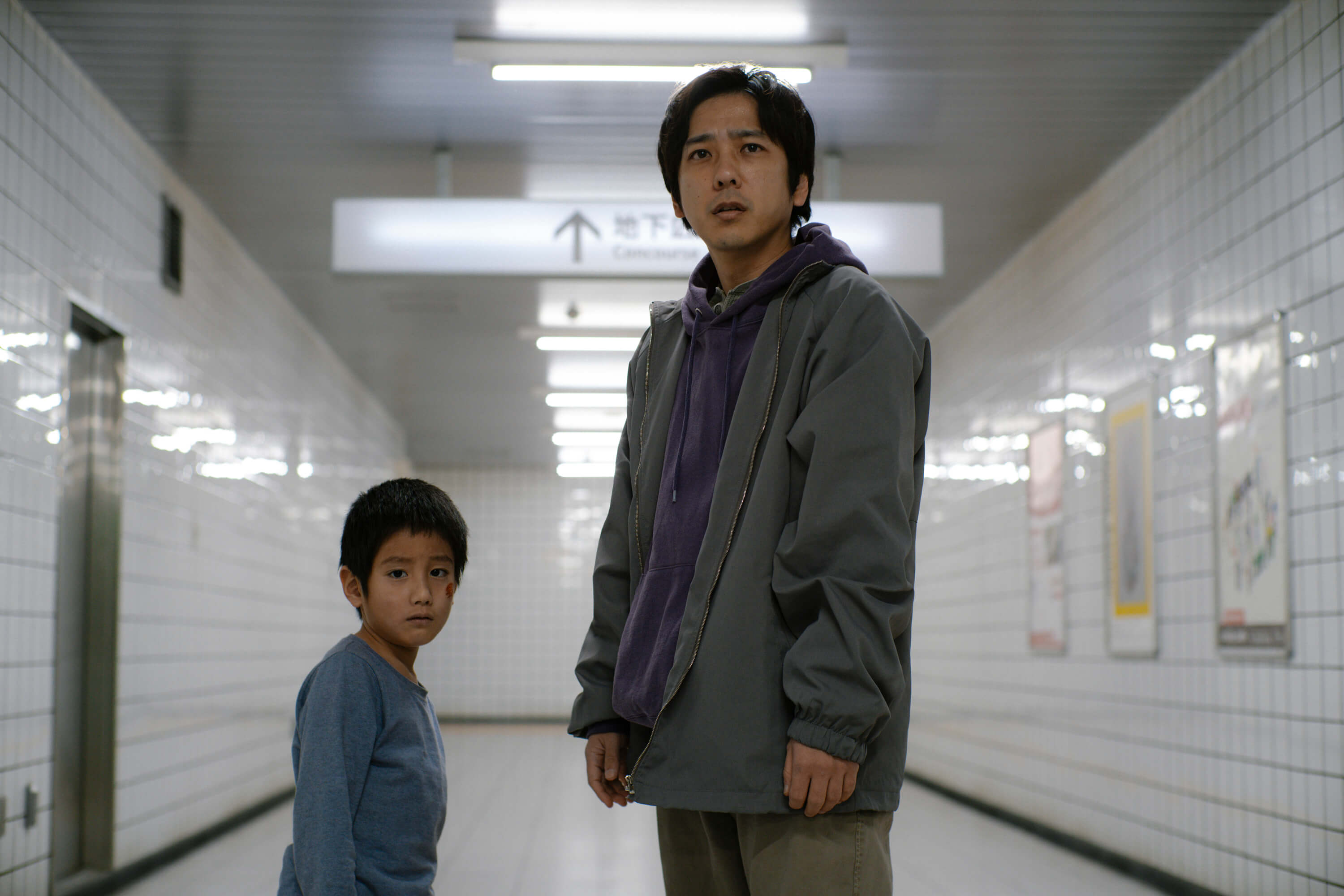
On his usual route from the subway to his workplace, a man becomes lost in a white-tiled underground passageway, endlessly circling without ever finding a way out (Kazunari Ninomiya). To escape this infinite corridor, he must follow the rules of the ‘Guide’ and reach ‘Exit 8’.
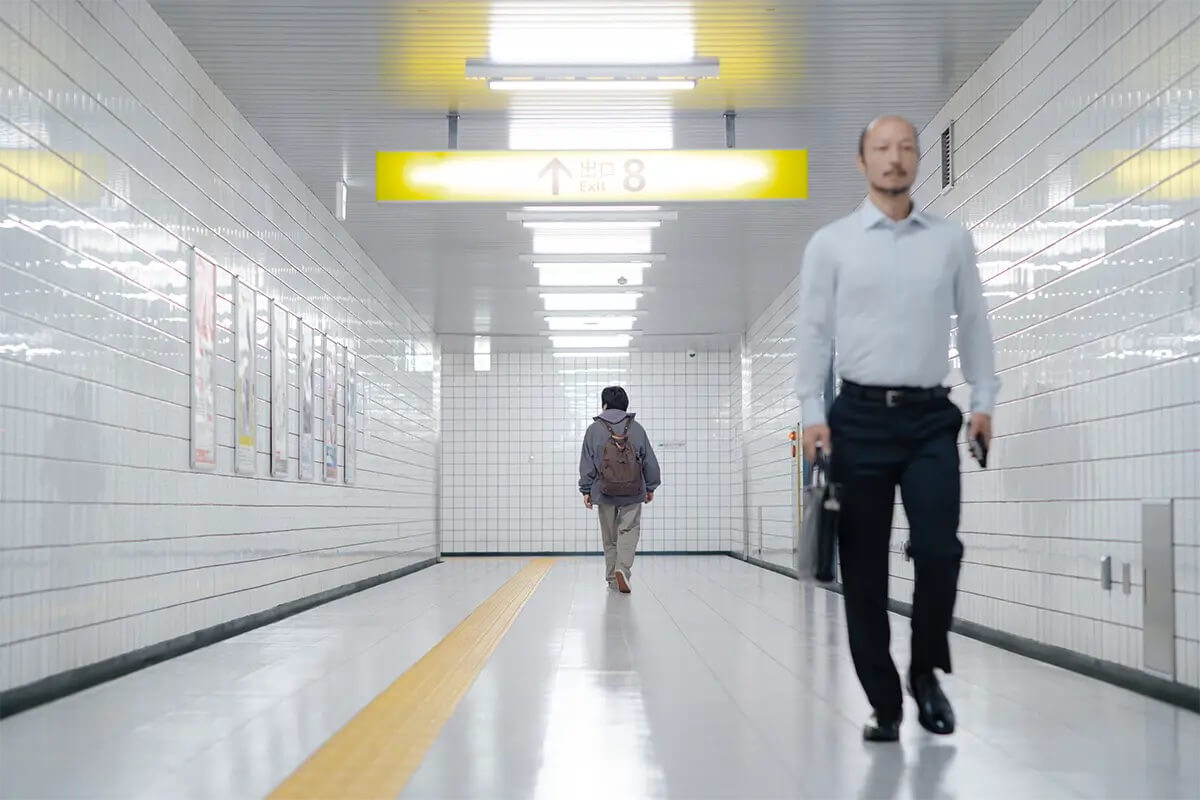
The unsettling smile of Yamato Kōchi, in the role of ‘the Uncle’, heightens the sense of unease. The once-familiar underground passageway turns into a source of trauma.
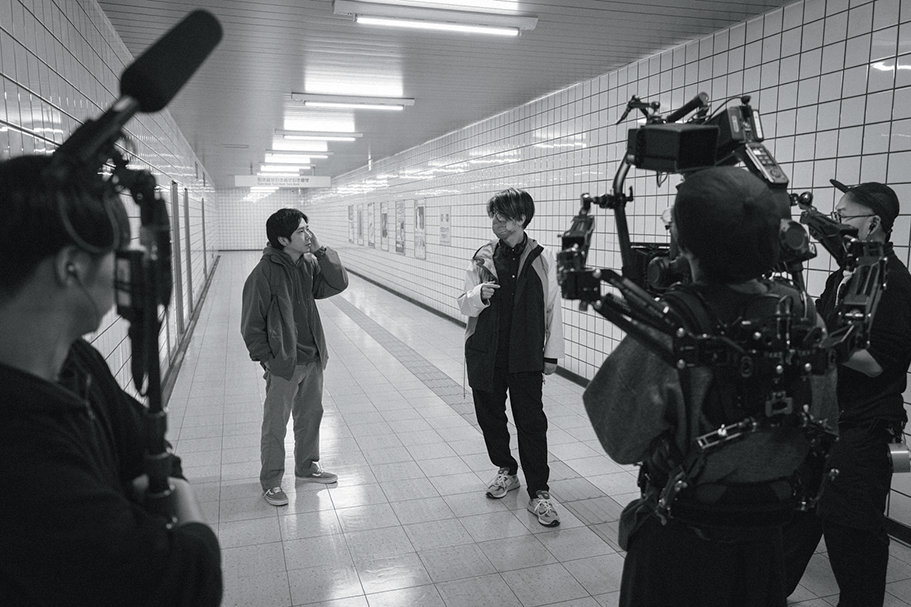
‘As in a game development process, I write the program—the screenplay—and Nino does the test play—the performance. We edit, watch it together, and if it doesn’t work, we rewrite the script and reshoot. It felt as though our brains had merged,’ says Genki Kawamura. Kazunari Ninomiya also put forward a wide range of ideas. The director continues his commitment to actively incorporating the perspectives of the cast and crew, a practice already in place since ‘A Hundred Flowers’.
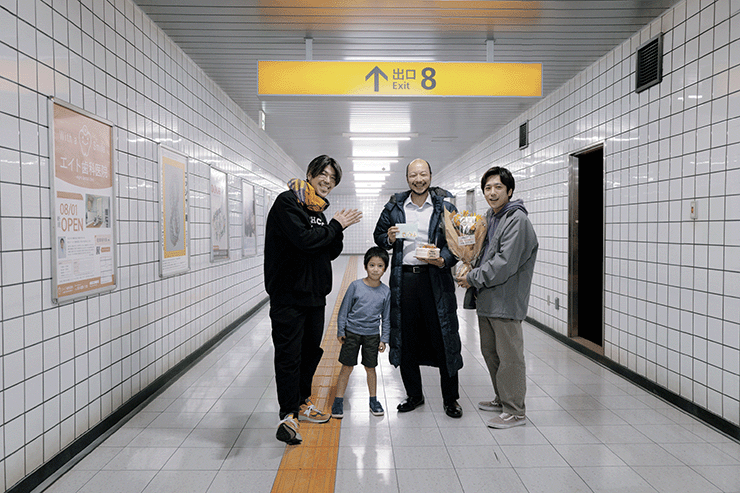
While the film sustains constant tension through the sense of confinement in the underground passageway, the shoot was also marked by convivial moments, such as the celebration of Yamato Kōchi’s birthday, the actor who plays ‘the Uncle’.
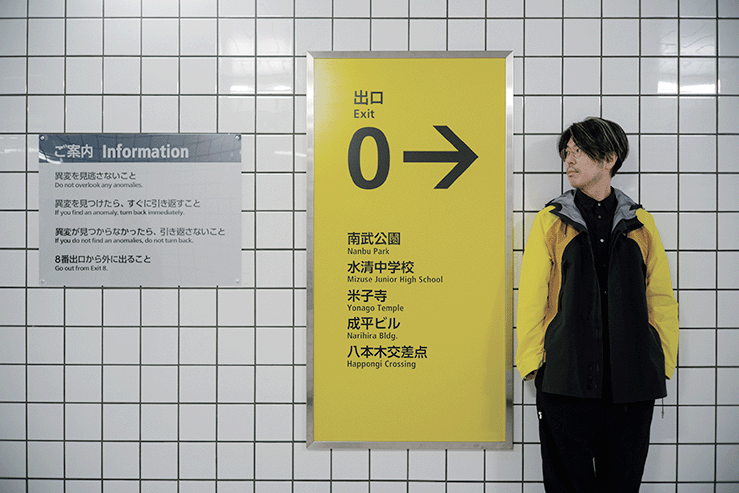
The metro wayfinding sign indicates a starting point at 0. Notably, it does not read Roppongi but ‘Hachimongi’. The ‘Guide’ posted alongside sets out the rules for escape.
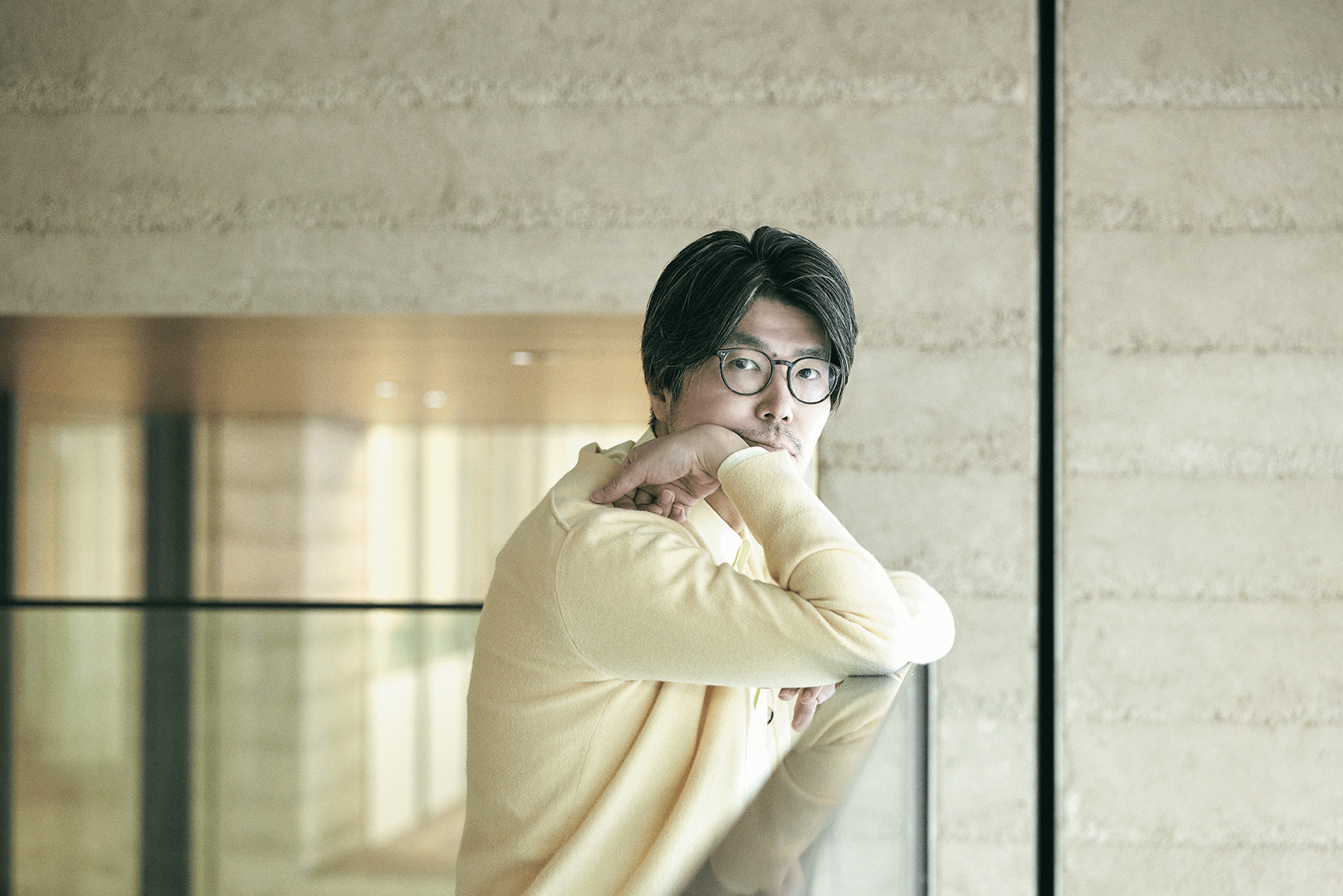
Genki Kawamura.