‘It’s a sincere pleasure when the objects I make are recognised as part of the Mingei circle’
The brass cutlery meticulously shaped by Ruka Kikuchi in his Setouchi studio has earned admirers across Japan and beyond.
What everyday tools reveal about our shared sense of ‘humanity’
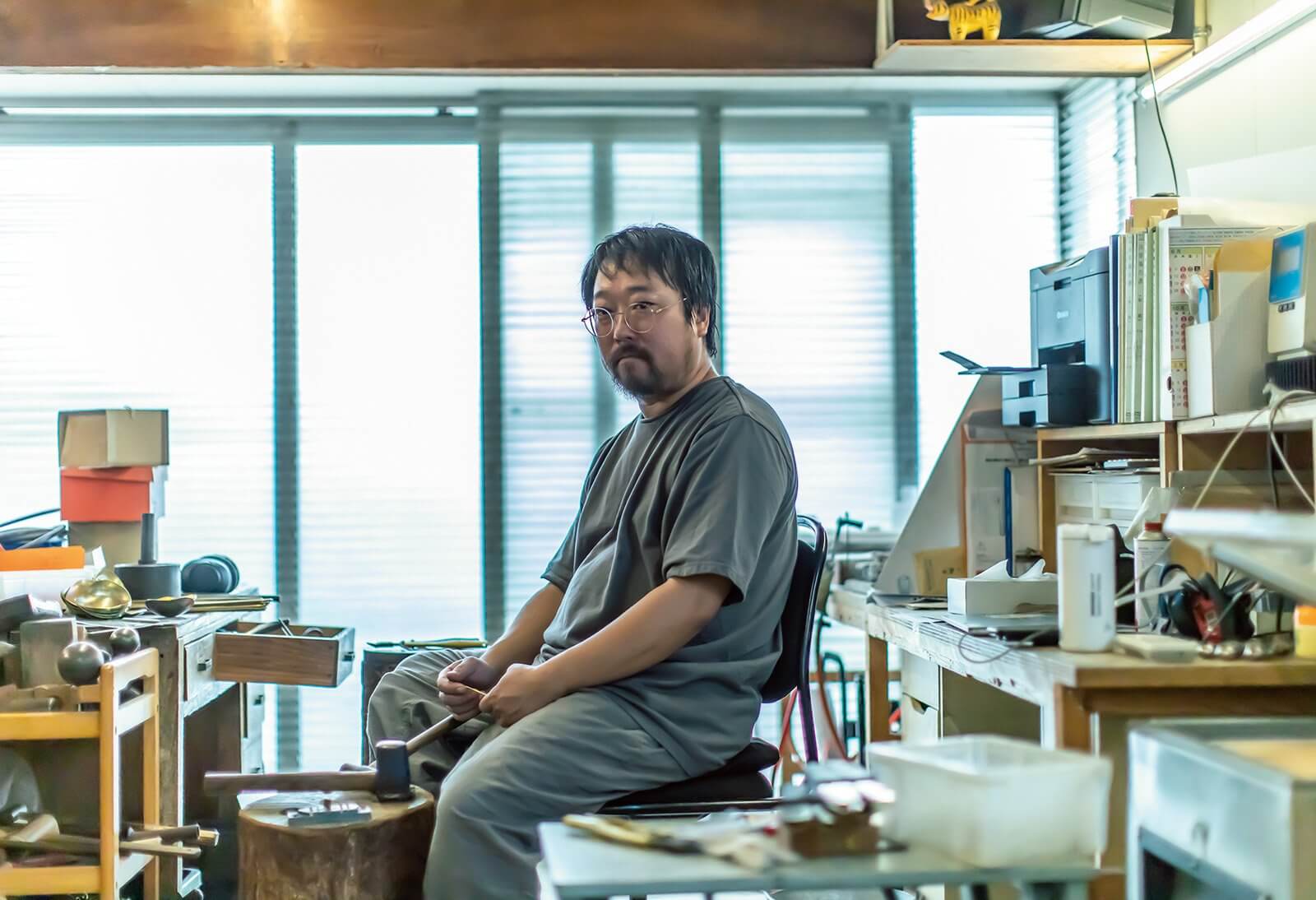
Ruka Kikuchi, a brass artisan born in 1983 in Okayama Prefecture. He began making accessories alongside his father in 2000, then launched his production of cutlery in 2006. In 2010, he founded his workshop, Lue. In May 2025, he presented a solo exhibition at Kashika in Tokyo.
Ruka Kikuchi’s spoons are instantly recognisable: long, slender handles extending into rounded bowls with a gentle swell. Their organic silhouette, the subtly shifting sheen of their curved surfaces, and the hammer marks intentionally left in place all testify to patient gestures and a fully hand-crafted process.
‘I don’t create with Mingei as a framework or ideology in mind. But I’m genuinely happy when the things I make are welcomed as part of that world.’ Ruka Kikuchi‘s pieces are sold not only in Mingei shops throughout Japan, but also in contemporary design stores with a sharp point of view, as well as in popular lifestyle retailers that draw a wide audience—a presence that crosses categories and aesthetics.
‘I appreciate the fundamental spirit of Mingei: the universal work of unnamed craftspeople, this wholesome beauty that accompanies everyday life. But once people begin to say ‘Mingei should be this way’, the whole idea becomes restrictive, almost stifling. Mingei isn’t something whose value should be determined by a small circle of authorised specialists. It’s something entrusted, broadly, to the public. Interpretations shift with the times, but at its core, I think it’s less about deciding what’s good or bad, and more about gently perceiving the ‘humanity’ that flickers within objects.’
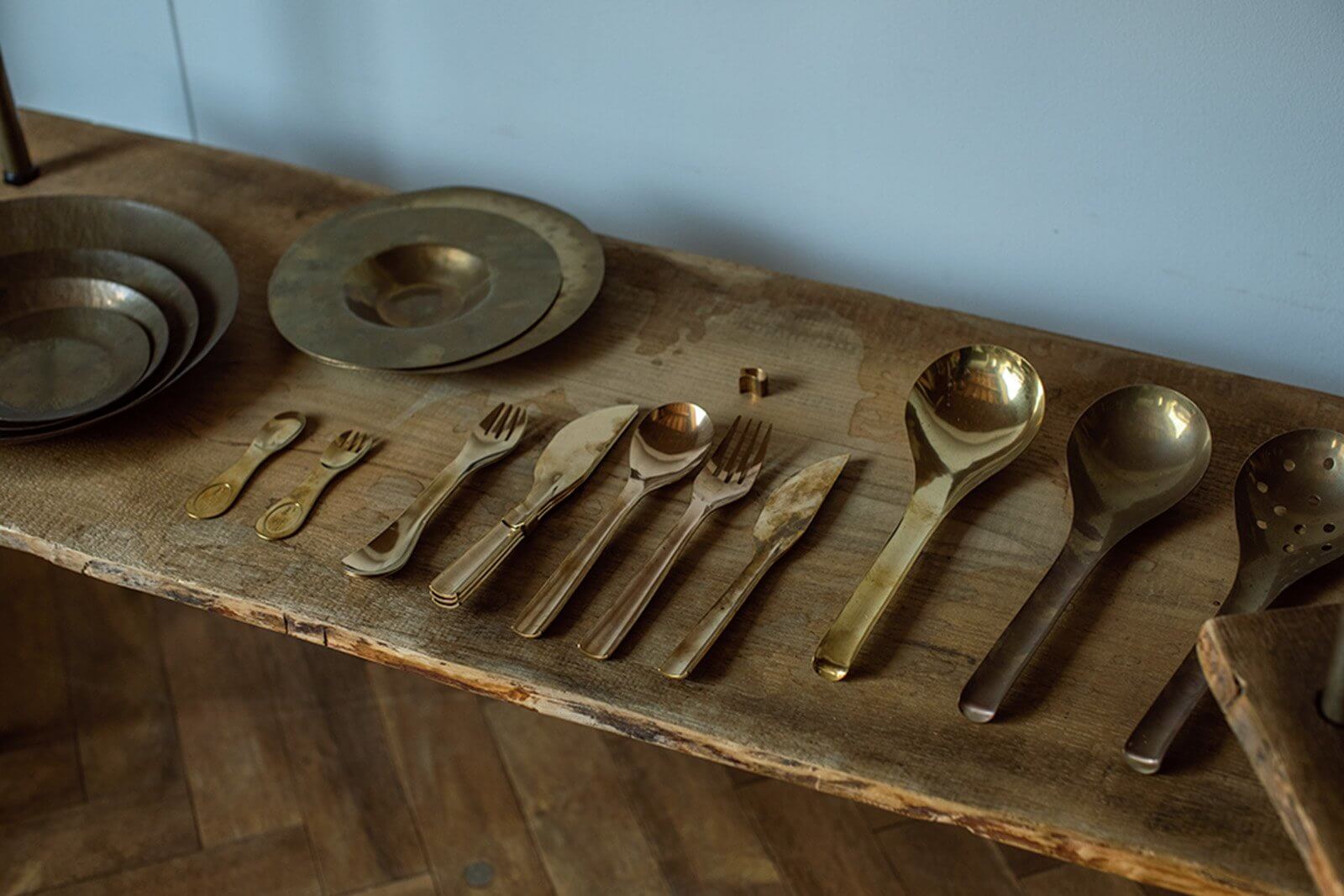
Ruka Kikuchi believes that machine-made objects also possess their own form of quality. With this in mind, he collaborates with a factory in Tsubame-Sanjo, developing an industrial collection based on his original designs.
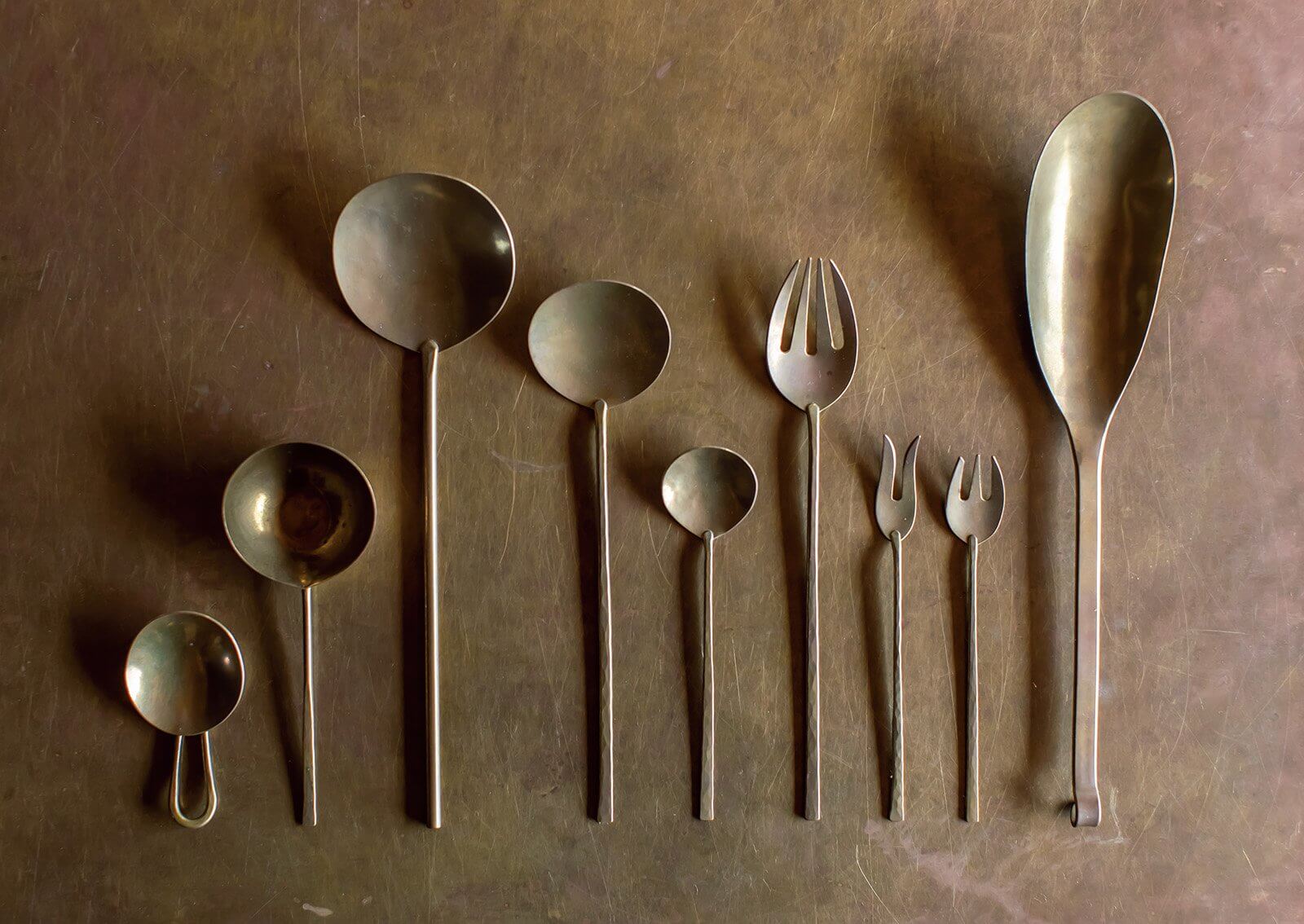
The signature cutlery series from the Lue workshop. When purchased, the polished brass has a bright golden hue that develops a patina with use. From right to left: one-piece serving spoon, ¥5,940; cake fork, ¥3,740; fruit fork, ¥3,520; clover fork, ¥4,180; small spoon, ¥3,300; large spoon, ¥3,960; serving spoon, ¥4,400; coffee serving spoon, ¥5,500; tea serving spoon, ¥4,180.
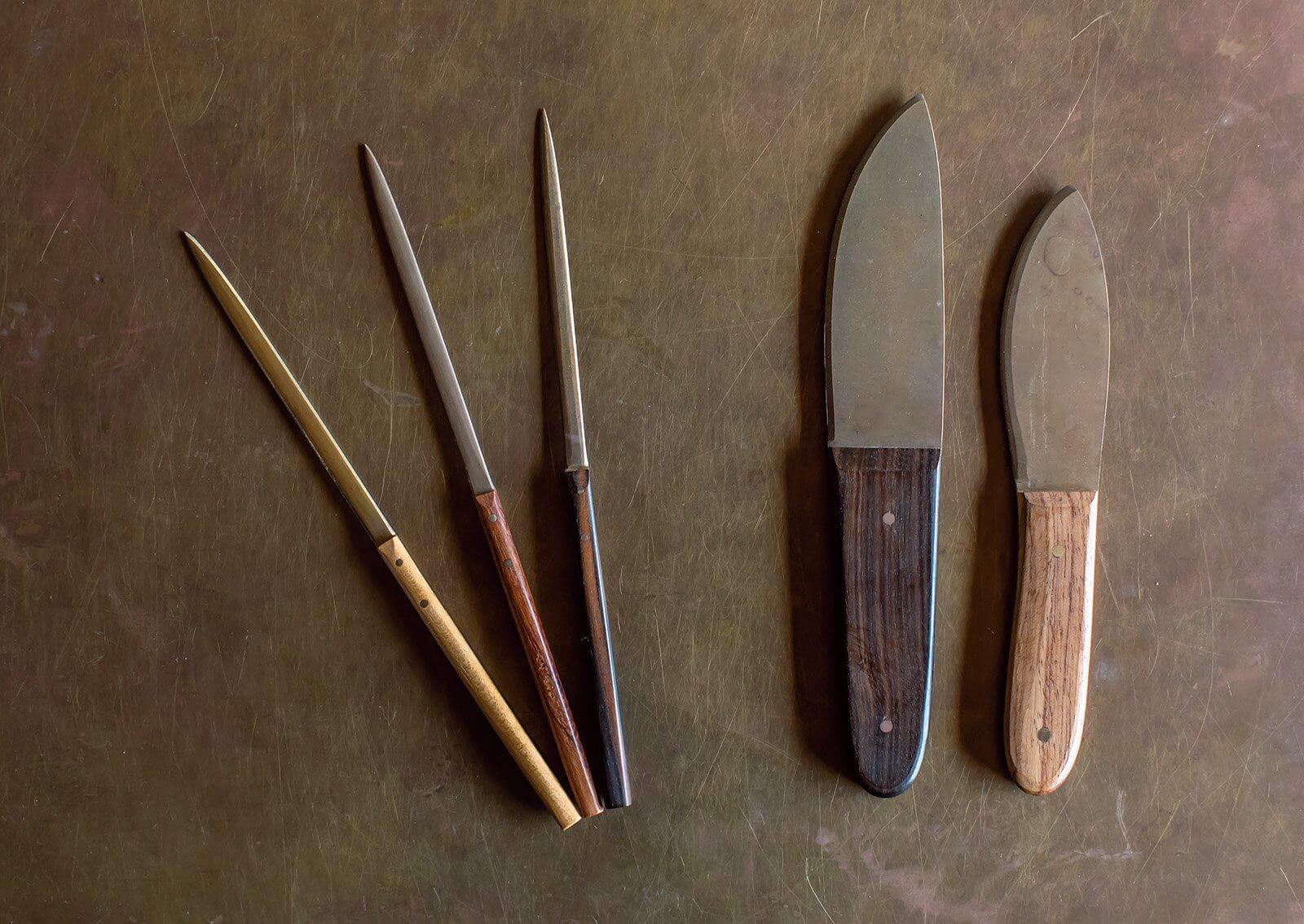
The width of the handle is adjusted according to the blade’s shape and intended use. When simply placed on a table, Kikuchi’s knives form a composition akin to a still life. From right to left: small cheese knife, ¥13,200; large cheese knife, ¥14,850; letter openers, ¥5,720 each.
Kikuchi grew up close to metalwork. From the age of seventeen, he helped his parents, who made and sold handmade accessories. After getting married and welcoming a child, he chose to set out on his own. He had never formally studied art or design, nor received specialised training in craft. Instead, the techniques of metalwork took root naturally through years spent by his parents’ side, while his love of cooking guided him towards making brass cutlery. Fifteen years later, the essential forms of his pieces remain almost unchanged, a detail he himself finds interesting.
‘The spoons I still make today evolved from those my father showed me just before I became independent. ‘If you want to make cutlery, try this’, he told me. When I made one for the first time—brazing the bowl and handle together, then hammering the sides and top in sequence to shape the piece—the whole process felt completely logical. The result was well-balanced, with a simple kind of beauty. That impression has never really changed, which is probably why I’ve kept making the same form.’
Hammering brass until the ‘just-right point’ appears
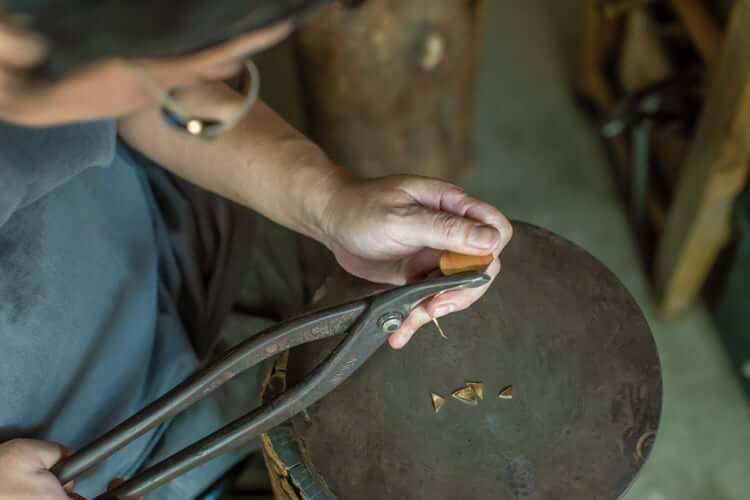
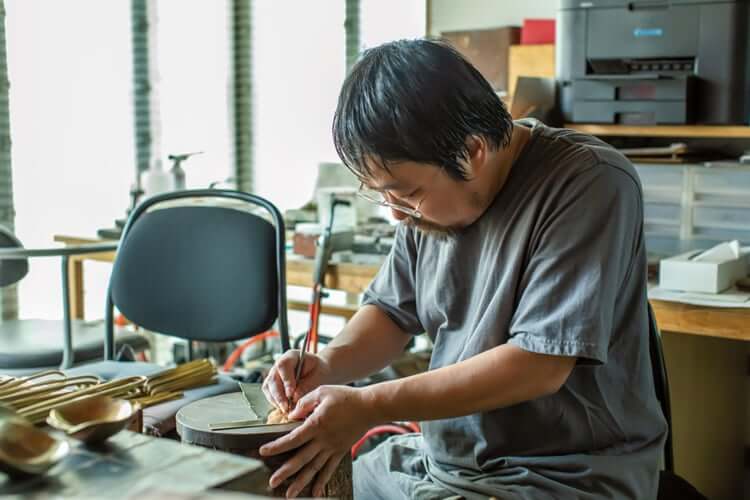
Kikuchi shapes each piece of cutlery through a succession of steps, starting from sheets of brass. Left: the cutting (‘honkiri’) of the pieces, performed with shears while following the traced lines with precision. Right: ‘kegaki’, the marking of contours and dimensions with a metal scribe on a standard-measure brass plate.
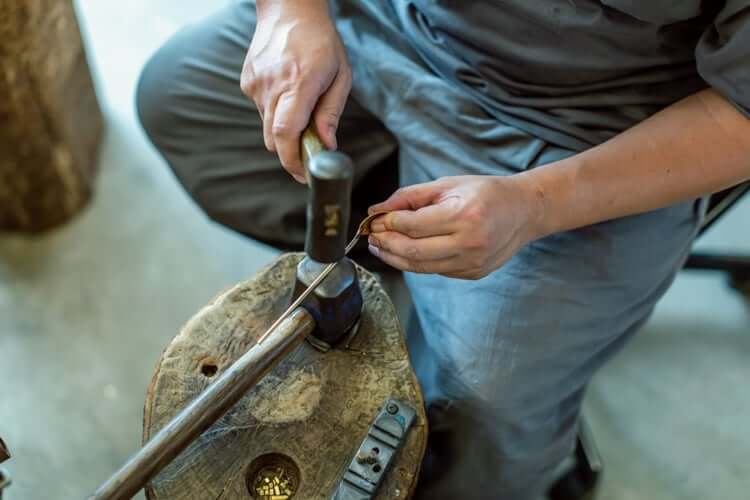
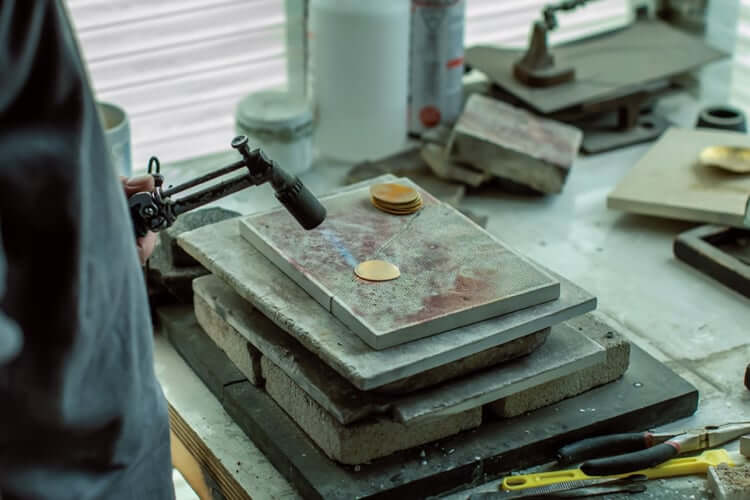
Left: the long handle—another defining element—is formed by hammering its four faces (‘tatakidashi’), which refines the shape while strengthening the piece. Too much force leaves a mark; too little prevents proper shaping. Achieving such a subtle balance on slender elements, like those of his cutlery, requires great skill. Right: the circular sheet is heated with a torch to soften the metal, a step known as ‘yakinamashi’, which facilitates precise adjustments. Placed on a mold and gradually hammered, it becomes the bowl of the spoon: a gentle, open, three-dimensional curve.
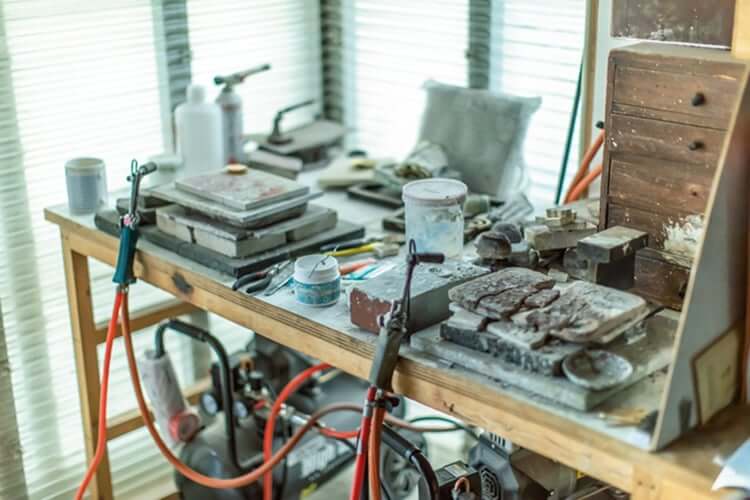
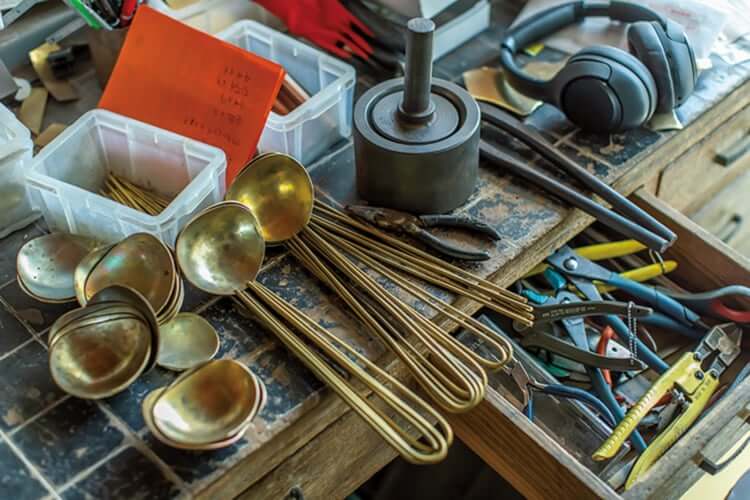
Left: the workspace dedicated to ‘yakinamashi’, the torch-heating of the metal. In summer, working so close to the flame becomes physically demanding. Right: a ladle in progress. Its bowl, fixed to the end of a U-shaped handle, is shallow and wide, making it easy to scrape the bottom of pots. The tool is lightweight, easy to handle, and can be hung from a hook for storage.
Asked about functionality, he immediately offers a nuance: what feels practical to him is not necessarily universal.
‘Cutlery is made for eating, so of course it has to function as a tool. But functionality isn’t my main priority. Just as everyone has preferences in terms of shape or size, there are countless ways to think about what makes something functional. Declaring that one form is the most practical would mean denying other sensitivities and perspectives. I wouldn’t feel comfortable doing that.’
There was a time when he sought to make every piece as uniform and precise as possible, aiming to maintain a consistent level of quality. With experience, however, he realised that many people were drawn precisely to what he himself considered ‘good’, even without strict homogeneity.
‘When you cut shapes from standard brass sheets and start hammering them, a point eventually emerges that feels exactly right. Even if the pieces aren’t perfectly identical, if someone chooses them for what they are—and if they resonate with my own sense of ‘rightness’—then that feels like the correct answer.’
His workshop has grown, now with staff members, and production has found a steadier rhythm. In autumn 2024, he opened a second studio on higher ground in the Hinase area, a short distance from his main atelier set in the rural landscape of Setouchi.
‘When I’m alone with my work, I sometimes feel the urge to approach it differently, not only as something that supports family life and daily needs, but as something I can pursue with another mindset. There are still so many things I want to try in brass, and new possibilities are beginning to come into view. By focusing more deeply, I have the feeling that new forms will emerge.’
A solo exhibition was held in spring 2025, an opportunity to embrace freer, more expansive expression.
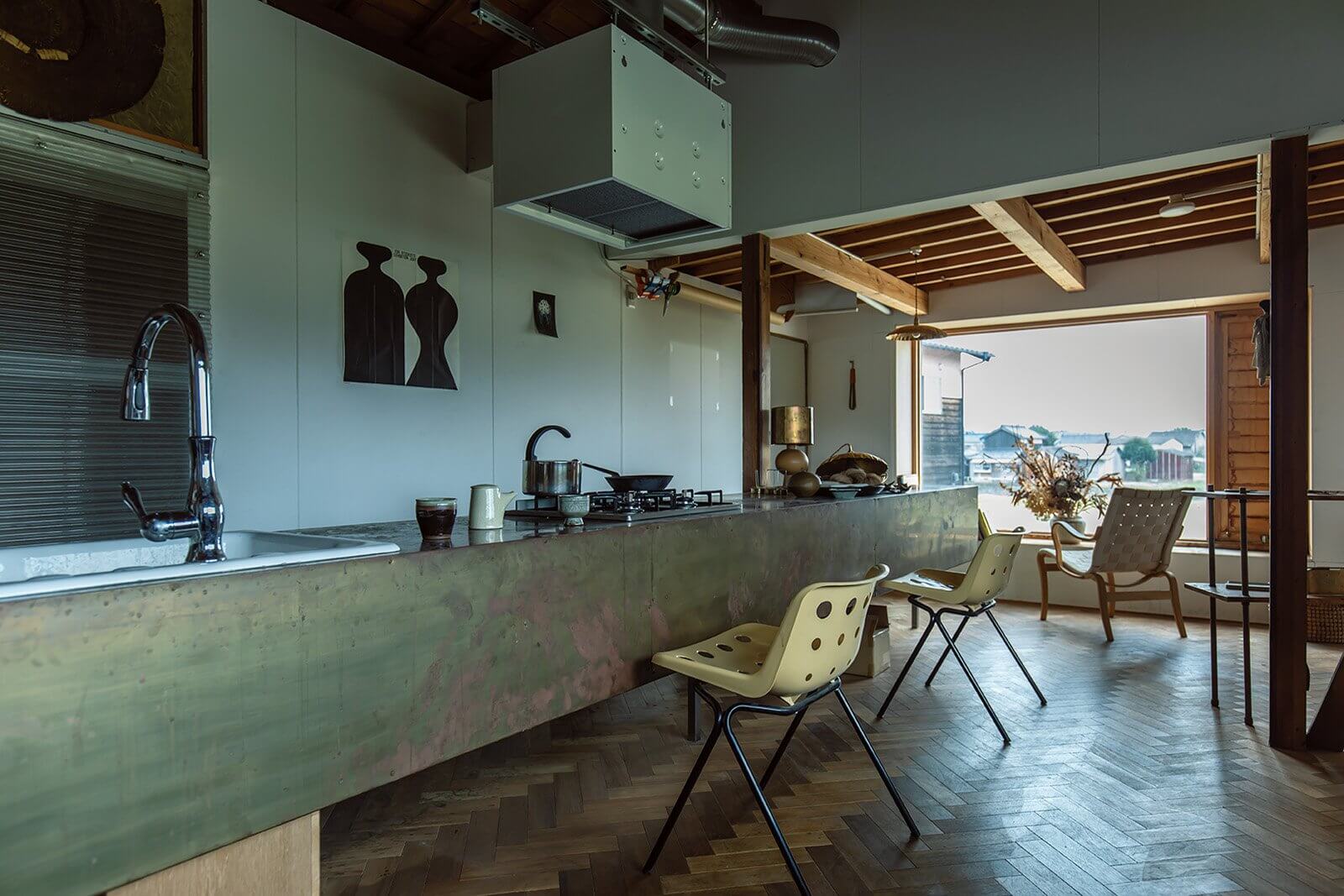
On the workshop’s second floor, a brass kitchen counter occupies the space. The area serves both as a meeting room for receiving visitors and as a small gallery-shop where selected pieces are displayed.
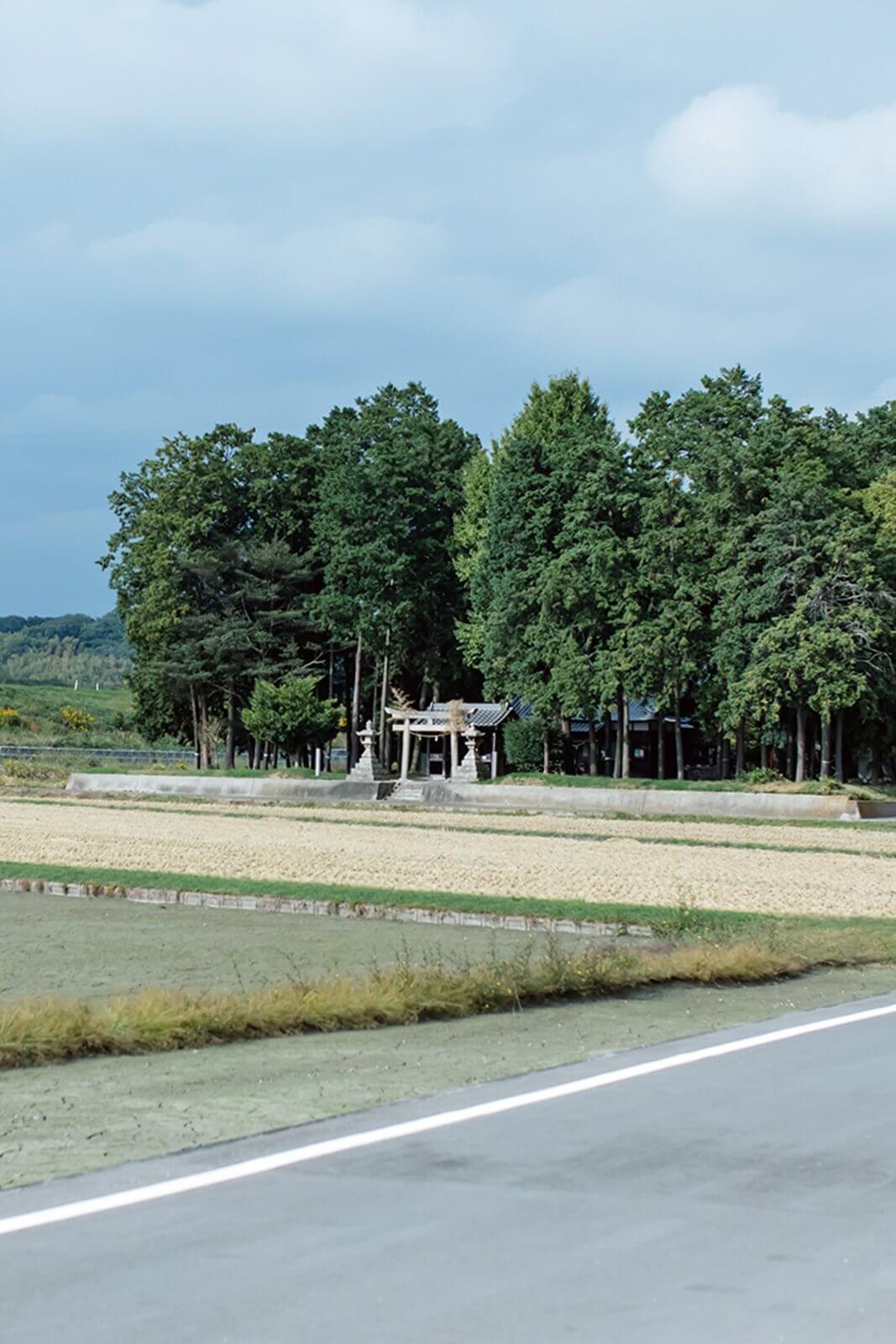
Ruka Kikuchi’s workshop stands in a rural landscape surrounded by rice fields. From the entrance, one can glimpse a small shrine in the nearby woods: Hachimangū, mentioned in the ‘Biyōkoku-shi’, a historical work from the Edo period.
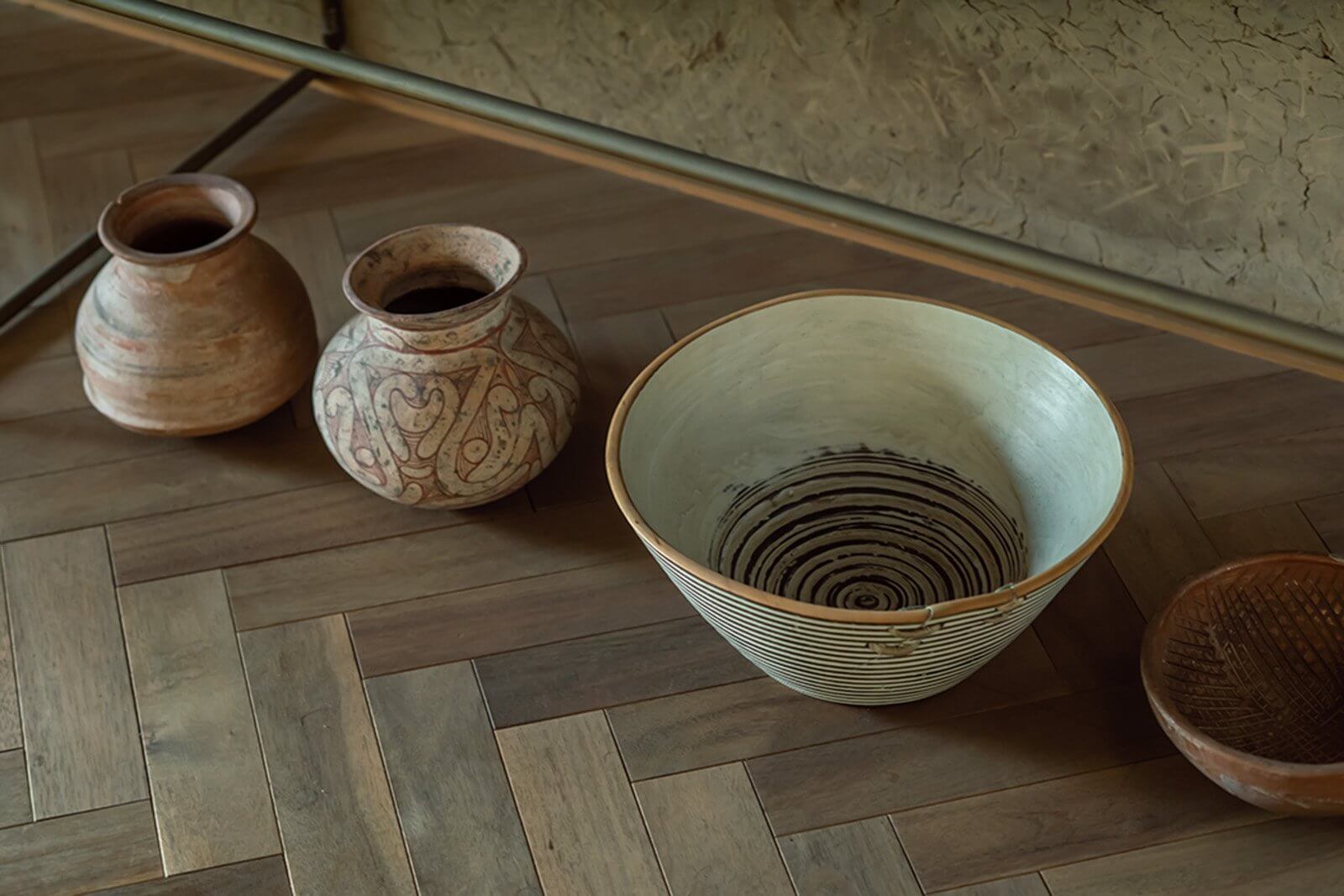
Vases—considered the original form of ceramics—from Ruka Kikuchi’s personal collection. The pieces range from works by contemporary American artists to Iranian antiquities, yet all share a strangely similar atmosphere.
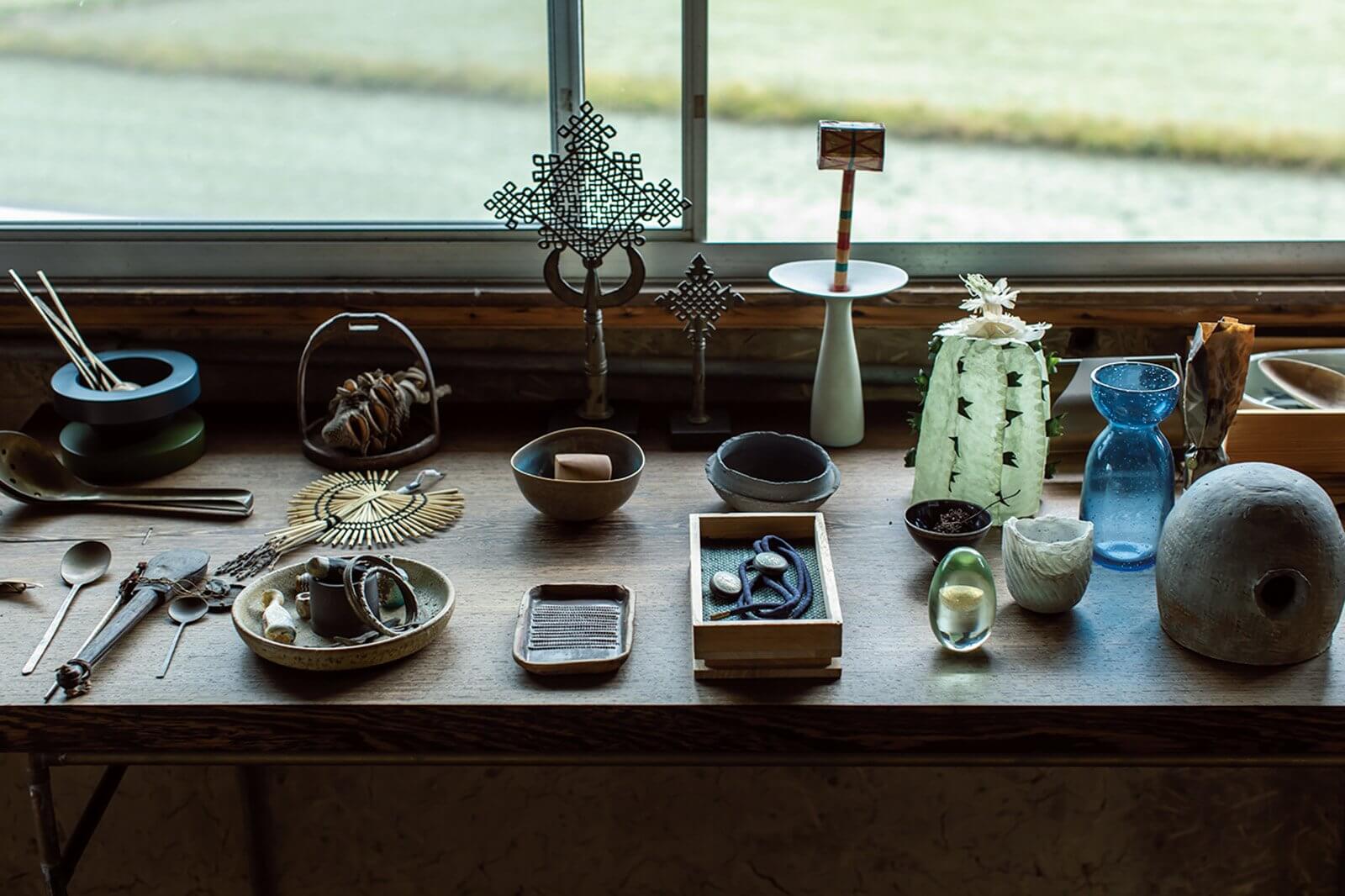
In a corner of the second floor lies Ruka Kikuchi’s favourite space. Pottery from across Asia, Scandinavian craft, and various objects from the Japanese Mingei tradition are carefully assembled there, together with some of his earlier works and accessories made by his father.