In France, the sleek metallic design of the 1980s and 1990s men’s streetwear are enjoying a resurgence
Two spaces offer a fresh perspective on French vintage, from Remix Gallery’s furniture pieces to Demain Rétro’s fashion finds.
In Paris, the aesthetics of past decades continue to shape contemporary tastes in design and fashion. From the minimalist black tones of 1980s French furniture showcased at Remix Gallery to the carefully curated vintage clothing blending 1990s and 2000s influences at Demain Rétro, a conversation unfolds across eras.
These spaces not only celebrate iconic forms and pieces but also reinterpret them for today’s generations, offering an elegant and timeless bridge between history and modernity.
At Remix Gallery, French Design from the 1980s Reveals Its Dual Nature: Stark Minimalism and Playful Excess
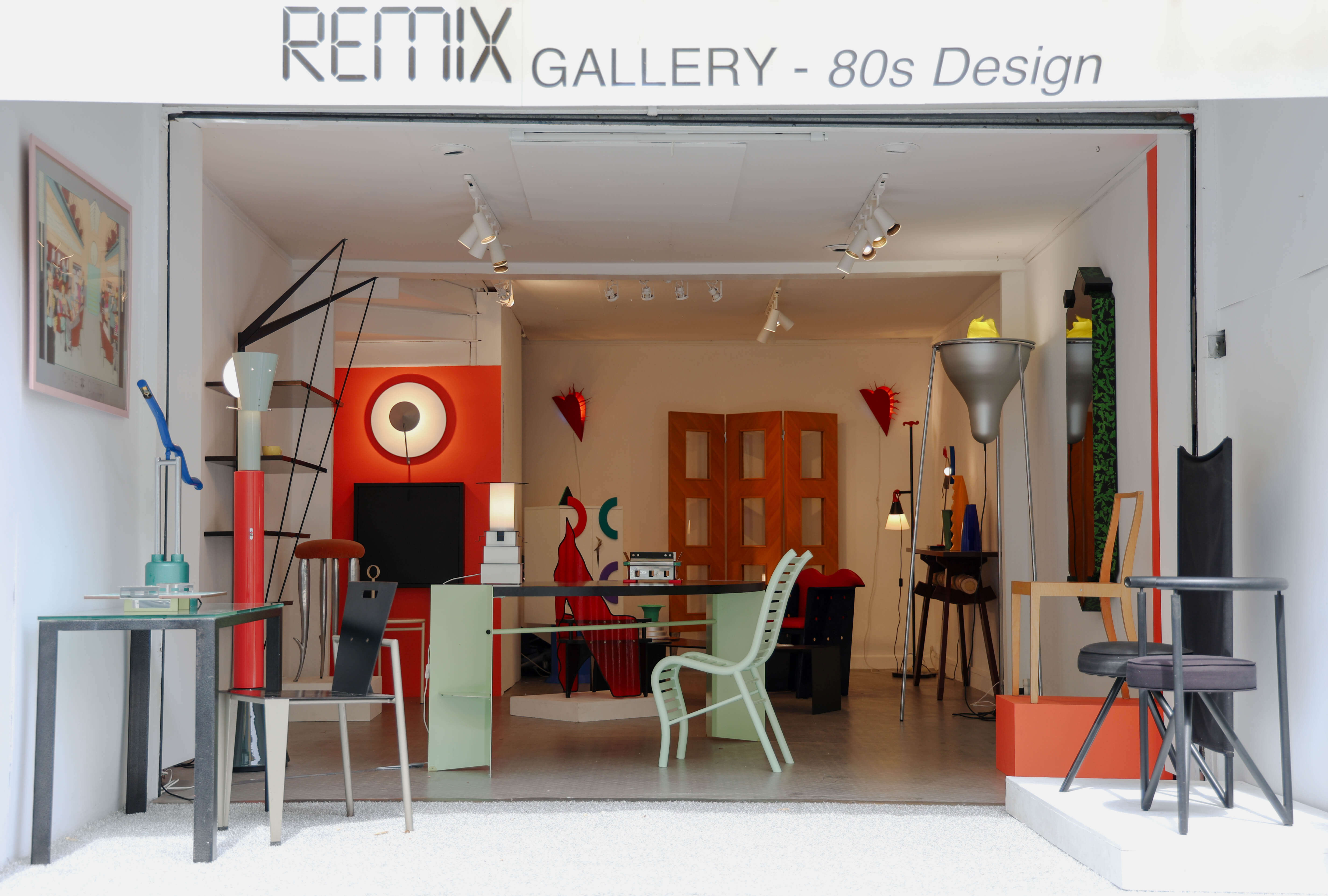
Located within the Saint-Ouen flea market in northern Paris, Remix Gallery specialises in furniture from the 1980s.
In the collective imagination, the design of the 1980s is often associated with the flamboyant colors and unabashed kitsch of fashion and pop culture. It was a decade marked by freedom, eccentricity—even recklessness—reflected in the lifestyles of the time: the golden age of nightclubs, unbridled sexuality, and a jet set fuelled by cocaine.
Italian designers, particularly the Memphis Group, embraced an intentional clash of materials, hues, and patterns that verged on bad taste. Their aim was to upend bourgeois interiors.
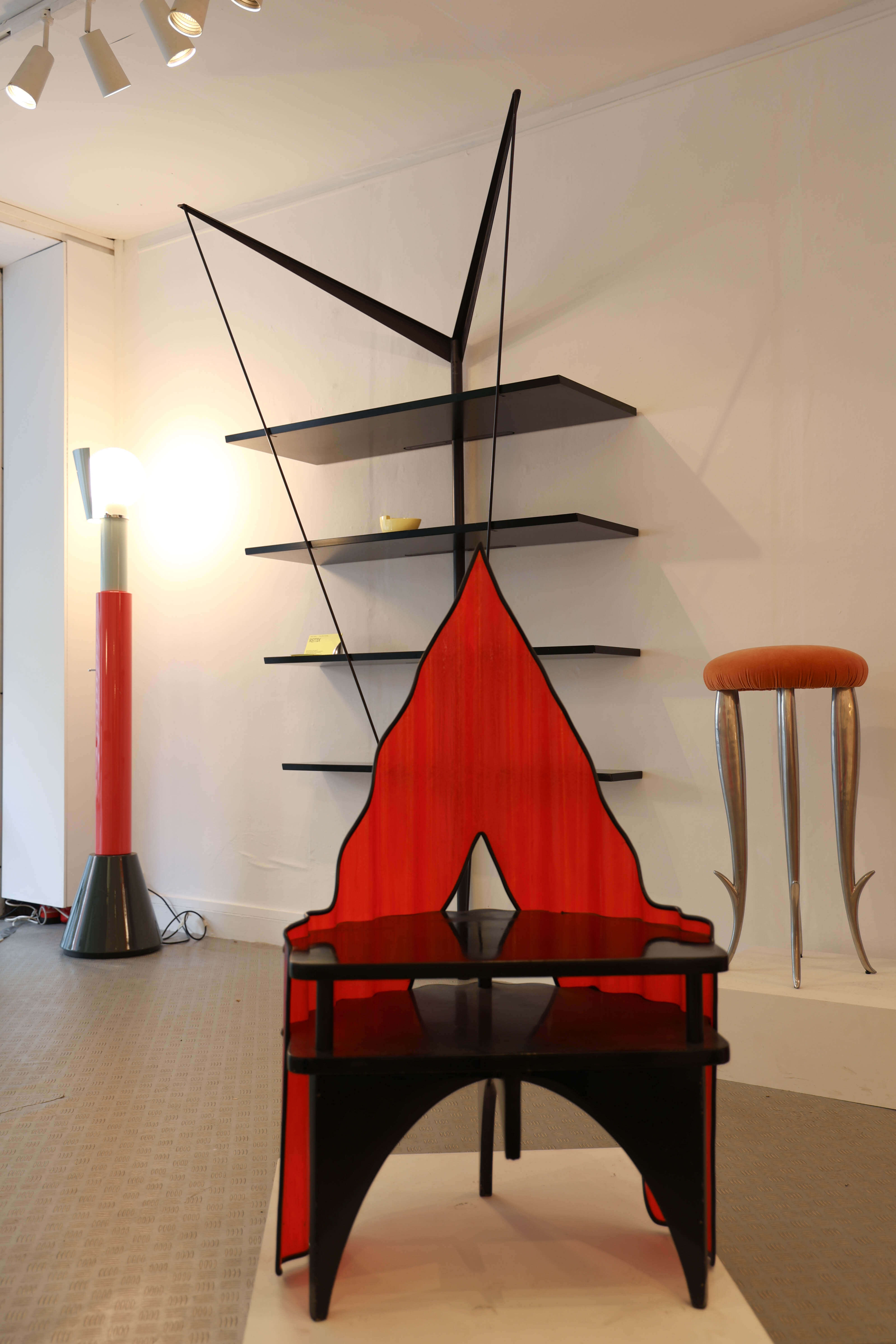
Like a throne, the ‘Chaise No. 4’ by the architect duo Bécheau & Bourgeois embodies the playful spirit of the 1980s. In the background, the bold design of Paolo Pallucco’s ‘Angelo Necessario’ shelf unfolds its black skeleton.
Both born in the 1980s, visual artist Valérie Bouvier and regional language historian Antoine Nouvet grew up immersed in this creative energy. Driven by a desire to reconnect with their childhood memories, they began collecting furniture from the period and launched Remix Gallery in 2015 at the Saint-Ouen flea market in Paris. Among the first to take a serious interest in the decade’s design, they recall one of their first aesthetic revelations: Verner Panton’s Vilbert chair—designed for Ikea as a tribute to Gerrit Rietveld. Composed of four boldly colored wooden panels, the chair epitomizes the duo’s attraction to daring yet pared-down forms.
Drawn to theatricality, Bouvier and Nouvet focus exclusively on discontinued pieces in good condition, avoiding restoration whenever possible. But for them, originality doesn’t always come in bright colors. In contrast to the exuberance of Italian designers like Alessandro Mendini, French design of the era leans toward cold minimalism, often emphasizing metal. This aesthetic perhaps echoes the more somber backdrop of the 1980s: the aftermath of the second oil crisis and the onset of the AIDS epidemic.
The Radical Simplicity of Philippe Starck’s Beginnings
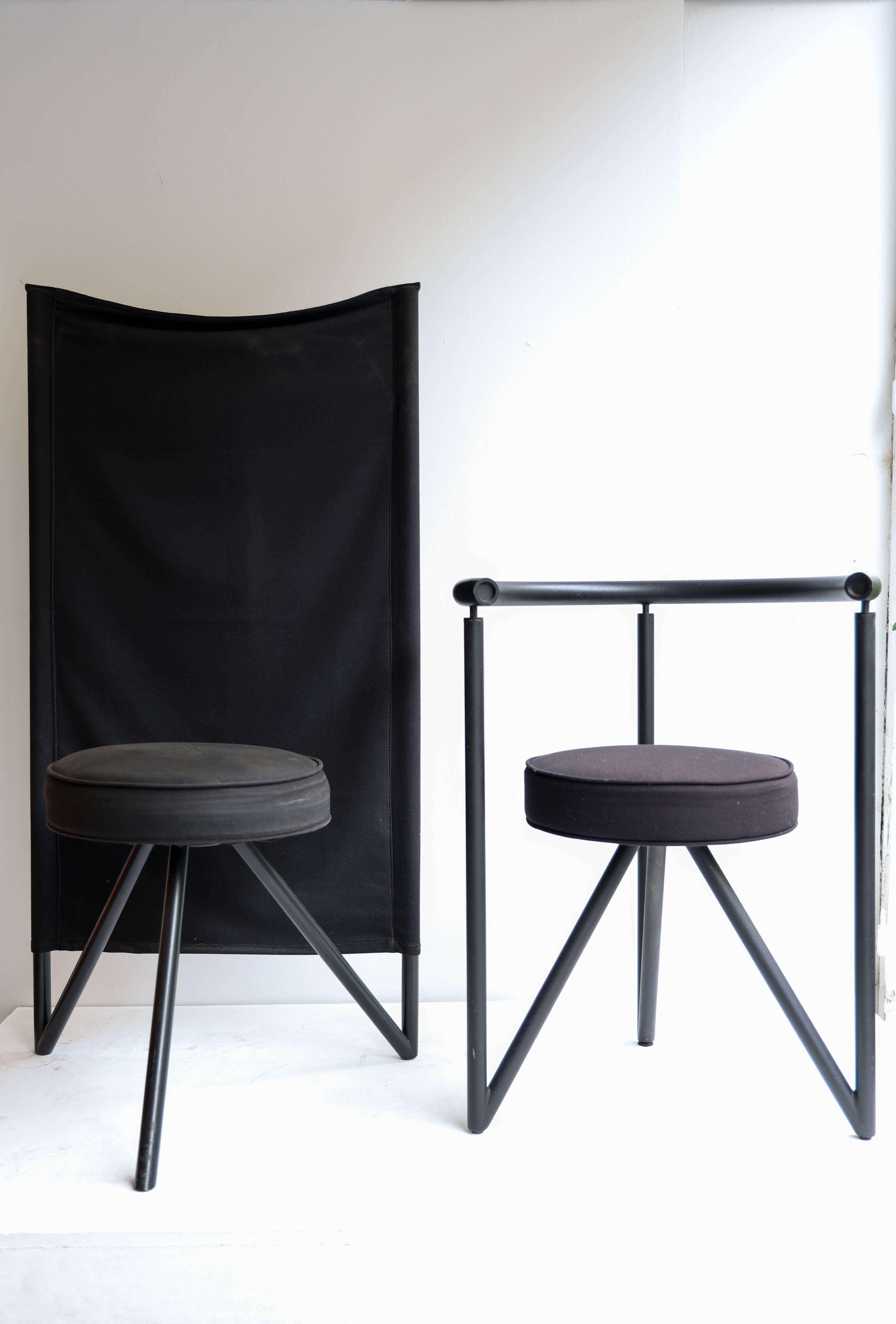
In his early work, Philippe Starck stripped furniture down to its essence, favouring clean lines and deep black tones. On the left, the ‘Miss Wirt’ chair; on the right, the ‘Miss Dorn’ chair (1981), both produced by Disform, Starck’s first manufacturer (€2,000).
This sense of restraint runs through the early work of Philippe Starck, one of the gallery’s signature designers and a regular visitor. Bouvier and Nouvet were among the first to showcase Starck’s 1980s creations—his formative years. The decade was a turning point for the designer, who began working independently, seeking out manufacturers to bring his pieces to life.
His 1980s furniture encapsulates the core of his style, as seen in the ‘Miss Dorn’ chair (1981), which strips the object down to its essentials: clean lines and a round seat cushion, all rendered in deep black—a defining color of the era. Starck’s later designs would evolve toward more organic forms, incorporating wood, but for Bouvier, he had already reached a peak with this chair. It was with ‘Miss Dorn’ that Bouvier and Nouvet began collecting Starck’s work, and it is also the piece she recommends to anyone looking to explore 1980s design.
Handcrafted Pieces, Often Produced in Limited Series
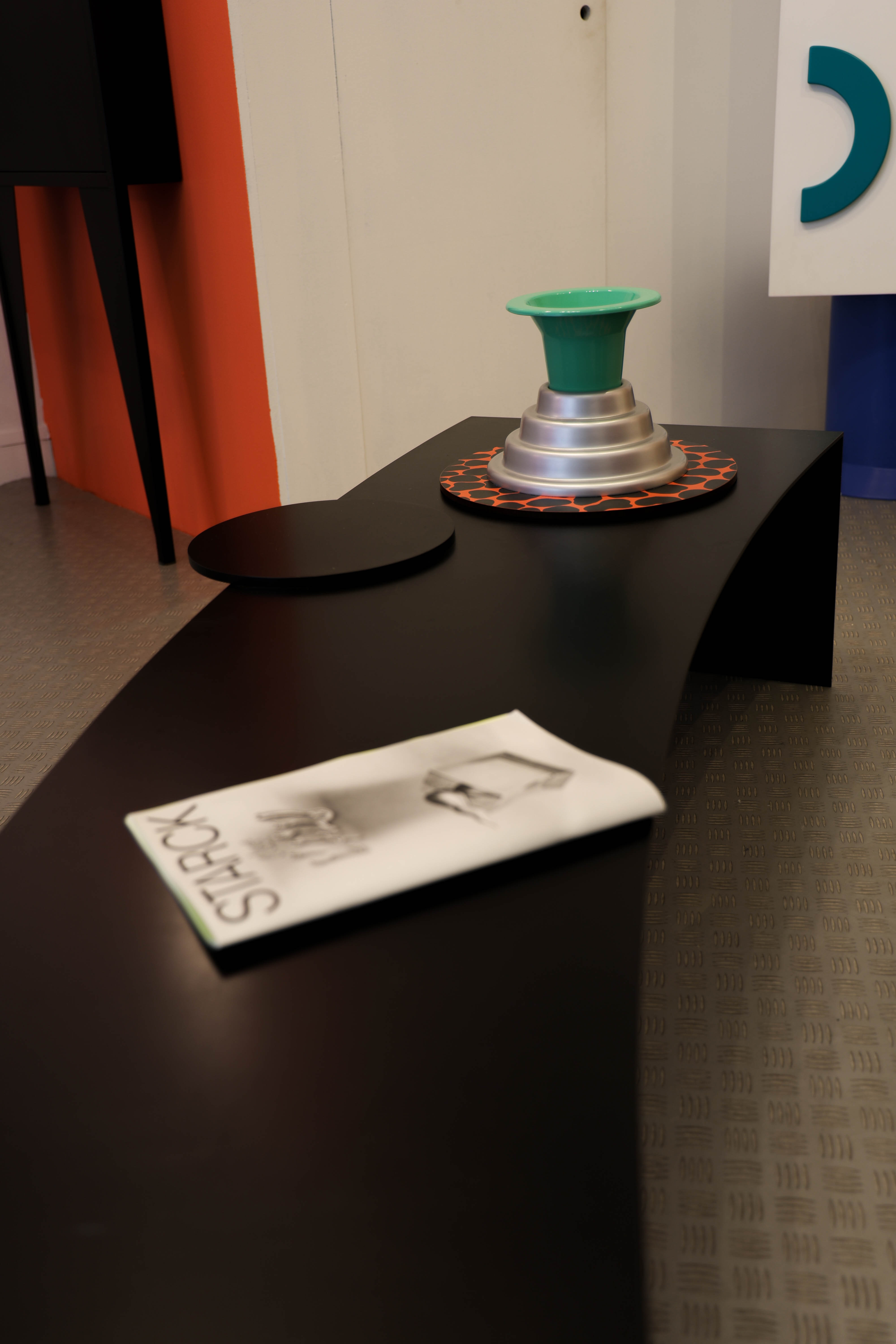
The ebony, curved ‘Agathe’ table by Gilles Derain (edited by Lumen Center), topped with the ‘Bon Temps’ vase by Memphis member Nathalie du Pasquier, alongside the catalogue from Remix Gallery’s 2024 exhibition devoted to Philippe Starck’s aluminum pieces.
Other designers also explored sleek black silhouettes, like Gilles Derain and his ‘Agathe’ coffee table, whose undulating form recalls a wave. In one corner of the gallery, a discreet secretary desk by Pascal Mourgue stands just 13 centimeters thick—designed for compact modern living. As Bouvier points out, the 1980s saw a rise in divorce rates, with families often splitting into smaller households. Space-saving furniture became increasingly popular, like Philippe Starck’s ‘Mickville’ stool or side table, whose legs fold beneath the seat for easy storage behind a door.
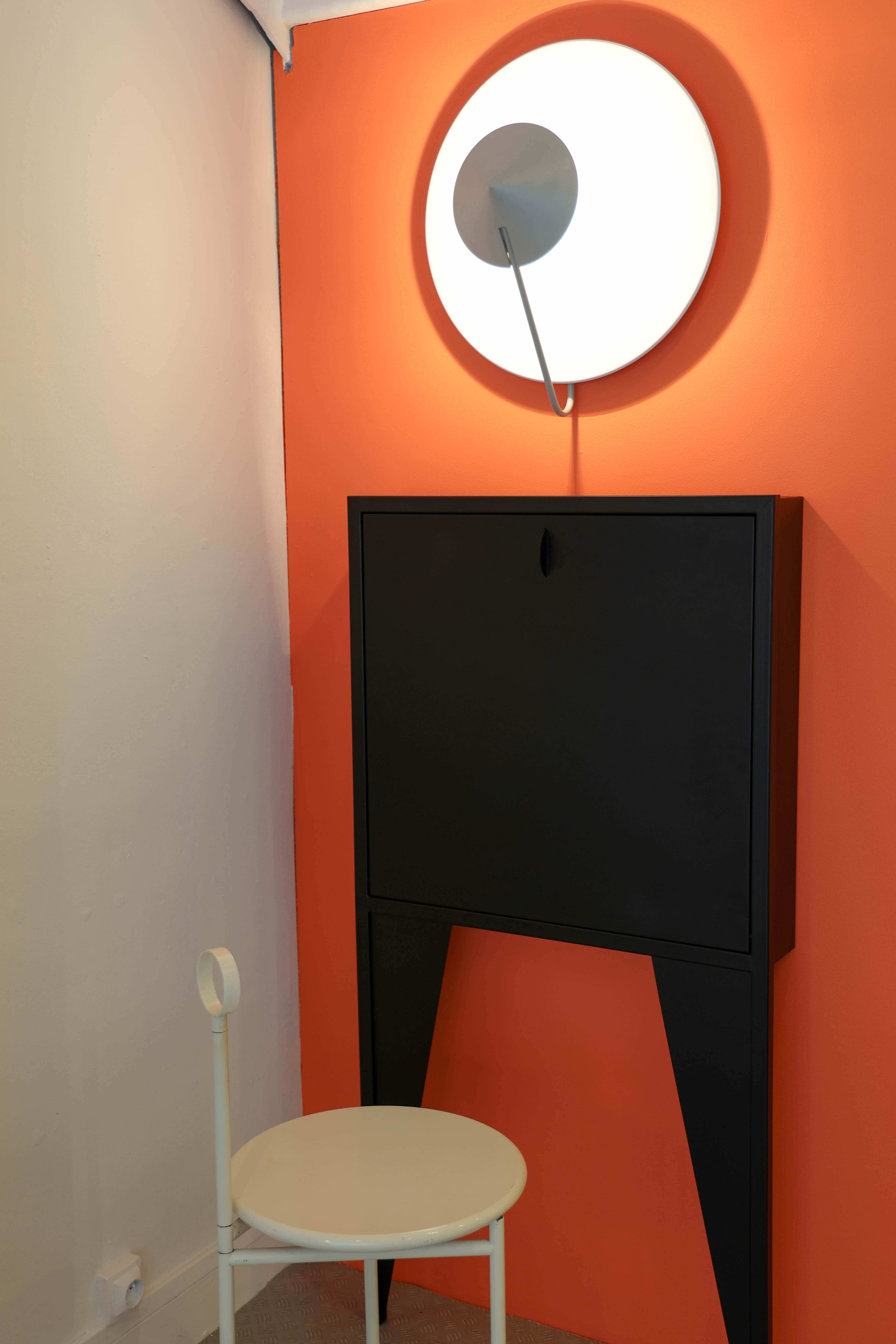
In the 1980s, discreet furniture became increasingly common to adapt to shrinking living spaces. Pictured here: the ‘Face à Face’ secretary by Pascal Mourgue, just 13 cm thick (€1,800), and the foldable ‘Mickville’ stool by Philippe Starck, produced by Aleph Ubik (€4,000).
Today, this furniture is enjoying renewed interest among collectors—largely thanks to its rarity. Many designers worked by hand or in small studios, producing limited, numbered editions. The ‘Tra’ cabinet by Alessandro Mendini, which brightens up the gallery space, is the second in a series of nine. Like Mendini, some designers took a sculptural approach to furniture, among them Pierre Sala, another of Bouvier’s favorites.
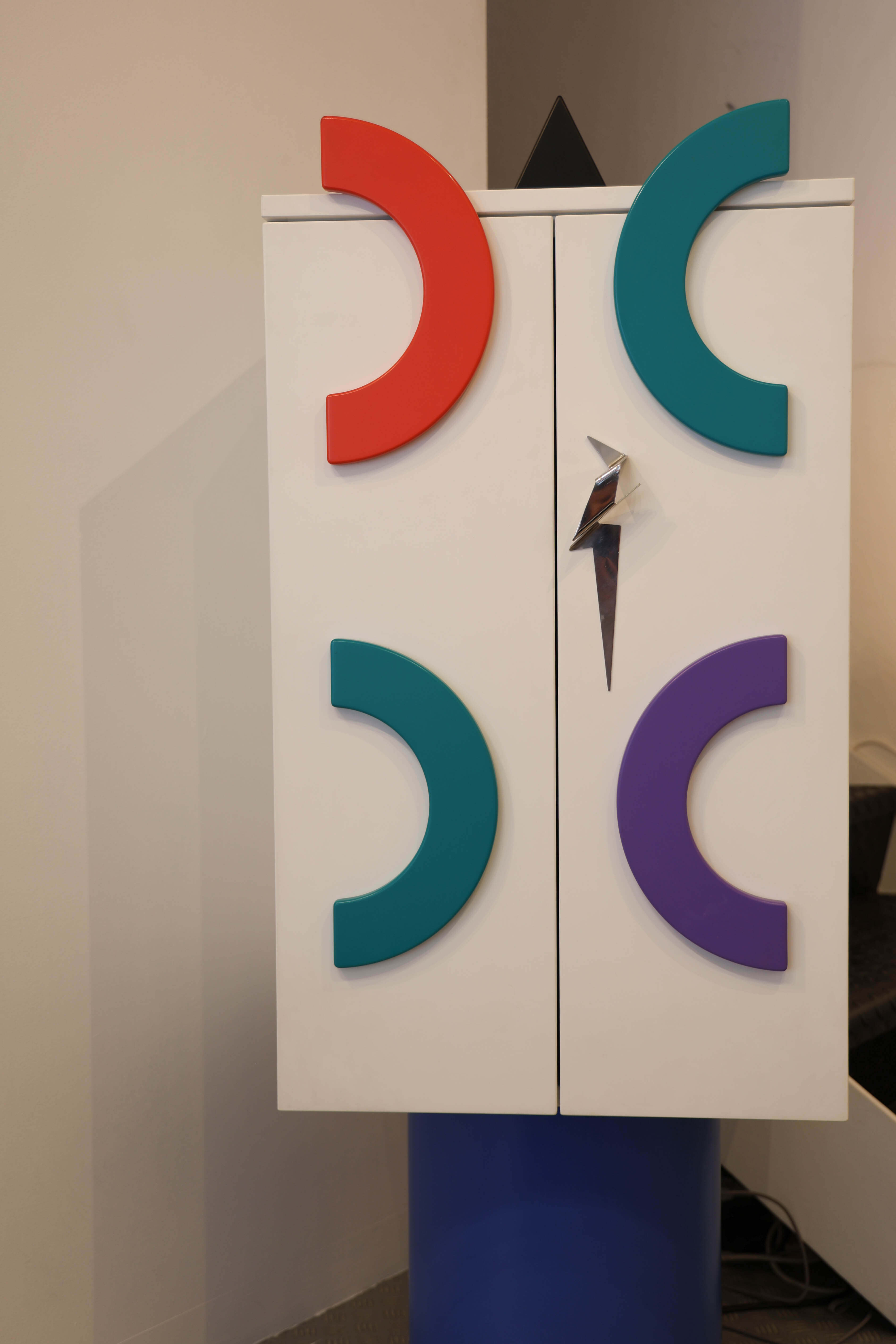
Alessandro Mendini’s ‘Tra’ cabinet, number 2 of 9, published by Zero Designo.
‘Pierre Sala is an extraordinary character,’ she enthuses. ‘He’s the house’s showman-designer. He created chairs with magical names—‘Licorne’, ‘Piranha’, ‘Autre Phoenix’. Since he worked in theatre set design, every one of his pieces includes a dramatic, narrative element. Just one of his chairs is enough to bring that ‘wow’ factor to an interior.’
For those hesitant about incorporating 1980s furniture into their homes, Bouvier insists the pieces are surprisingly versatile. They pair easily with 1950s wooden furniture à la Charlotte Perriand, Art Deco classics, or even antique pieces from the Napoleonic era. ‘The 1980s were fearless. People were free,’ she concludes. That freedom lives on in these irresistible pieces, which bring joy and originality to any space.
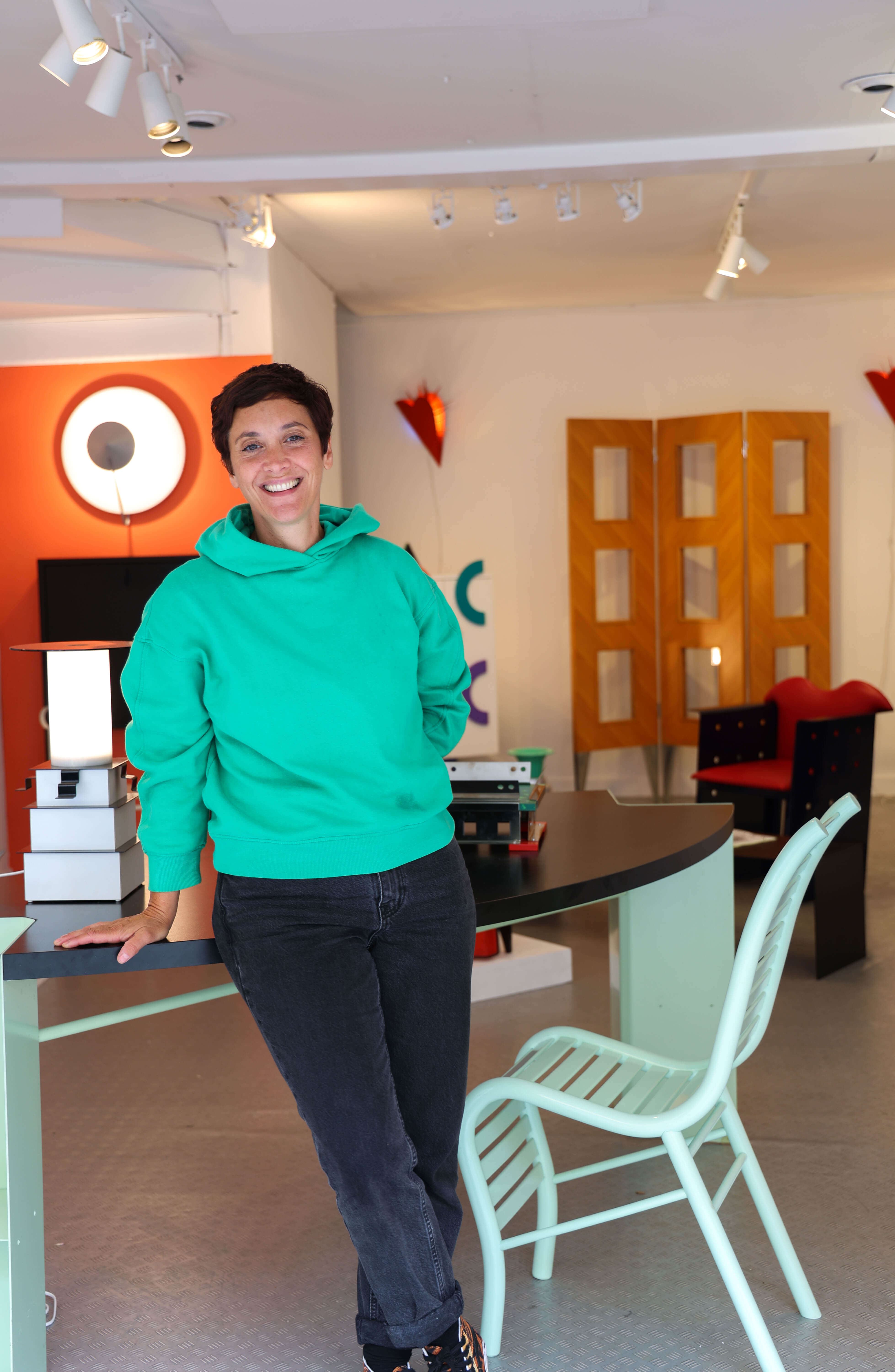
Valérie Bouvier, co-founder of Remix Gallery, seated on the ‘Prima Duna’ desk from Alessandro Mendini’s ‘Légion Étrangère’ series, matched with Philippe Starck’s pale green ‘Dick Deck’ chair (produced by Aleph).
Remix Gallery
Address: Marché Paul Bert, allée 6, stand 91, 96–110 rue des Rosiers, 93400 Saint-Ouen, France
Phone: +336 6378 0693
Saturdays and Sundays: From 10 am to 6 pm, Fridays: From 9 am to 12 pm.
www.remixgallery.frDemain Rétro: Timeless Menswear at the Crossroads of Past and Present
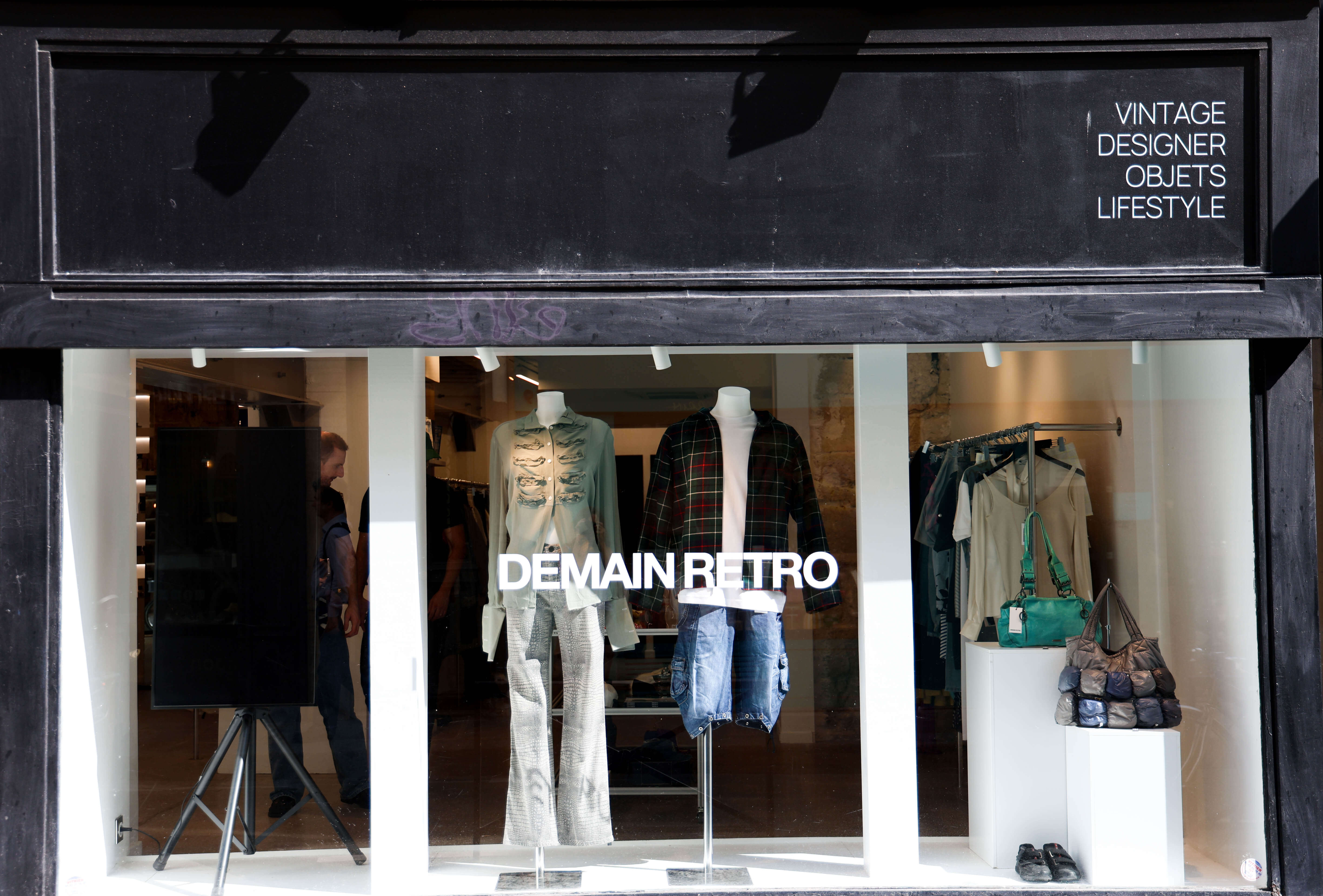
Demain Rétro, a concept store located in Paris’s Marais district, offers a curated selection of vintage and contemporary designer clothing for men and women.
Set within a light-filled space of exposed stone walls in the upper Marais district of Paris, Demain Rétro presents a sharp curation of vintage clothing for men and women. Fans of the 1990s and 2000s will find much to covet here: pieces from major fashion houses such as Prada and Jean Paul Gaultier in pristine condition. Some designers who have since faded from the spotlight also enjoy renewed success, such as Marithé + François Girbaud, pioneers of 1980s denim and early adopters of stonewashed finishes.
Founded in 2020 by Thibaud Beugre, a passionate vintage hunter who was struck by the limited offering of menswear in the field, Demain Rétro began as a series of pop-ups, in collaboration with the RE_CHERCHE vintage store collective. Two invitations to join Le Printemps Haussmann followed. When given a pop-up space that exceeded his own selection, Beugre opened it up to other labels—spanning fashion, interior objects, and fragrance. The idea of a concept store began to take shape, eventually coming to life on rue du Temple in Paris.
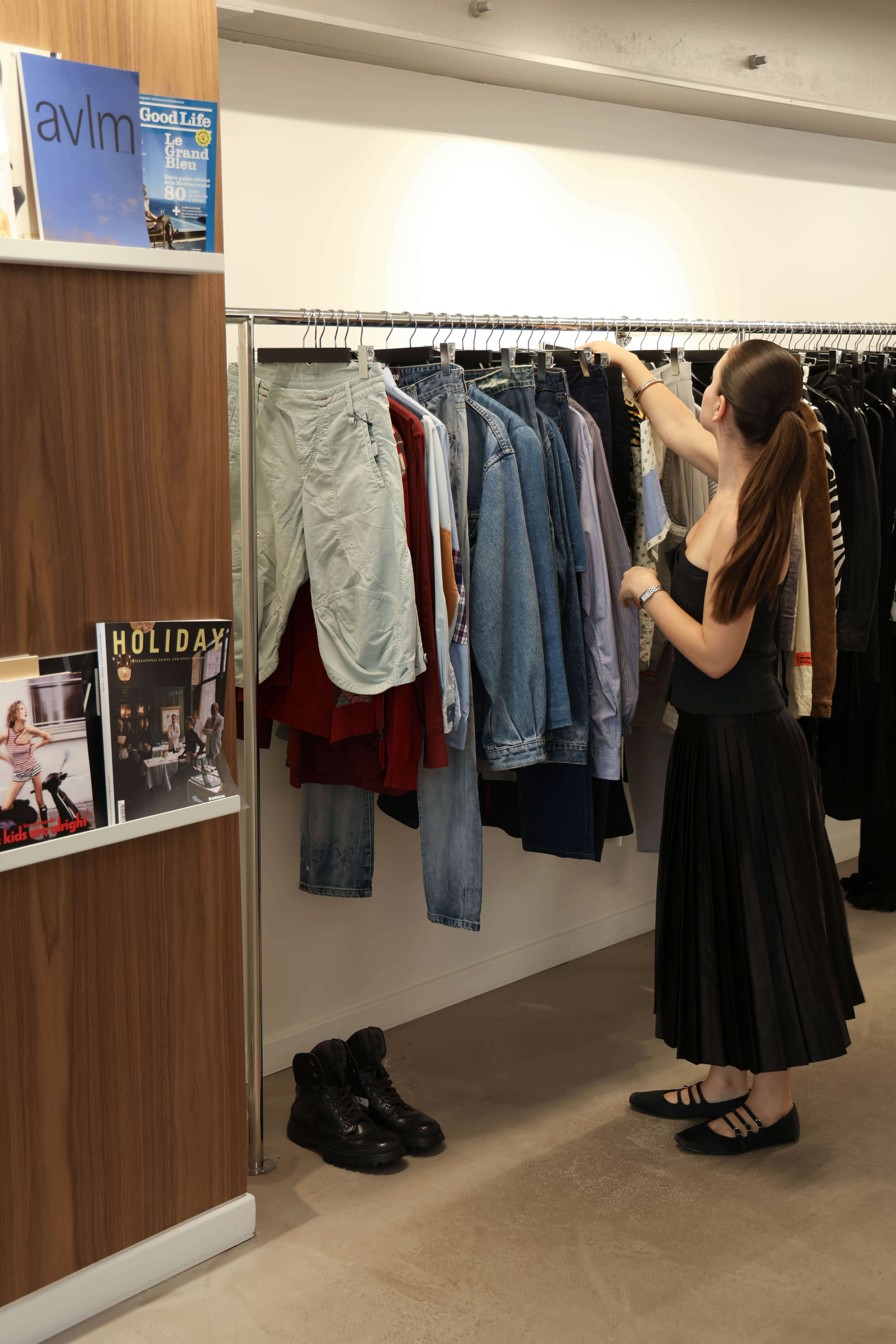
Lucia, a sales assistant, rearranges the men’s vintage fashion section.
Blending Eras and Influences to Create Contemporary Looks
In-store, the vintage selection—curated by Thibaud and his team, each with their own distinct sense of style—is enhanced by contributions from other specialists. Vintage Therapy and Mission Vintage, among others, bring a keen eye to sourcing, ensuring a rich and ever-changing assortment refreshed every two weeks. Prices vary widely, from around a hundred euros to several thousand for rare runway pieces.
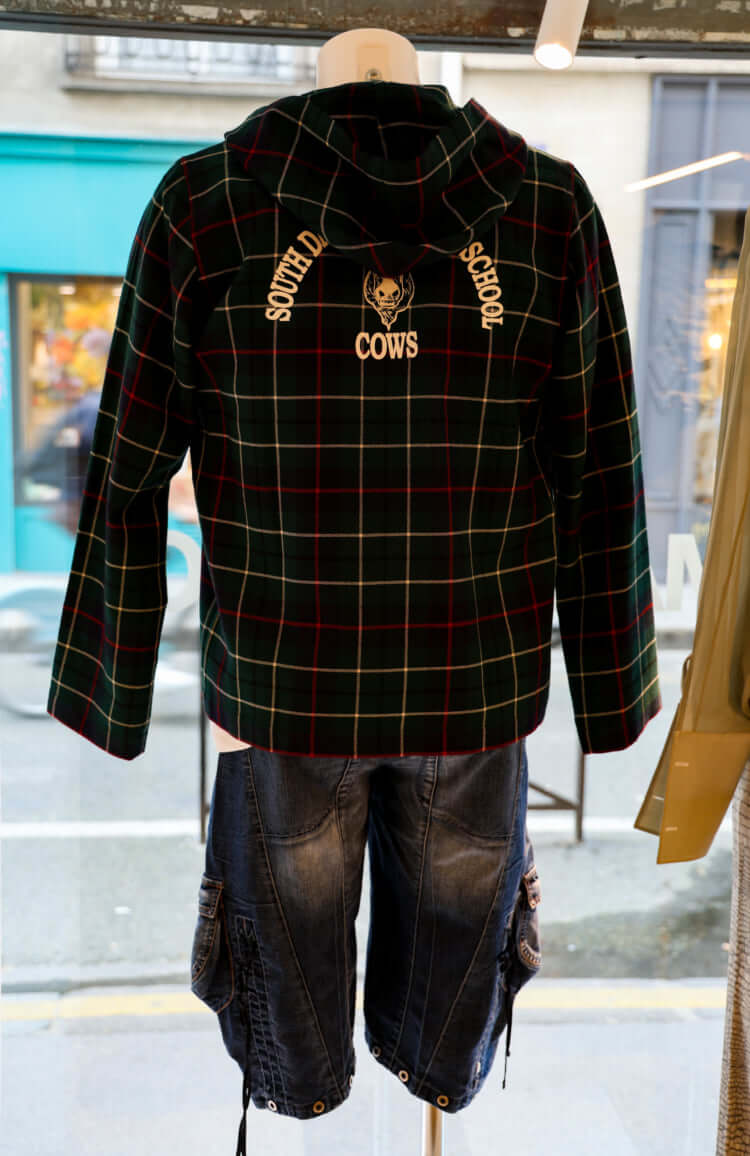
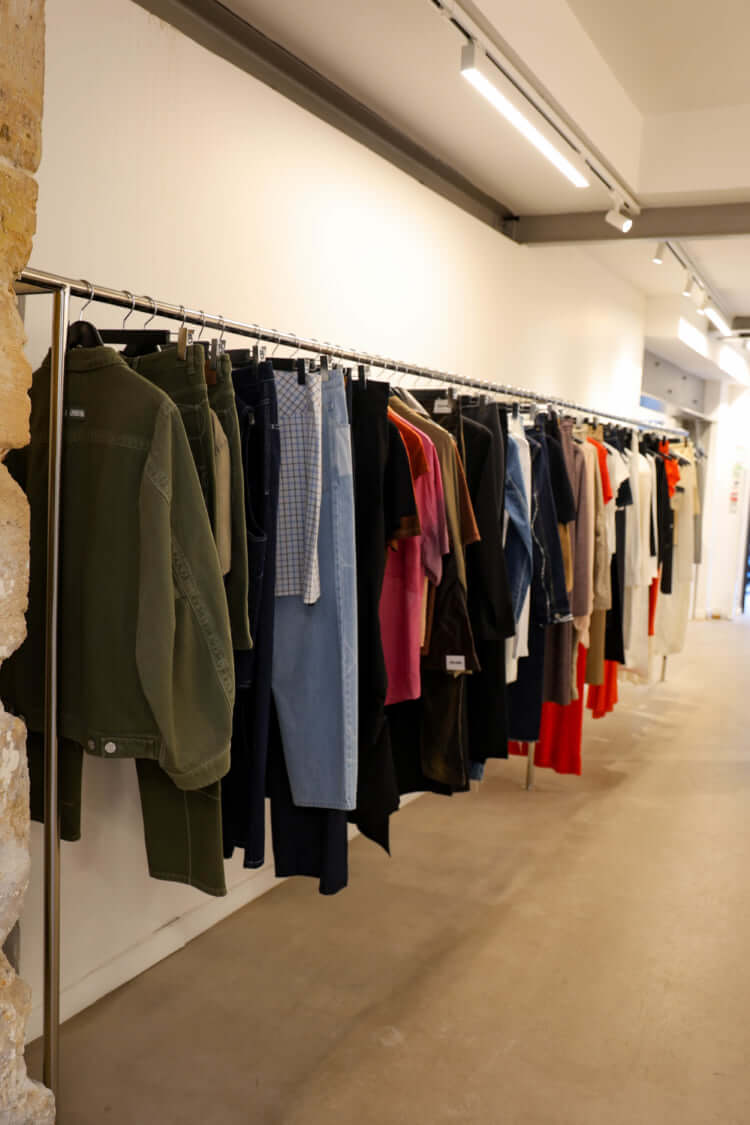
On the left, an outfit featuring a Yohji Yamamoto sweatshirt paired with Marithé + François Girbaud denim shorts, displayed in the store window. Demain Rétro also has a dedicated section showcasing young designers, such as Alexandre Sintive, on the right.
From the start, Demain Rétro was founded on the idea of combining vintage garments with contemporary design. The aim: to play with timelines and influences, and avoid falling into overly nostalgic or dated aesthetics. Liva Hing, the store manager, suggests highlighting a single strong piece rather than layering too many branded items. ‘Otherwise, it all becomes too much and nothing really stands out.’
One example of this approach: a silhouette pairing a houndstooth-print vintage Prada windbreaker with voluminous raw denim jeans designed by Alexandre Sintive. Featuring an adjustable waistband for styling versatility, this unique piece is currently the young designer’s only creation.
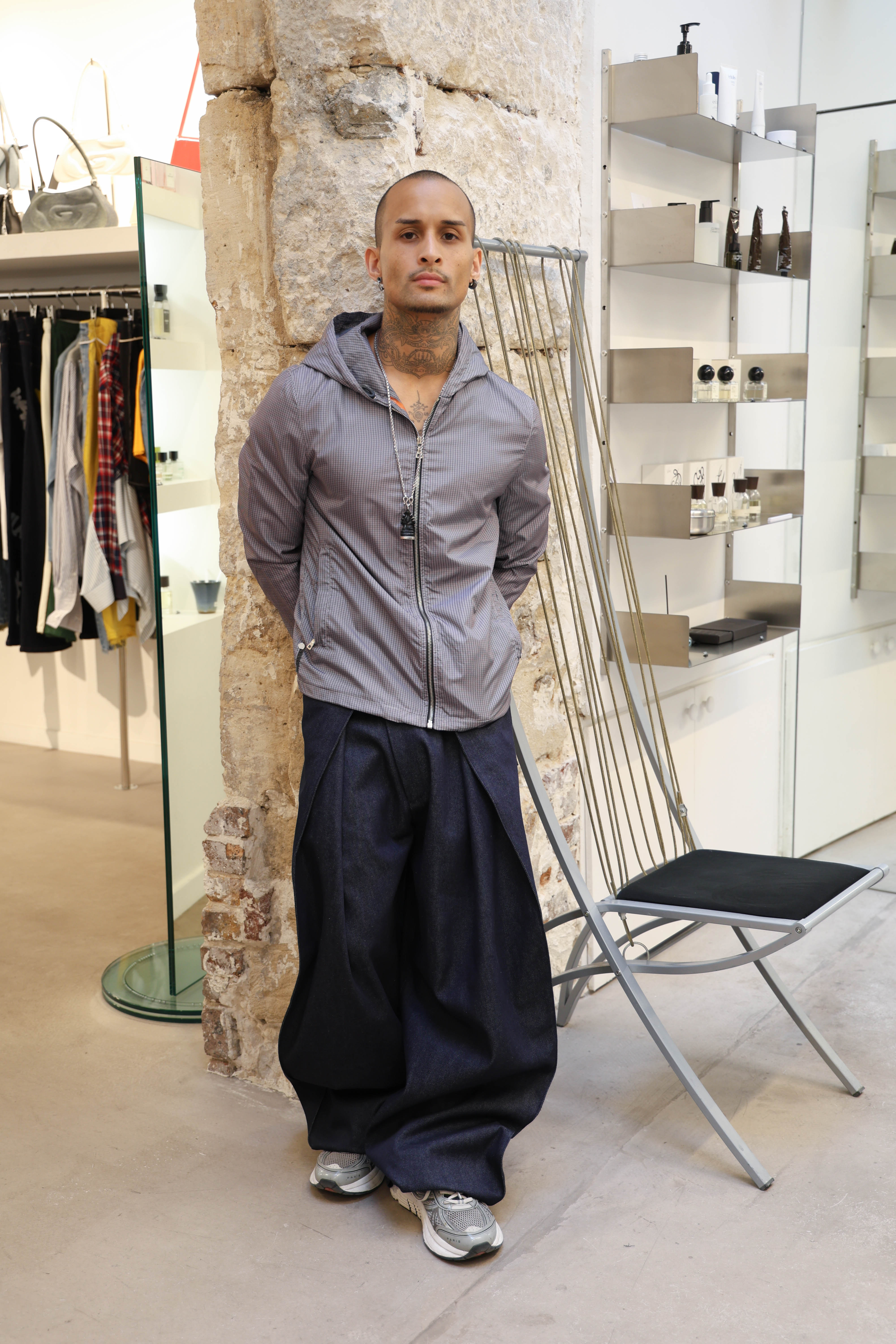
Liva Hing, manager of Demain Rétro, wears a vintage Prada jacket (€420) paired with voluminous raw denim jeans by young designer Alexandre Sintive (€240).
Vintage Pieces Presented Like New
Giving visibility to underrepresented designers is key for Thibaud Beugre, a nod to his own early days in pop-ups. In the contemporary section of the store, London-based Studio Ü is prominently featured. Known for its commitment to upcycling, the label reimagines vintage garments in bold new forms—such as a jersey with its hem folded and stitched to create a cropped silhouette. When paired with deconstructed denim shorts by Marithé + François Girbaud, the result is a strong 1990s-inspired streetwear look.
Beyond clothing, the concept store also offers a selection of accessories, jewellery, and home objects. Studio Ü again takes center stage, this time with a line of contemporary caps deliberately distressed at the edges—a nod to classic London punk.
In a spacious and carefully organized setting, Demain Rétro presents vintage fashion as if it were brand new—far from the cramped, naphthalene-scented thrift stores often associated with menswear. It’s a place to return to, not only to greet the warm and welcoming team, but also to check out the latest arrivals, perhaps while flipping through one of the elegant magazines displayed throughout the store. A refreshing source of inspiration in a neighbourhood already brimming with fashion-forward ideas.
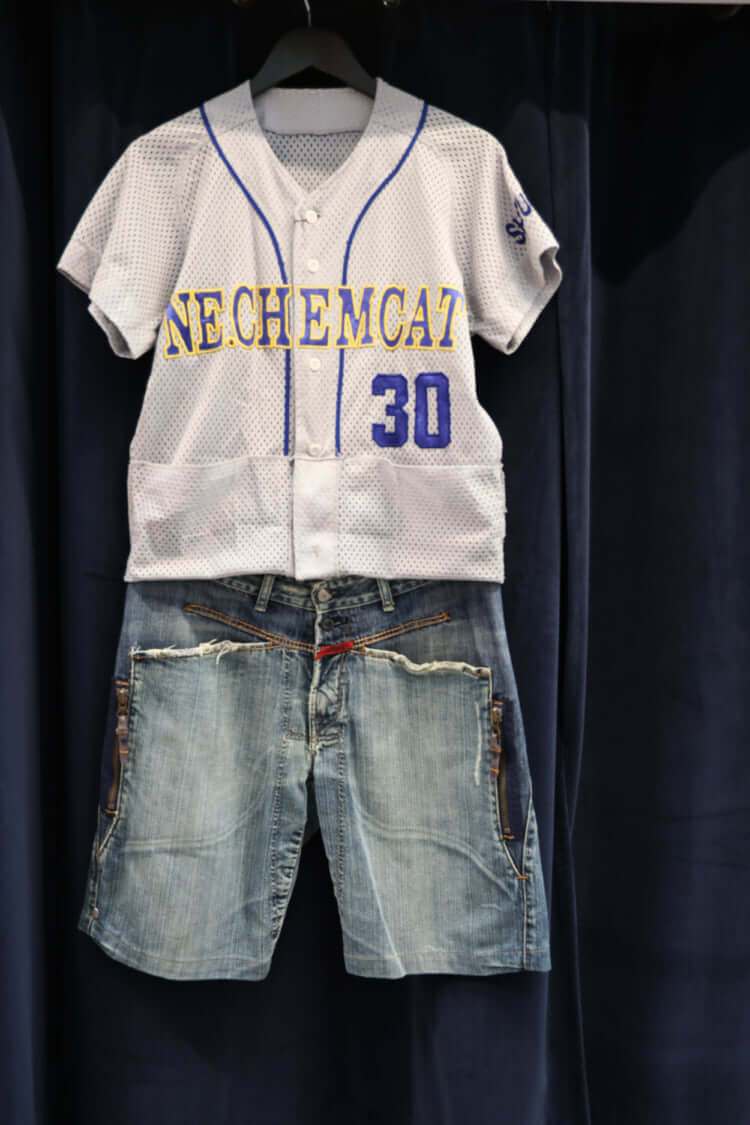
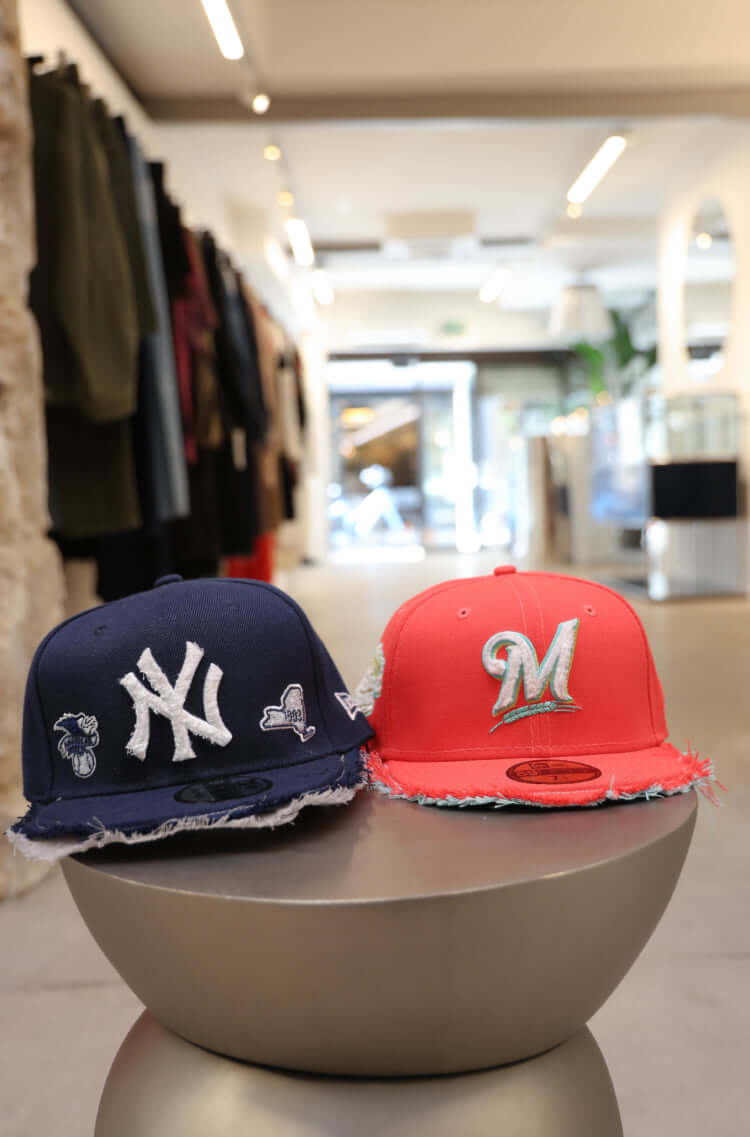
Left: an upcycled jersey by London-based Studio Ü (€350) styled with vintage Marithé + François Girbaud denim shorts (€140). Right: Studio Ü caps with deliberately distressed brims (€145 each).
Demain Rétro
Address: 154 rue du Temple, 75003 Paris, France
Phone: +331 8509 0380
Tuesday - Saturday: From 11:30 am to 7:30 pm. Sunday: From 1 pm to 7 :30 pm. Closed on Mondays.
www.demainretro.com