Sou Fujimoto, ‘What Role Can Architecture Play in an Age of Division?’
In a world marked by separation, the architect now seeks to ‘connect’ rather than ‘fragment,’ as he explains in this interview.
Through the design of the ‘Grand Ring’ for the 2025 Osaka World Expo, Sou Fujimoto set out to question how people across the globe might be brought together. In an era of growing divides, he reflects on the role architecture can play, while tracing the evolution of his own vision.
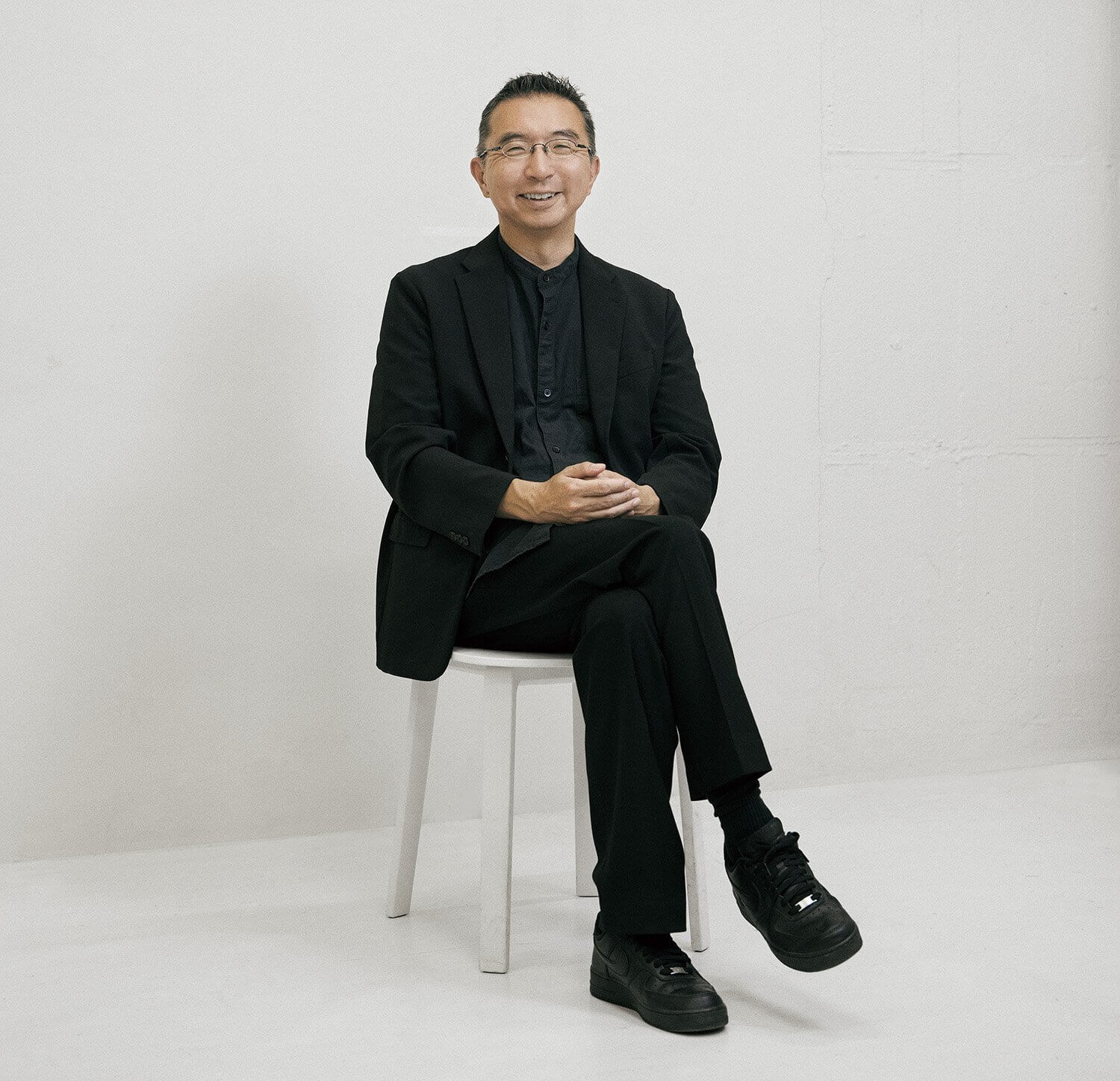
Sou Fujimoto, architect. Born in 1971 in Hokkaido. After studying architecture at the University of Tokyo’s Faculty of Engineering, he founded Sou Fujimoto Architects in 2000. Based in Tokyo, Paris, and Shenzhen, he has completed projects both in Japan and abroad. He was also the design producer for the site of Expo 2025 Osaka.
You were appointed design producer for the Osaka World Expo in 2020, five years before its opening. How did you feel when you took on this role?
At that time, the debate over Tokyo’s new National Stadium for the Olympics had just concluded, and a sense of hesitation pervaded the creative community regarding state projects. Declining the role did not feel right either. I thought it was important first to reflect on the significance of holding a World Expo today, and to see whether I could find a personal justification for participating.
The concept of ‘division’ was increasingly present in discourse, and precisely because the world seemed fragmented, the framework of an Expo—bringing nations together—felt especially meaningful. I have always believed that the essence of architecture lies in creating spaces where people gather. From that perspective, the Expo embodied what architecture should be at its most fundamental. It felt like a mission full of purpose and potential, and I decided to accept it.
Before the opening, the Expo faced considerable criticism.
I had prepared myself, but it was even more intense than I imagined (laughs). Yet, in a context of mixed opinions, carrying the project through to completion while staying true to my convictions was an invaluable experience. Looking back, I am grateful to have been entrusted with such a role. The realization of the ‘Grand Ring,’ a fairly radical proposal, would not have been possible without the trust of the organizers.
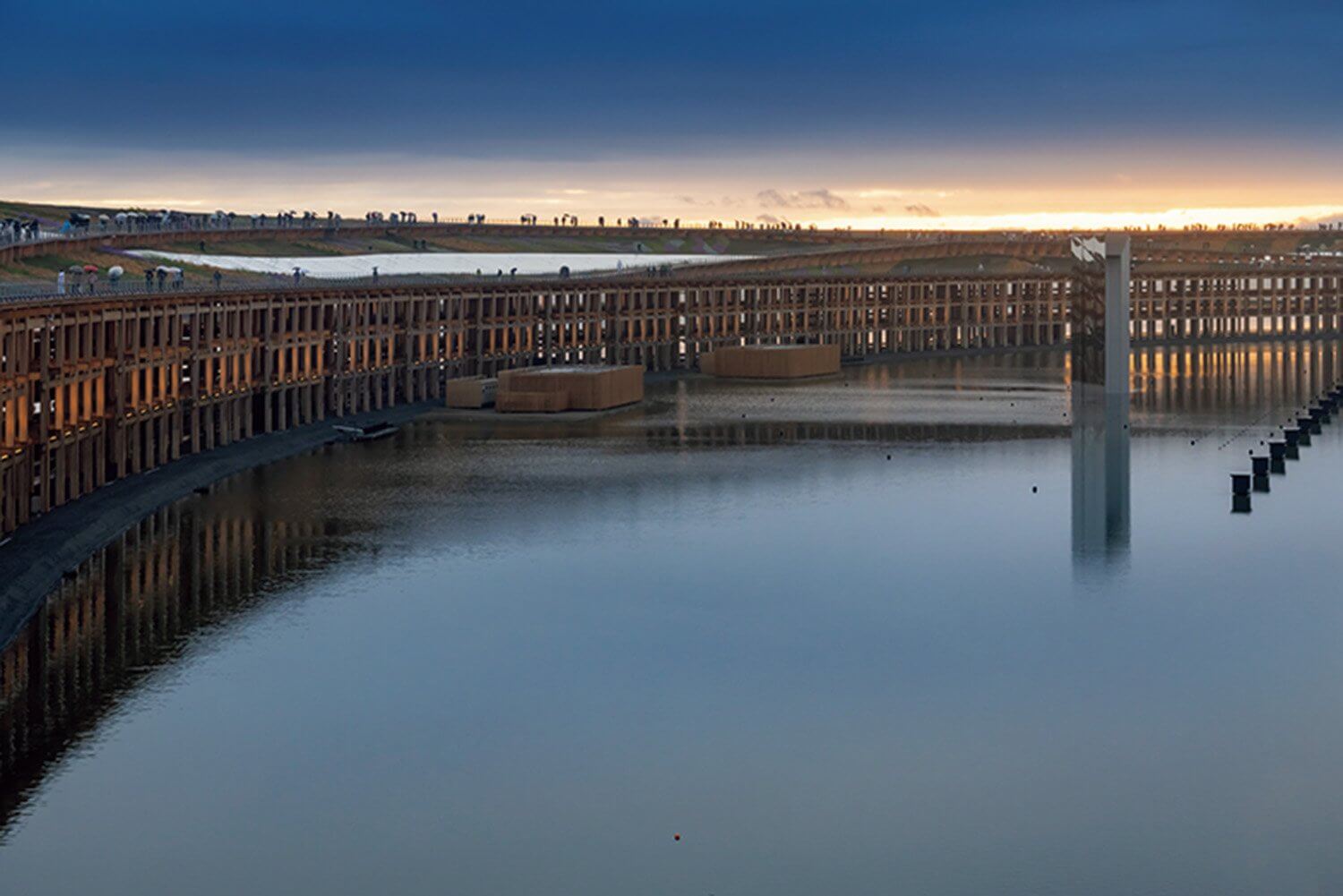
‘Grand Ring’ (Osaka). © Iwan Baan
And on the day of the opening, what did you feel?
Seeing visitors stream in all at once was deeply moving. People seemed genuinely happy simply to walk along the ring. As sunset approached, a vast crowd gathered. Sharing the simple act of observing the sun set together is rare. The ring spans roughly 675 meters in diameter, and from a distance you can spot tiny figures walking along it. Each person is separate, yet a shared consciousness emerges, a subtle sense of connection.
It was a powerful moment. I was reminded that architecture exists only when inhabited. What we had built with conviction seemed to resonate with visitors, and it brought me great joy. I realized that architecture can indeed convey a message. In that landscape, all the difficulties we had faced felt insignificant, as if everything had been purified in an instant (laughs).
After this experience, have you noticed any changes in your perspective?
Yes, especially in my awareness of the future. A World Expo compels you to look at least fifty years ahead. I sought to apprehend more concretely what the world and society might look like once I am no longer here. The birth of my child around the same time certainly intensified this perception.
Your view of the world has therefore changed.
I believe my gaze on society has become more resolute. Even in a world marked by divisions, I am convinced that different worlds can be connected. That was the message I wanted to convey through the ‘Grand Ring,’ and now I don’t just believe it intellectually—I feel it deeply. The idea that fragments can still be connected has long been a concern of mine. One of my earliest projects, a psychiatric care center for children, was based on this principle: providing both intimate spaces for retreat and shared spaces that foster connection.
At the time, my approach was diffuse, focused on valuing diversity and fragmented states. That sensitivity remains, but in an era of division, it is no longer enough. Recognizing plurality while creating a point of convergence—an environment where bonds can form gently—now seems essential. This is likely the most significant evolution in my thinking.
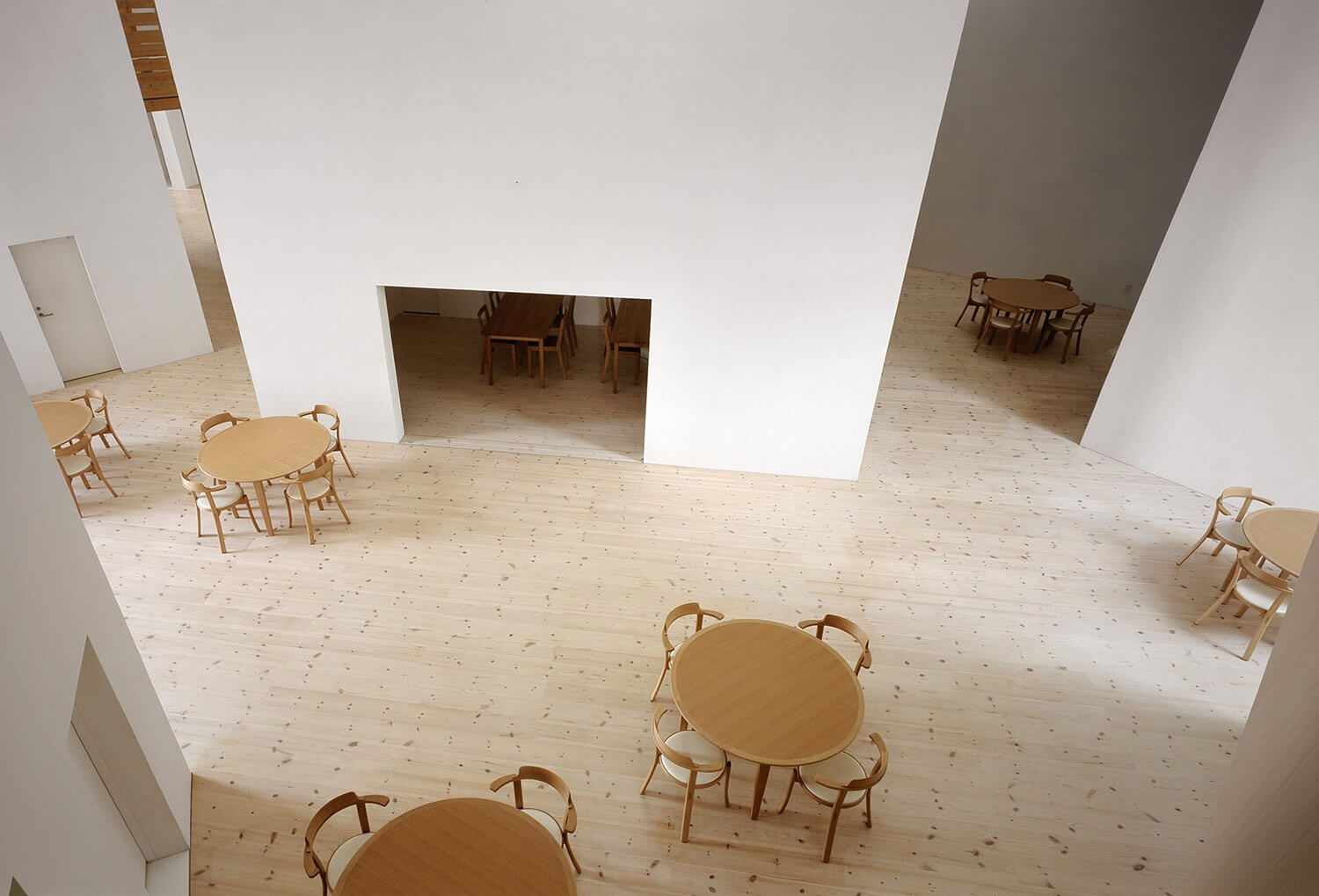
‘Children’s Psychiatric Care Center’ (Hokkaido). © Daici Ano
Your firm recently celebrated its 25th anniversary. How do you reflect on your journey?
After graduation, I spent six years without employment or further study, almost like a NEET—‘not in education, employment, or training.’ It was a precious period for deeply contemplating my relationship with architecture. I identified four fundamental themes: ‘space and body,’ ‘city and architecture,’ ‘interior and exterior,’ and ‘nature and architecture.’ Gradually, through competitions and projects, these reflections took concrete form.
For instance, exploring ‘nature and architecture,’ I proposed for the 2000 ‘Aomori Museum of Art’ competition not a large monolithic building, but a series of gallery corridors weaving among the trees on site. The project won second prize. It was the first time I received such recognition as an unknown young architect, and it gave me confidence. Subsequent work on residential projects confirmed that architecture was indeed my path.
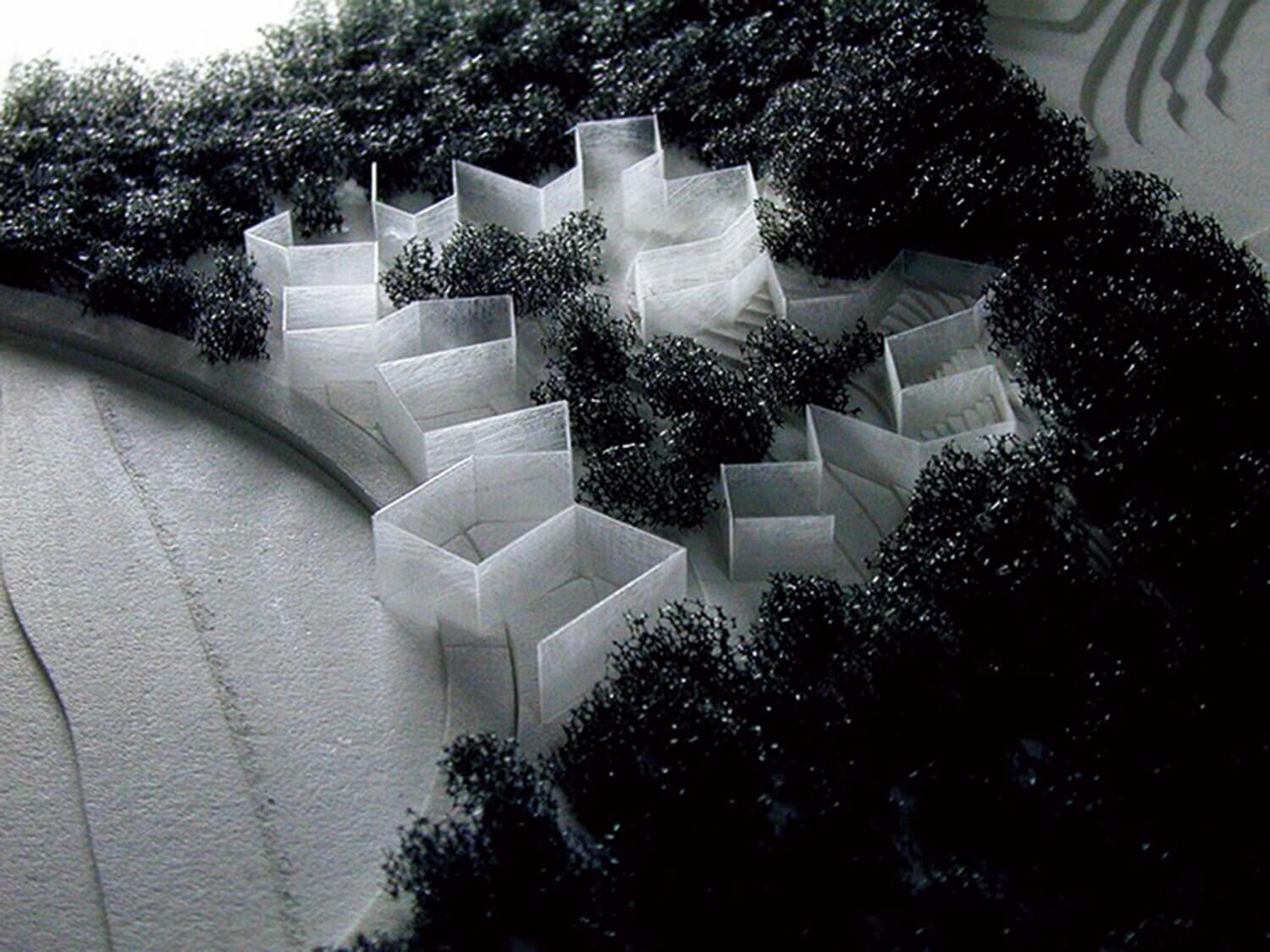
Proposal for the ‘Aomori Museum of Art’ competition (concept). © Sou Fujimoto Architects
This was the birth of Sou Fujimoto, the architect.
The 2010s were particularly decisive. In 2011, even though the projects were not realized, I was selected for two international competitions in Serbia and Taiwan. More importantly, after the 2011 earthquake, I joined Toyo Ito, Kumiko Inui, and Akihisa Hirata in the ‘Home for All, Rikuzentakata’ reconstruction project.
We devised numerous ideas to propose a ‘new architecture’ on land where everything had been destroyed by the tsunami, but none felt right. I realized that rather than inventing from our own knowledge or ideas, we needed to listen closely to the local culture, to the lived experience of residents, and to respect the singularity of each site. This is how truly universal architecture can emerge. Recognizing the importance of ‘listening’ became a turning point in my practice.
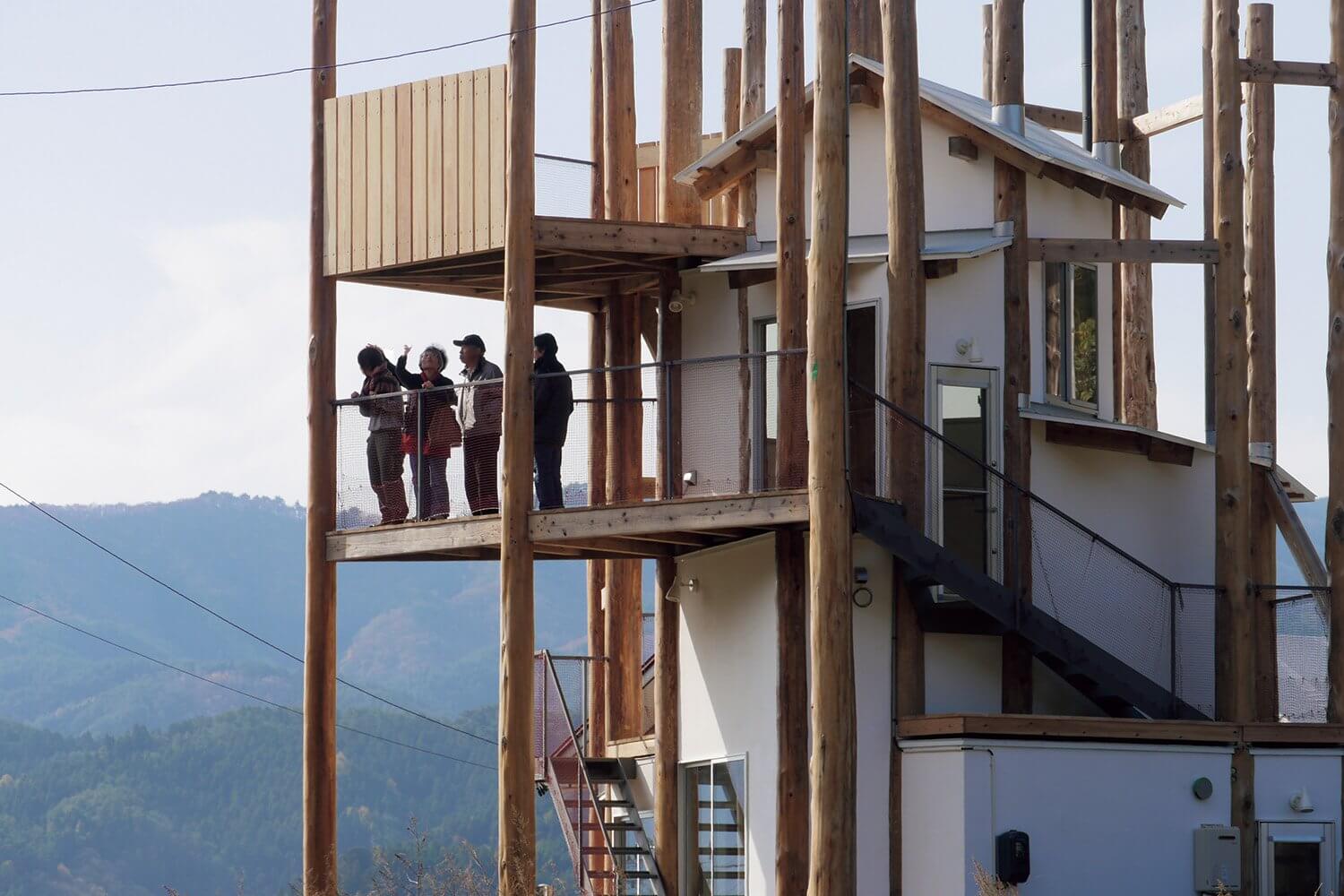
‘Home for All, Rikuzentakata’ (Iwate). © Naoya Hatakeyama
Towards a Society That Recognizes Diversity While Fostering Gentle Connections
You mention an experience that directly led to your more recent projects.
Yes. The culmination of these reflections crystallized in the 2013 ‘Serpentine Gallery Pavilion’ in London. It was the synthesis of my four fundamental themes, the culmination of more than a decade of work. It gave me a sense of liberation.
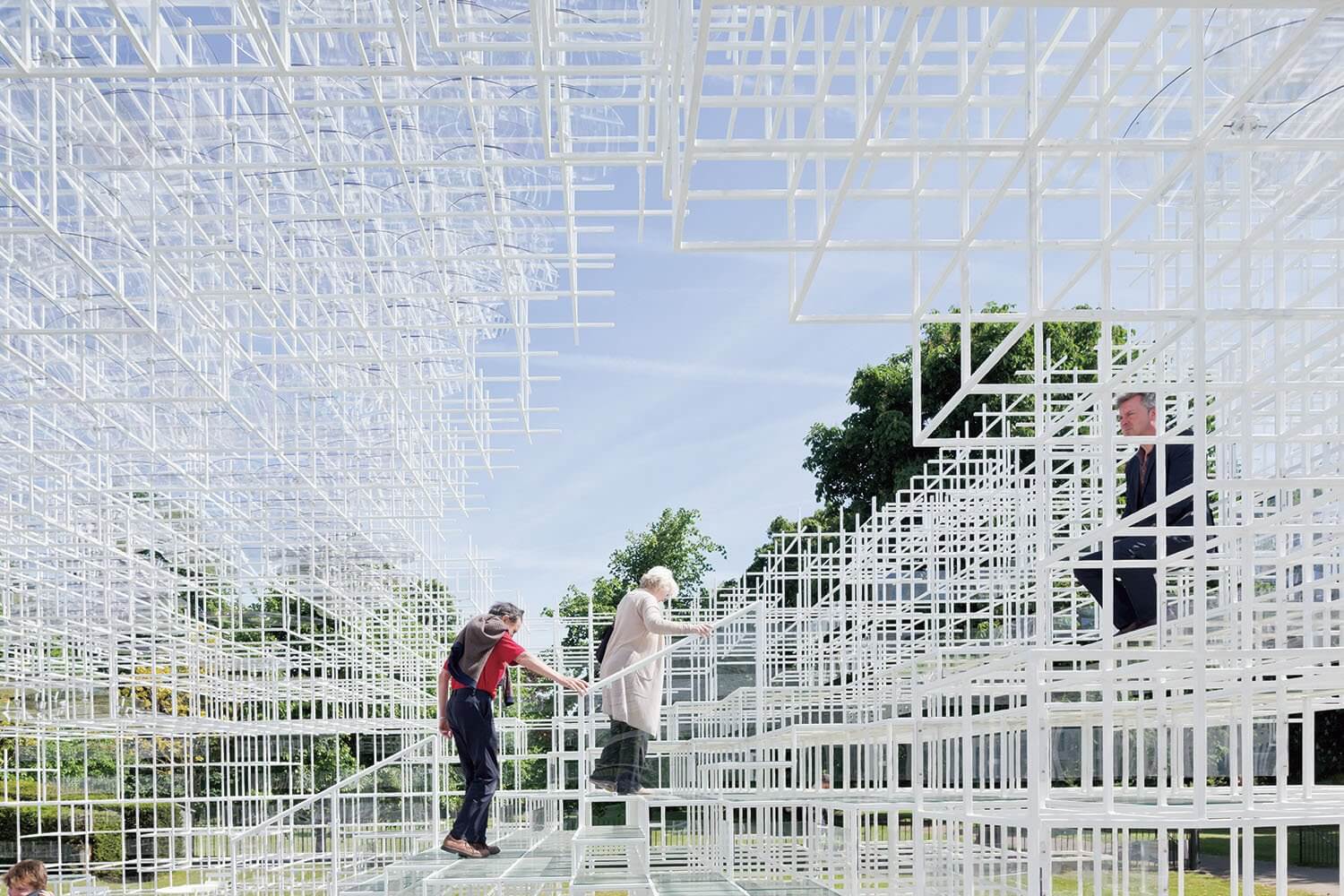
‘Serpentine Gallery Pavilion’ 2013 (UK). © Iwan Baan
Since then, your international projects have multiplied, and your style seems to evolve with each work.
Indeed. Around that period, I felt that personal desires—‘I want to do this,’ ‘this seems interesting’—were no longer sufficient. My experience in Rikuzentakata had shown me that I needed to focus on what each place reveals: its climate, culture, and the life of its inhabitants, creating something simultaneously unique and universal.
For example, in Montpellier, France, with its sunny climate, I designed bold protruding balconies for the residential complex ‘L’Arbre Blanc’ (2019). In Budapest, for the ‘Hungarian House of Music’ (2021), set within a wooded park, I conceived a concert hall integrated with the forest. Each project emerged from a direct engagement with the site, approached with enjoyment. While the underlying ideas remain consistent, the diversity of outcomes is such that one could think each building was designed by a different architect. It was at this moment that I truly experienced and celebrated the diversity of the world. Receiving the invitation for the World Expo, which brings together over 150 countries and regions, felt like a natural and gratifying continuation.
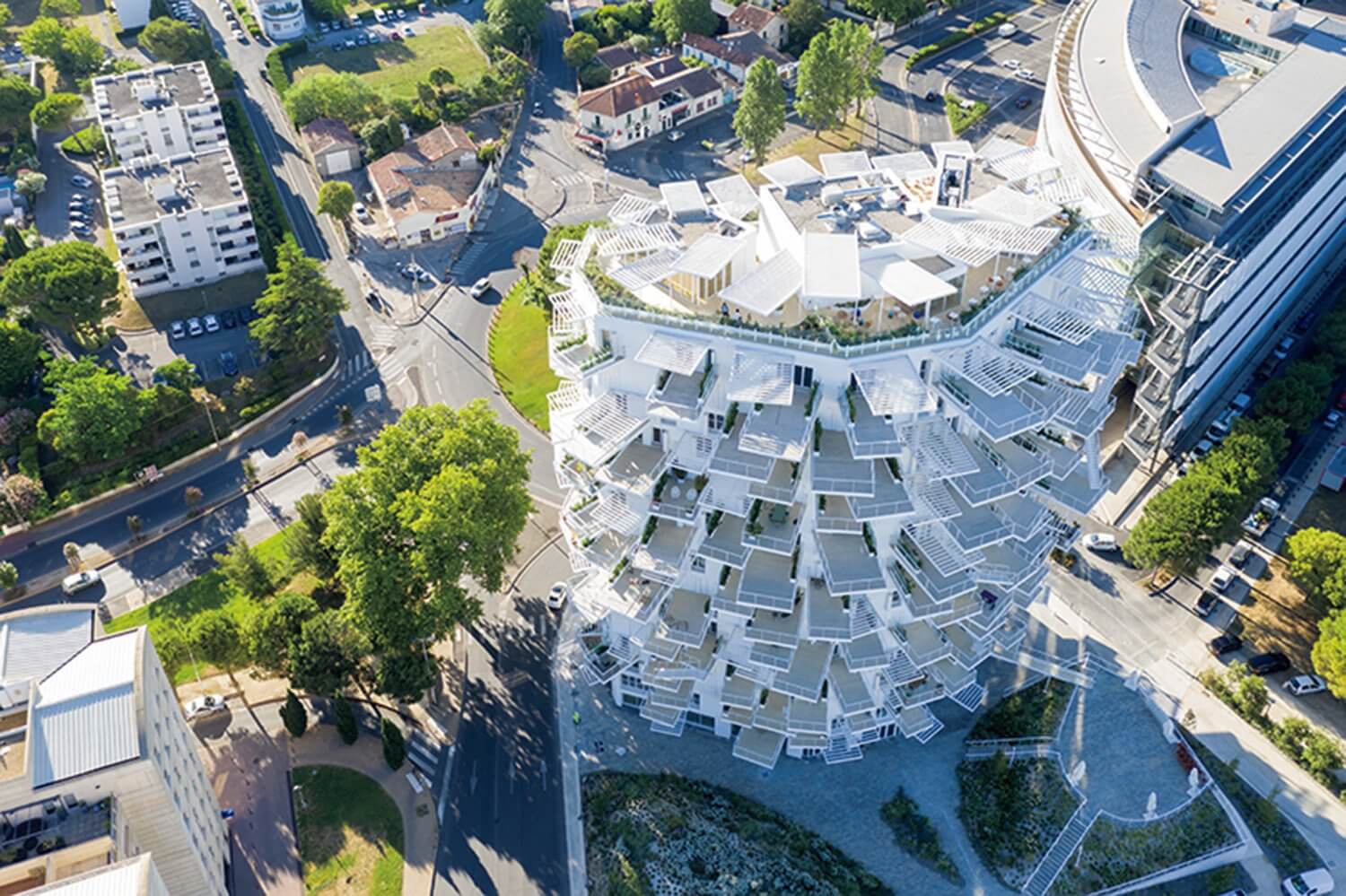
‘L’Arbre Blanc’ (Montpellier, France). © Iwan Baan
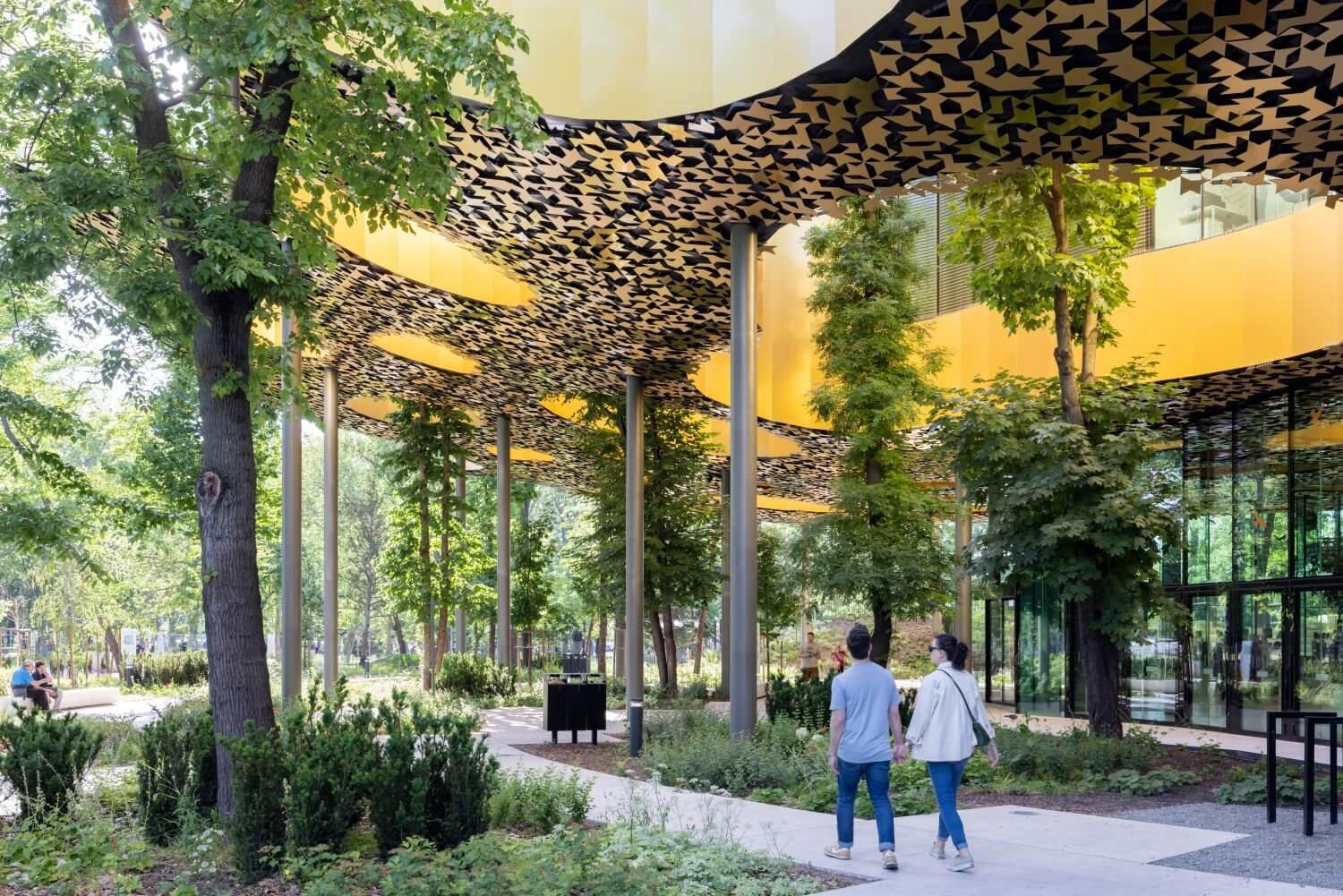
‘House of Music, Hungary’. © Iwan Baan
Where is your architecture headed today?
While preparing the exhibition The Architecture of Sou Fujimoto: Primordial Future Forest at the Mori Art Museum, I revisited my work. I realized that while the importance of ‘being fragmented’ remains, my interest has shifted toward ‘connecting.’ Connections—both architectural and social—are essential.
You are therefore entering a new phase.
Yes. The most emblematic project of this reorientation is the complex currently underway in Sendai: a concert hall integrated with a earthquake memorial near Kokusai Center Station. The building unfolds in multiple layers of floating floors, connected through the power of sound. The idea is that during commemorative ceremonies, the entire space resonates as one, allowing music and memory to be shared. I wanted to consider how the emotions and memories of the disaster, different for each person, could be linked. Through projects like this, I hope architecture can allow each individual to exist in their singularity while participating in a society capable of forming gentle, flexible connections.
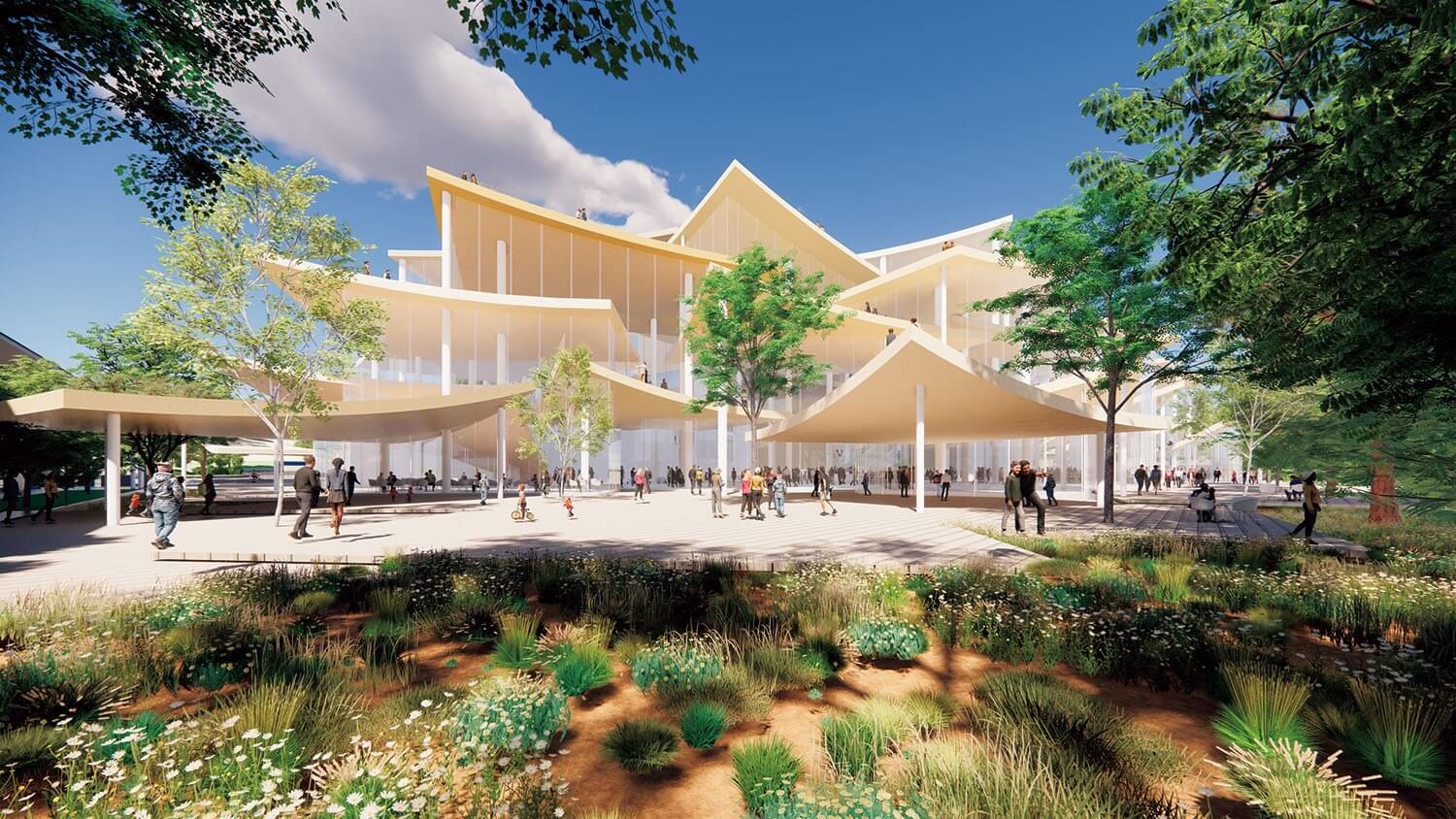
Complex at Kokusai Center North Exit (provisional name, Sendai, Miyagi). © Sou Fujimoto Architects
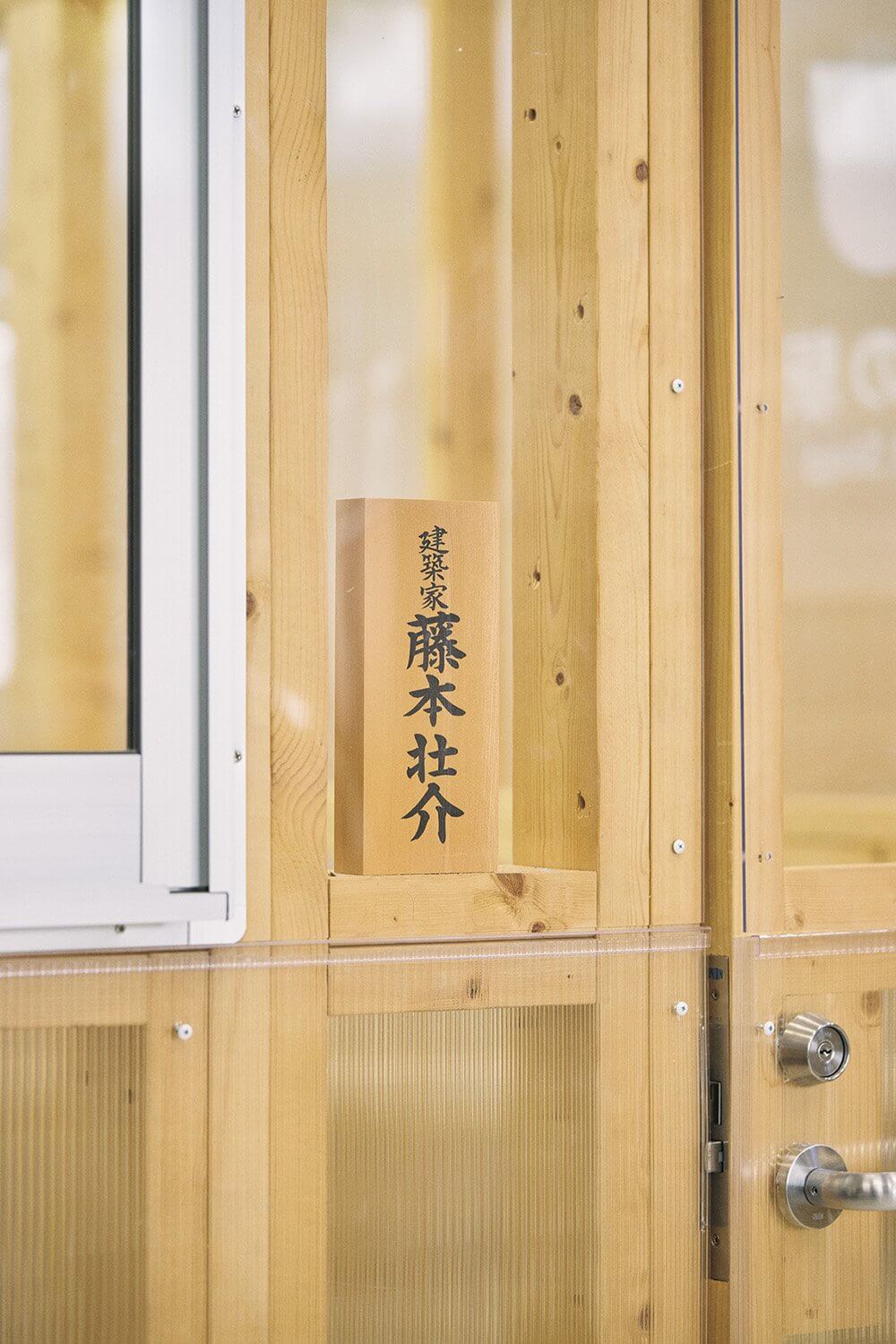
Plaque at the entrance of Sou Fujimoto Architects’ Tokyo office.