Jérémie Périn carries Mamoru Oshii’s legacy in France
His first animated film ‘Mars Express’ blends science fiction and a detective plot in the vein of ‘Ghost in the Shell’, with realistic visuals.
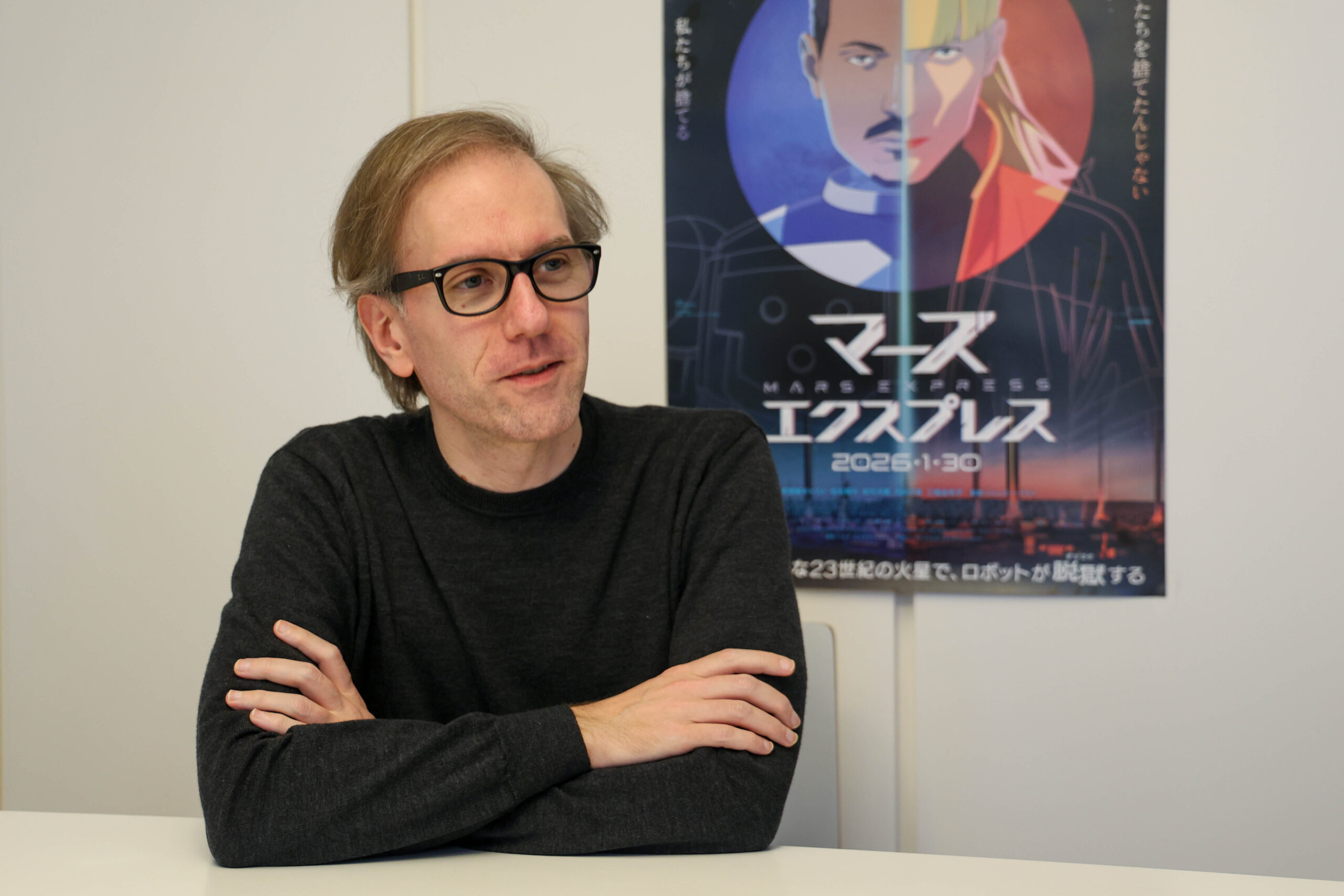
Jérémie Périn is a French director and animator, born in 1978. After a critically acclaimed loose adaptation of the comic ‘Lastman’ in 2016, he directed his first animated feature, ‘Mars Express’, in 2023. The film drew attention at both the Cannes Film Festival and the Annecy International Animation Film Festival.
Even before deciding to become an animation artist, Jérémie Périn harbored a deep admiration for Mamoru Oshii’s work, from Urusei Yatsura 2: Beautiful Dreamer to Patlabor, and of course, Ghost in the Shell. Since then, the French director has proven his mettle. In 2016, he directed the first season of Lastman, an adult-oriented fantasy animation series that follows a boxer drawn into a thriller-worthy quest. This success gave him the opportunity to helm a feature film, reuniting with Laurent Sarfati on the screenplay, who had co-written the series. Together, they decided to merge two genres rarely explored in French cinema: science fiction and the detective film.
At a time when industry giants like Elon Musk and Jeff Bezos were discussing colonies on Mars, reigniting humanity’s fascination with space conquest, the two writers asked themselves what a society imagined by such libertarians might look like. The result was Mars Express, released in 2023, which immediately caught attention at the Cannes Film Festival and the Annecy International Animation Film Festival.
The film follows a detective duo consisting of Aline, a human, and Carlos, a ‘Saved’—a robot imbued with the memories and personality of a deceased man, Aline’s former coworker. Set in 2200, in a society increasingly hostile to robots, they investigate the disappearance of a young cybernetics student, from Earth to Mars. Their quest takes them to the darkest realities of a world where technological progress has produced little more than a superficial utopia. At the heart of the story lie the complex questions raised by the ever-closer relationship between humans and machines.
On the occasion of Mars Express’s release in Japan, Jérémie Périn discusses the influence Ghost in the Shell had on his approach to directing and his vision for adult-oriented animated films.
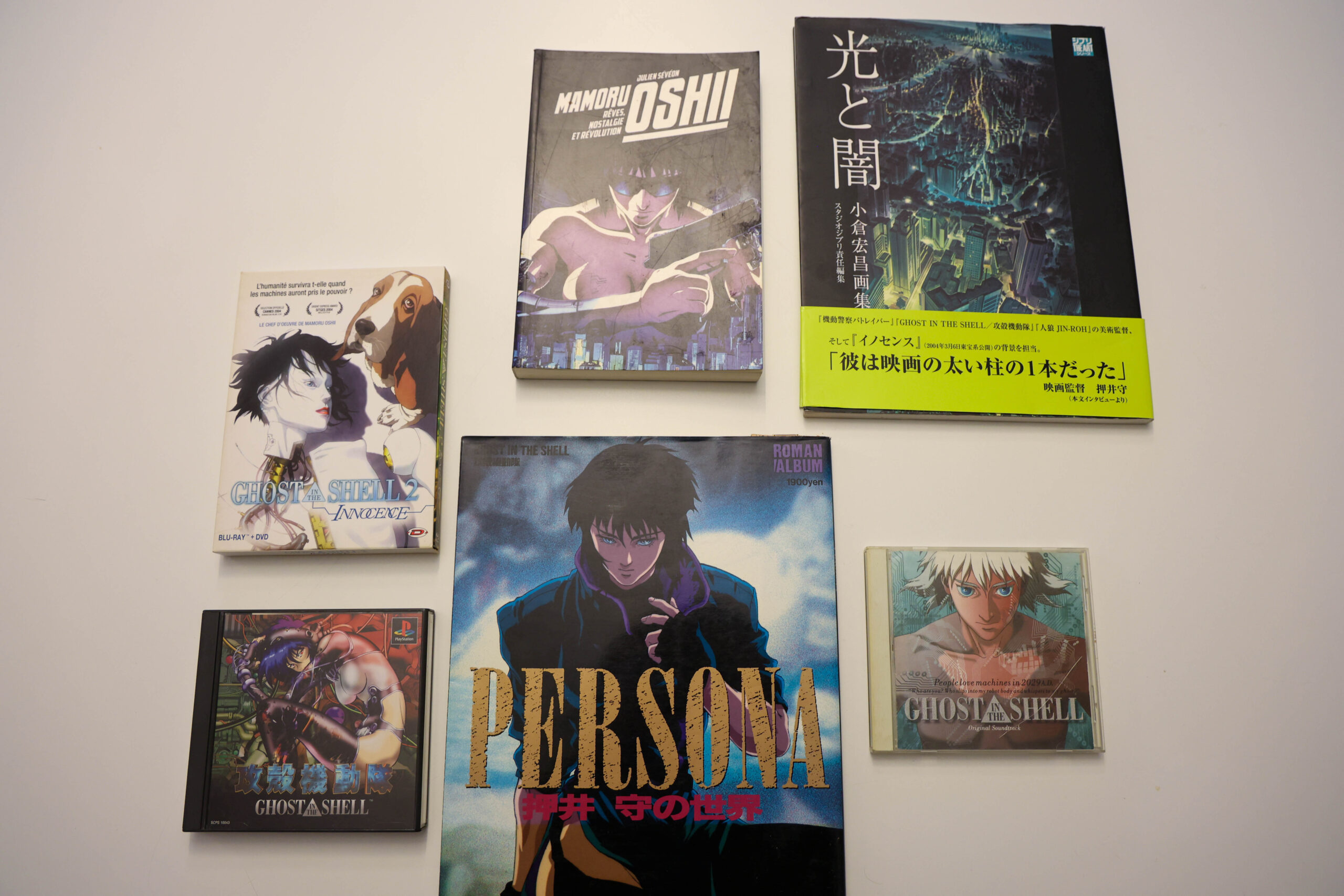
A glimpse of Jérémie Périn’s collection of ‘Ghost in the Shell’-related objects. Some are very old, like ‘Persona — The World of Mamoru Oshii’, which he purchased from the import section of a bookstore shortly before the film’s release in France, probably in 1996. The collection also includes a PlayStation game, which Périn notes is closer to the manga, a Blu-ray of the series’ second installment, and a 2012 book on the Japanese director written by a specialist in Asian cinema.
Do you remember the first time you saw Ghost in the Shell?
I saw it before its release in France in 1997, when I was in high school. Some of my friends were studying Japanese and had gone to Japan on exchange. They managed to get a copy of Ghost in the Shell on VHS. I watched it in Japanese first, even though I understood nothing. I was already an admirer of Mamoru Oshii, having seen Patlabor, Urusei Yatsura, and Angel’s Egg (which was only released in France in December 2025). But these were films aimed at a niche audience of cinephiles.
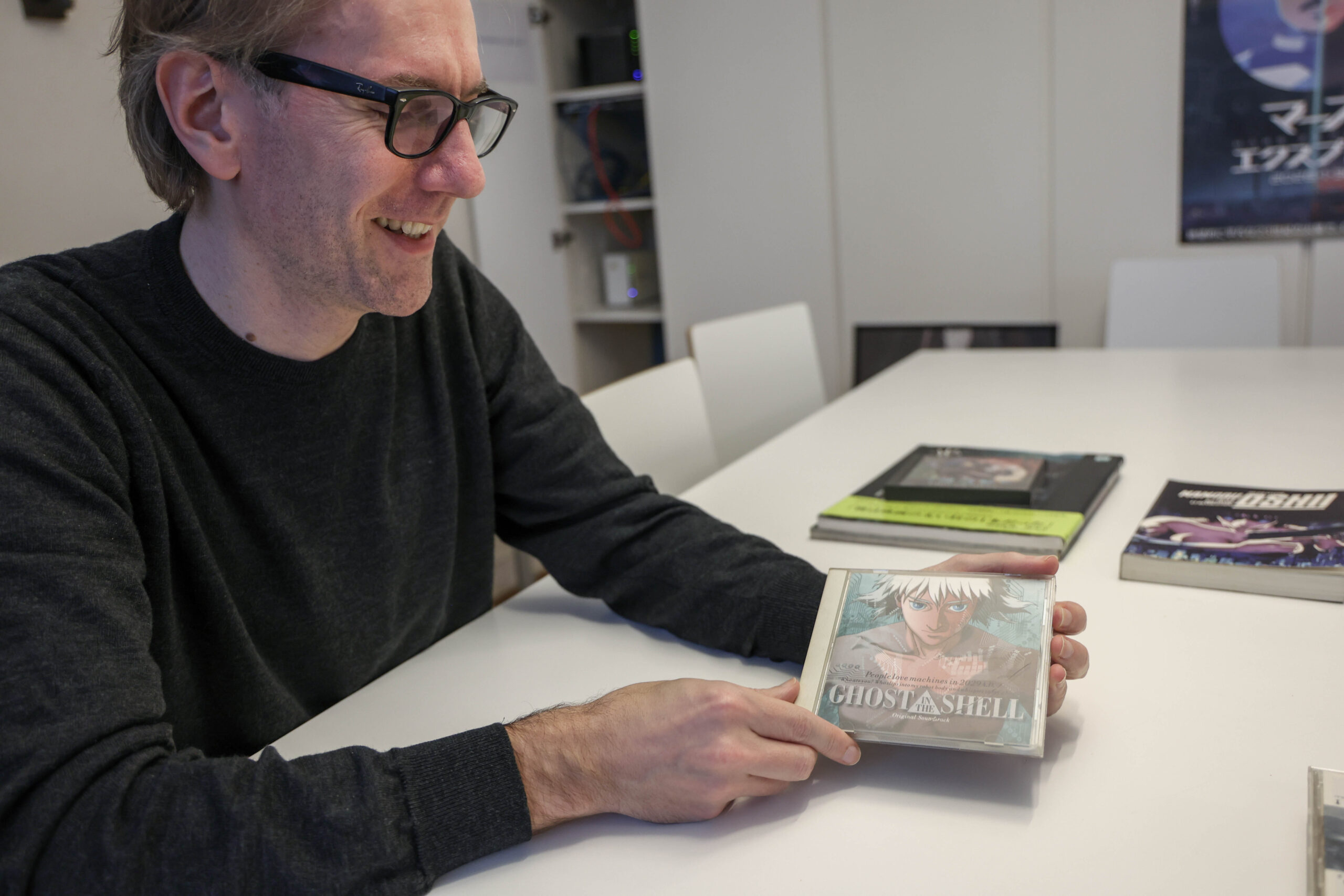
Jérémie Périn acquired the film’s soundtrack after watching it on VHS, even before its theatrical release in France. For a film whose dialogue he didn’t understand, it was the music that made an impression. This is the Japanese edition of the CD, which he listened to extensively. He later purchased the soundtrack for the second film before even seeing it.
What struck me most was the film’s meditative quality. All those moments of reverie, of suspension, of wandering through the city, have always appealed to me in Oshii’s work and aren’t unique to Ghost in the Shell. I think, alongside Michael Mann, Oshii is probably one of the best directors at portraying the city almost as an existential architecture.
His cinematic experiments didn’t exist elsewhere in animation, neither Japanese nor American. These lateral steps, with a strange, slightly offbeat rhythm, reminded me of Andrei Tarkovsky, while also engaging with political themes reminiscent of 1970s American films.
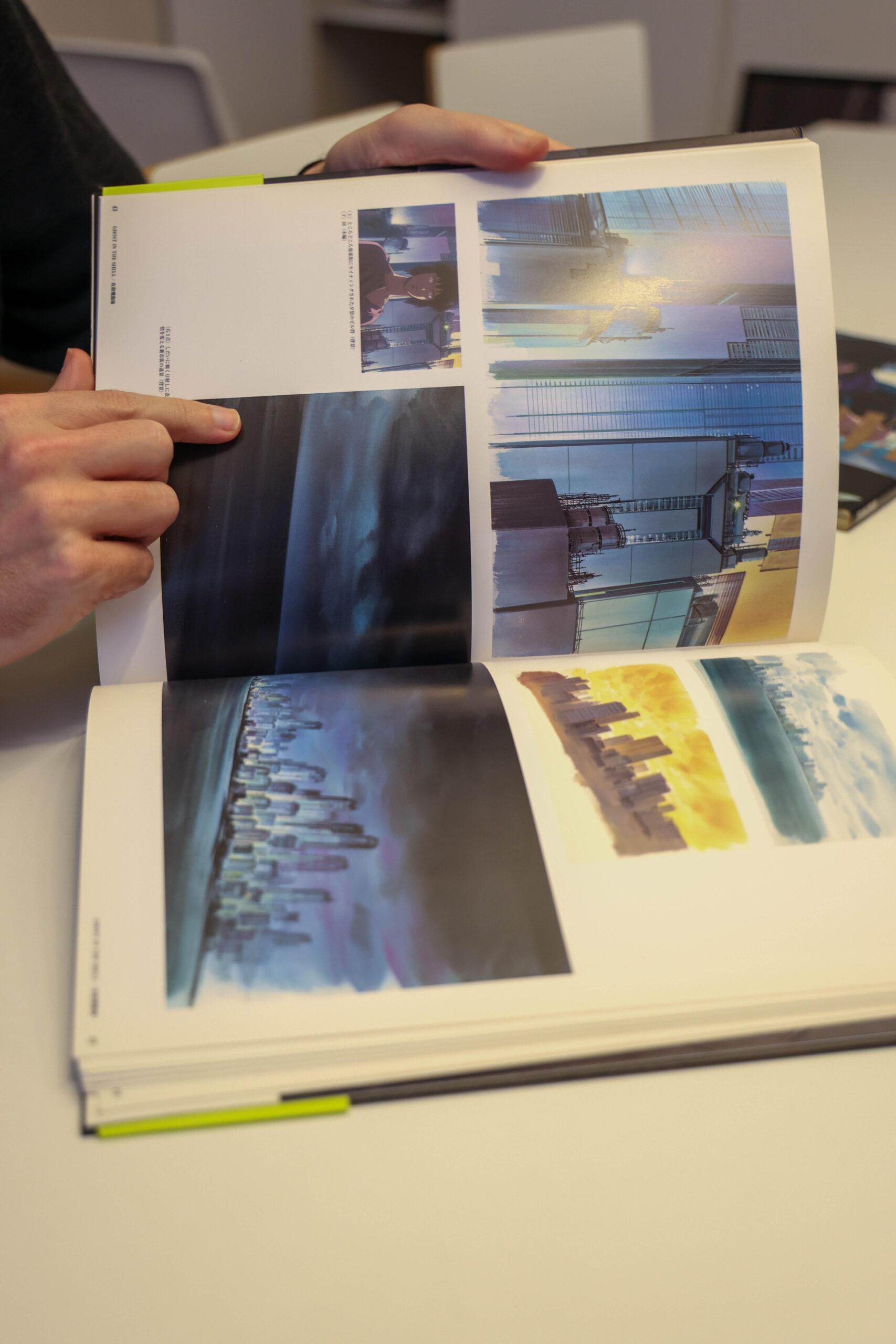
‘Hikari to Kage (Light and Shadow)’ is a book dedicated to Hiromasa Ogura, the art director of ‘Ghost in the Shell’ who designed the film’s backgrounds. Jérémie Périn is particularly drawn to the cityscapes in the film. ‘All the backgrounds in the film are made of cold, uniform buildings, but then, suddenly, you notice the human touch of the brushstroke, and you realize they were created by people.’
It seems the visuals left a lasting impression on you.
The power of Ghost in the Shell lies in how far the film pushed a certain school of drawing: realism, which had begun with Akira. But Oshii’s version was synthetic, simplified, with far fewer shadows, entirely in silhouettes, using clear, simple lines—and yet, incredibly difficult to draw. He employed visual effects to get as close as possible to the characters’ psyche, as if trying to enter their minds without quite succeeding. This aesthetic influenced me greatly, even before Mars Express.
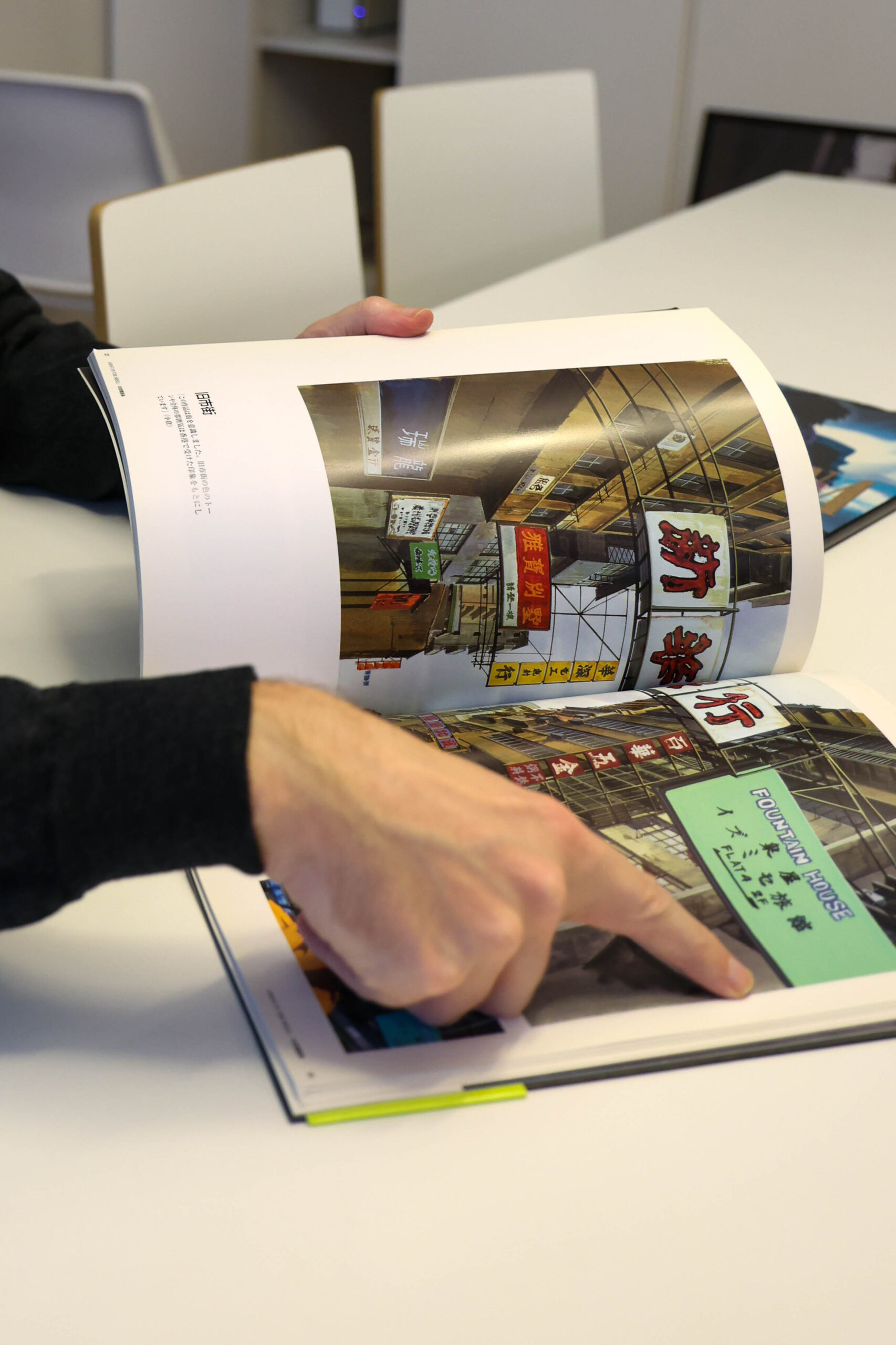
Also in the book on Hiromasa Ogura, Périn notes the moments when the backgrounds seem to extend beyond the frame, with brushstrokes trailing into emptiness, ending nowhere.
Of course, there had been earlier attempts at adult-oriented animation with realistic visuals, such as René Laloux’s French film Time Masters (1982), based on Moebius’s drawings. But their graphics were more fragile, and it was clear the animators at the time did not have that same cultural grounding, as Western animation tends to be more cartoonish, more Disney-like. Transitioning to animation with this kind of drawing is more delicate because it’s harder to maintain coherent volumes in faces. Much more so than drawing Mickey, for example, whose design had been standardized so different artists could reproduce it. In Japan, almost everything is hand-drawn, requiring animators to be able to reproduce it without guides. They gained experience and a level of mastery that put them ahead of the rest of the world. Only now are we finally able to approach that level.
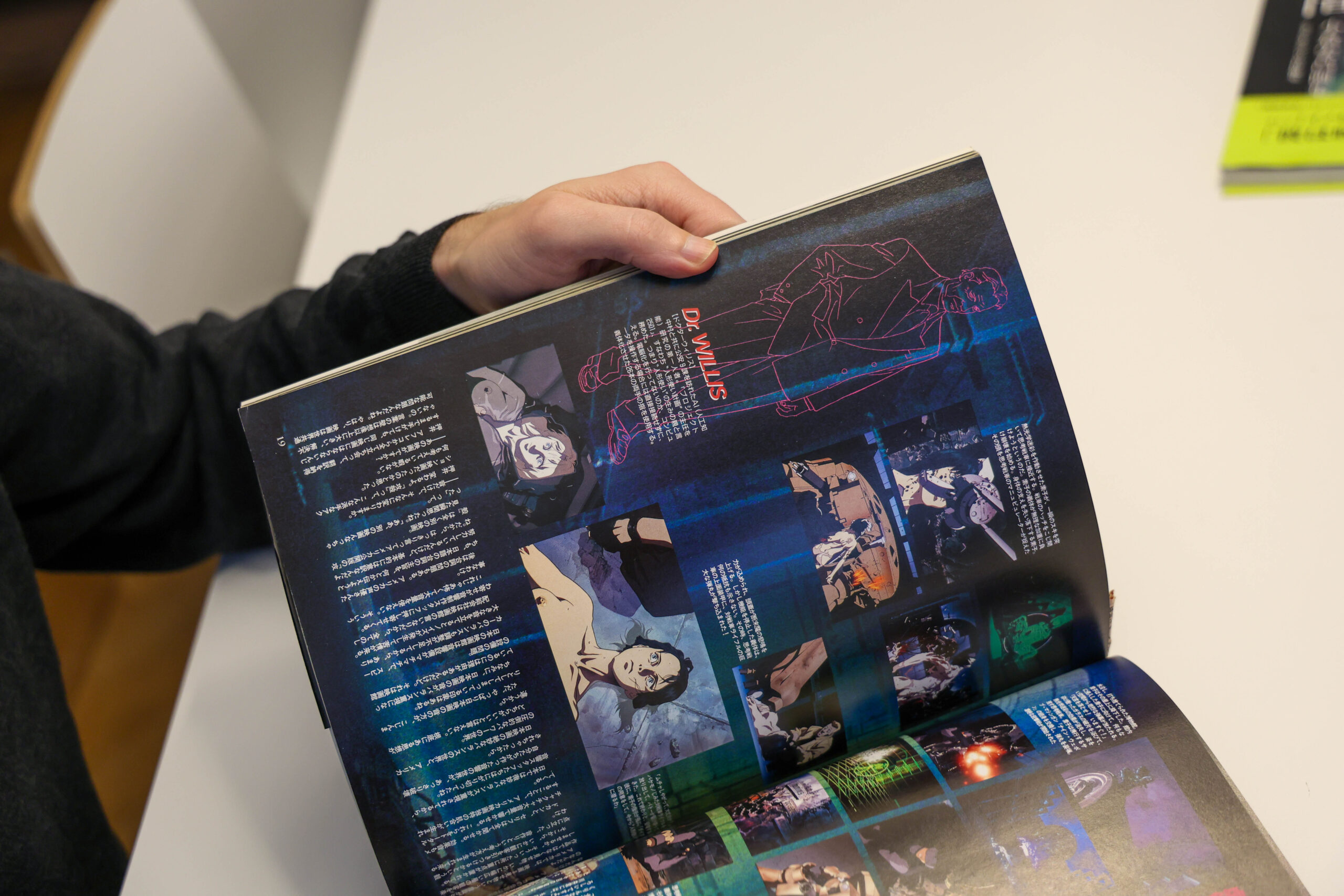
Jérémie Périn purchased ‘Persona — The World of Mamoru Oshii’, a book devoted to the director’s work, for one particular element: it includes model sheets from the film. Normally, there are several for each character, showing different angles and poses. This book, however, presented only one at a time. While the features are not entirely clear, the sheets still offer clues about the level of drawing required to convey the character to animators. At the time, Périn was not yet a student of animation but enjoyed analyzing how the folds of sleeves, the drape of pants, or the dynamics of curves were represented.
This realism is evident in Mars Express, particularly in how the characters’ expressions convey a wider range of emotions than is usually seen in science fiction. Humor also plays a significant role. This dimension was, for instance, absent from the film version of Ghost in the Shell, though present in the original manga. Why is this important to you?
Humor makes the film feel even more realistic, in my view. In real life, we joke, or strange things happen unexpectedly, and it’s funny. Including humor felt essential to create a tangible universe that viewers could relate to.
As for expression realism, I wanted to represent what I call ‘intermediate expressions.’ These are expressions that are neither fully happy nor sad—for example, when a character is unsure where they are, or when a photo is taken at the wrong moment and they look awkward. In animation, the same iconic expressions often recur: a wide-open joyful mouth, clenched teeth and furrowed brows.
Another challenge is creating characters of a precise age. Sometimes animators hesitate to draw wrinkles because they fear it will age the character too abruptly or make them unattractive. As a result, characters often end up as children, adolescents, adults, or elderly. Intermediate ages are harder to convey. I struggled to make Aline someone in her early forties. By working on her silhouette, I wanted it to be felt—when she turns her head—that her cheeks are slightly hollowed, more than what one might imagine seeing her face-on. Her posture and acting are designed differently than if she were a younger character running everywhere. Her eyes are always slightly narrowed, with tiny pupils, reminiscent of a character from Patlabor 2, giving her a somewhat world-weary, lived-in quality.
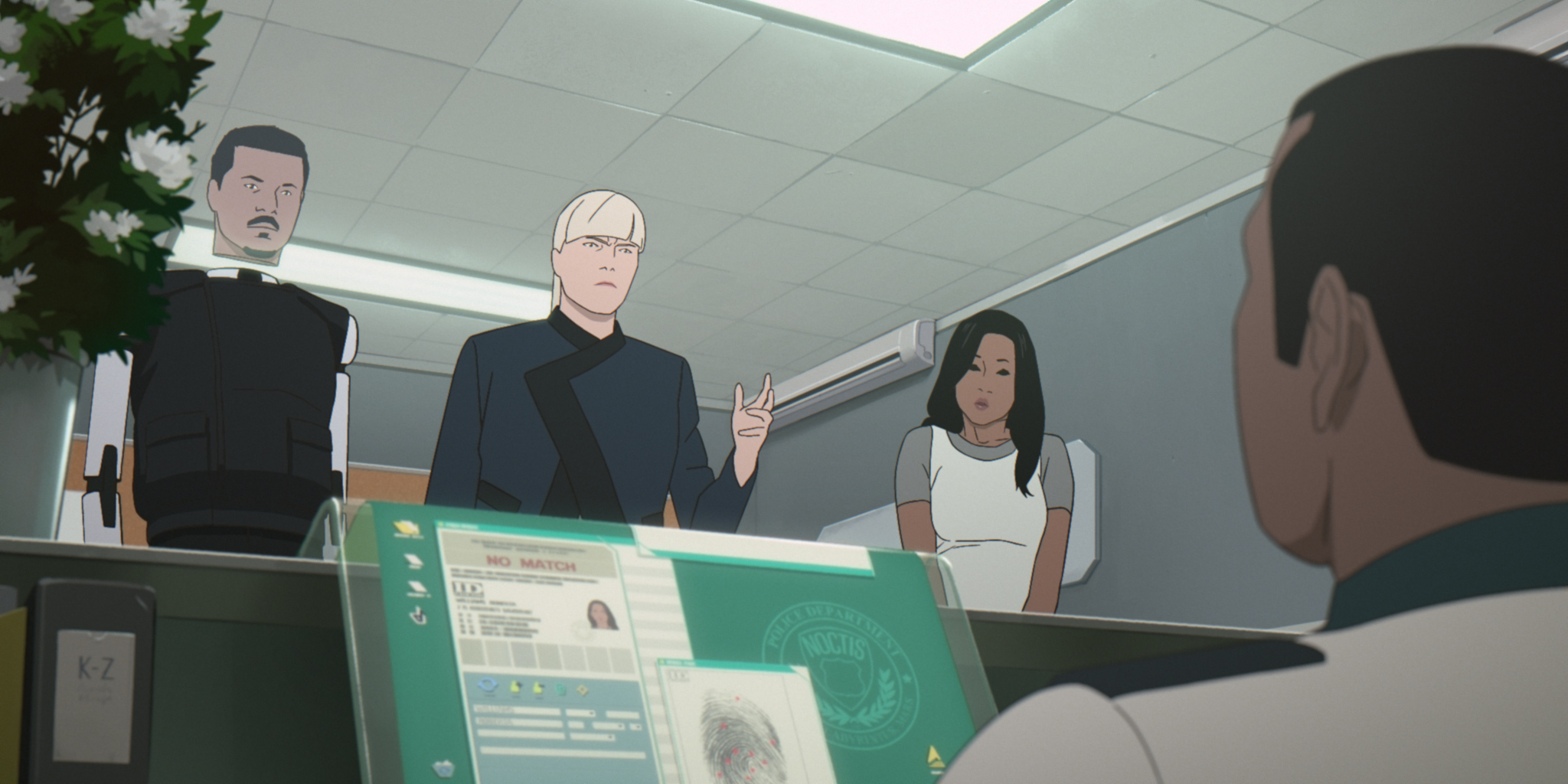
In ‘Mars Express’, characters display a wide range of emotions, not always flattering, reflecting the reality of their lives. Aline, at the center of the image, resists addiction, while Carlos, on the left, grapples with a violent past. © Everybody on Deck - Je Suis Bien Content - EV.L prod - Plume Finance - France 3 Cinéma - Shine Conseils - Gebeka Films – Amopix
In Ghost in the Shell, the urban setting was inspired by Hong Kong. Your depiction of the future on Mars is quite bold and deviates from typical dark, sprawling futuristic cities. Why choose a landscape closer to California?
Art director Mikael Robert pushed this idea very far. We wanted to contrast Earth, vertical with tightly packed buildings, with Mars, which is horizontal and low-rise. On Mars, you can see the horizon; it’s more colorful and appears utopian—though, in reality, it’s a mirage.
We were inspired by Los Angeles, because it embodies the idea of the new frontier, the last frontier. It evoked American explorers who traversed the country to reach the sea. In Mars Express, humans leave Earth to colonize another planet. We even see them sending probes in search of other planets, though none truly exist. They’ve already reached the limit of what they can accomplish.
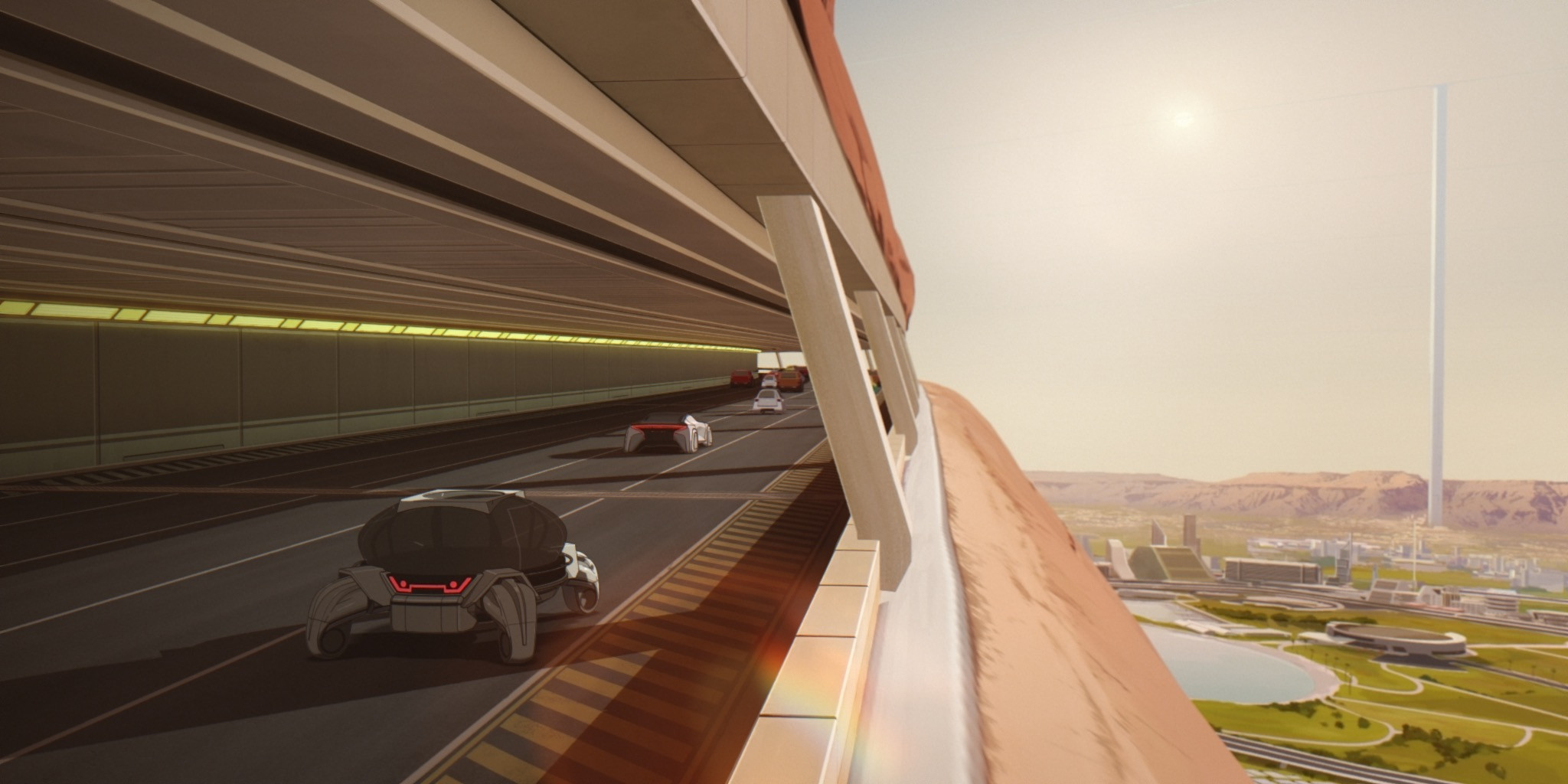
Noctis, the capital of the human colony on Mars, unfolds as a colorful, appealing cityscape inspired by California. It is meant to convey the grandeur of technological progress. Its precise location on Mars, in the Noctis Labyrinthus lava tunnel, was suggested by a planetary scientist. Committed to hard science fiction, Jérémie Périn and his team ensured that the universe was as realistic and coherent as possible. They developed multiple generations of robots and vehicles: from the geometric designs of the older models to the sleek curves of modern machines, while the latest generation is almost organic in form. © Everybody on Deck - Je Suis Bien Content - EV.L prod - Plume Finance - France 3 Cinéma - Shine Conseils - Gebeka Films – Amopix
Could the final frontier be immortality? Here again, this is a quest seemingly fulfilled in Mars Express, as humans can continue to exist through the Saved. Conversely, do robots inevitably aspire to some form of humanity, as in Ghost in the Shell?
At the start of writing, there was only one main character. Then the theme of robots and their emancipation entered the story, becoming central. We realized that if there were only a human character, the viewer would have only an outside perspective on the film’s end, without experiencing the world among the robots. It therefore seemed important to have a duo consisting of a robot and a human.
I don’t think it’s a good idea to give machines emotions. But the film acknowledges that it could happen. Robots are the way they are because humans made them. Humans make things in their own image. Robots must be practical for humans. We often wondered why robots are always humanoid. But why would they be otherwise? They need to pass through the same doors as us, navigate our spaces. If we started designing them with four heads and wheels in all directions, they could never coexist with us. Likewise, robots have faces or screens even though they don’t need them for themselves. It’s humans interacting with them who require interfaces. All these interactions make robots resemble us, and even give them humor.
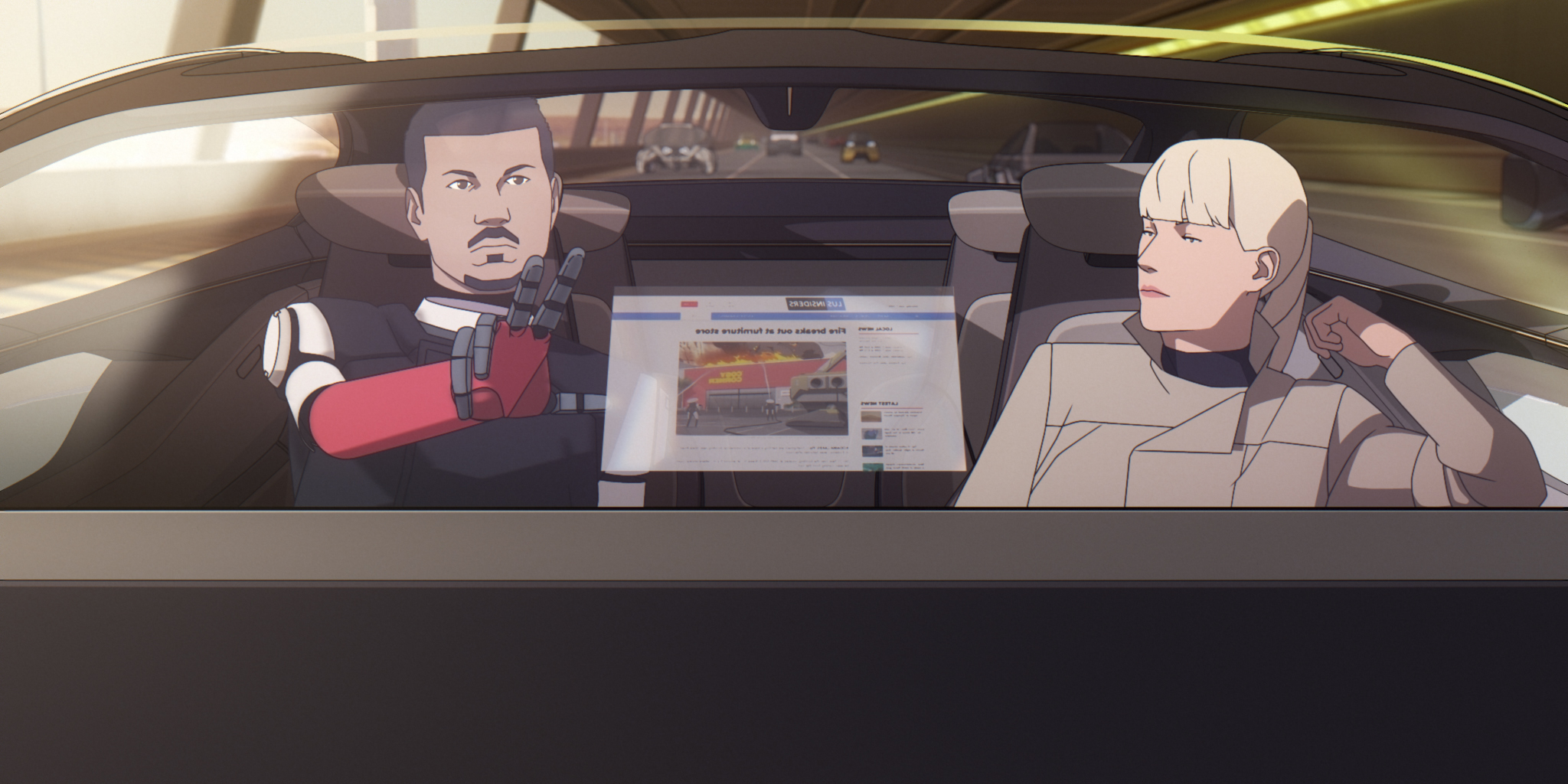
Carlos, a ‘Saved’ who inherits the personality of Aline’s former partner, repeatedly displays a mischievous, human-like sense of humor in ‘Mars Express’. His story also carries the imprint of a desire to form a family, despite a turbulent past. © Everybody on Deck - Je Suis Bien Content - EV.L prod - Plume Finance - France 3 Cinéma - Shine Conseils - Gebeka Films – Amopix
What do you expect from the Japanese reception of your film? Did you give any specific instructions for the dubbing?
I requested the film be dubbed as if it were live-action, not an animated feature. My wish was respected, and I’m satisfied. In fact, the only time I watched the film in full again was in Japanese, and I had the hilarious feeling that I understood everything!
I hope Japanese audiences enjoy Mars Express. If I may dream a little, I would like it to revive the desire to make adult-oriented animated films. I may be wrong, but it feels to me that Japanese animation has become far more family-focused than it once was. There don’t seem to be many films I would call auteur works, though that is subjective—ambitious and original. I feel that this side of Japanese animation closed with Satoshi Kon’s death. But perhaps that’s just my memory and my nostalgia speaking.
Mars Express (2023), a film directed by Jérémie Périn, is available for purchase or rental on the G-Kids website.
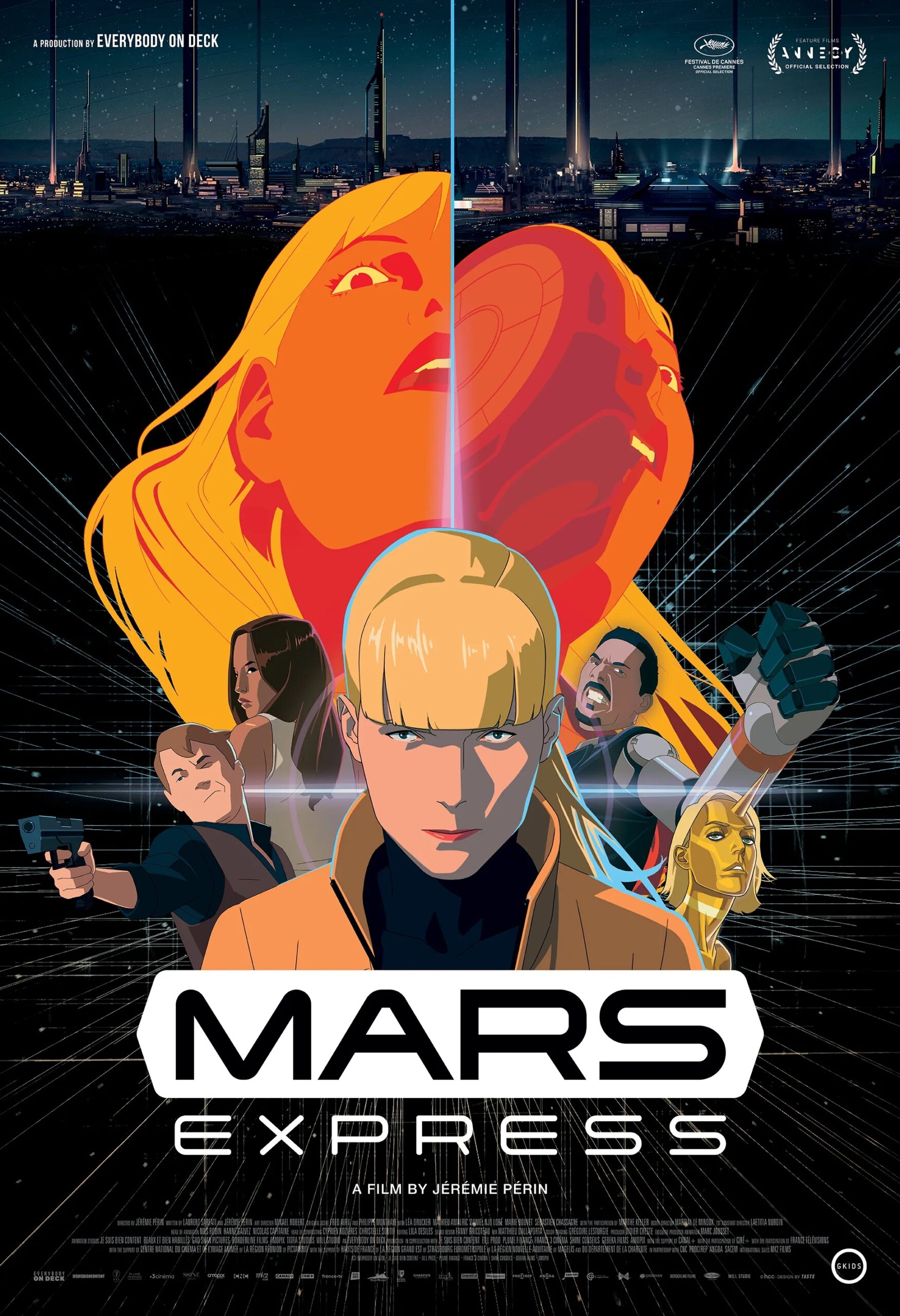
‘Mars Express’, a film directed by Jérémie Périn © Everybody on Deck - Je Suis Bien Content - EV.L prod - Plume Finance - France 3 Cinéma - Shine Conseils - Gebeka Films – Amopix