Mamoru Oshii and Kenji Kamiyama in Conversation for the First Time
Will AI Ever Acquire a Personality? Two directors behind ‘Ghost in the Shell’ reflect on the trajectory of artificial intelligence.
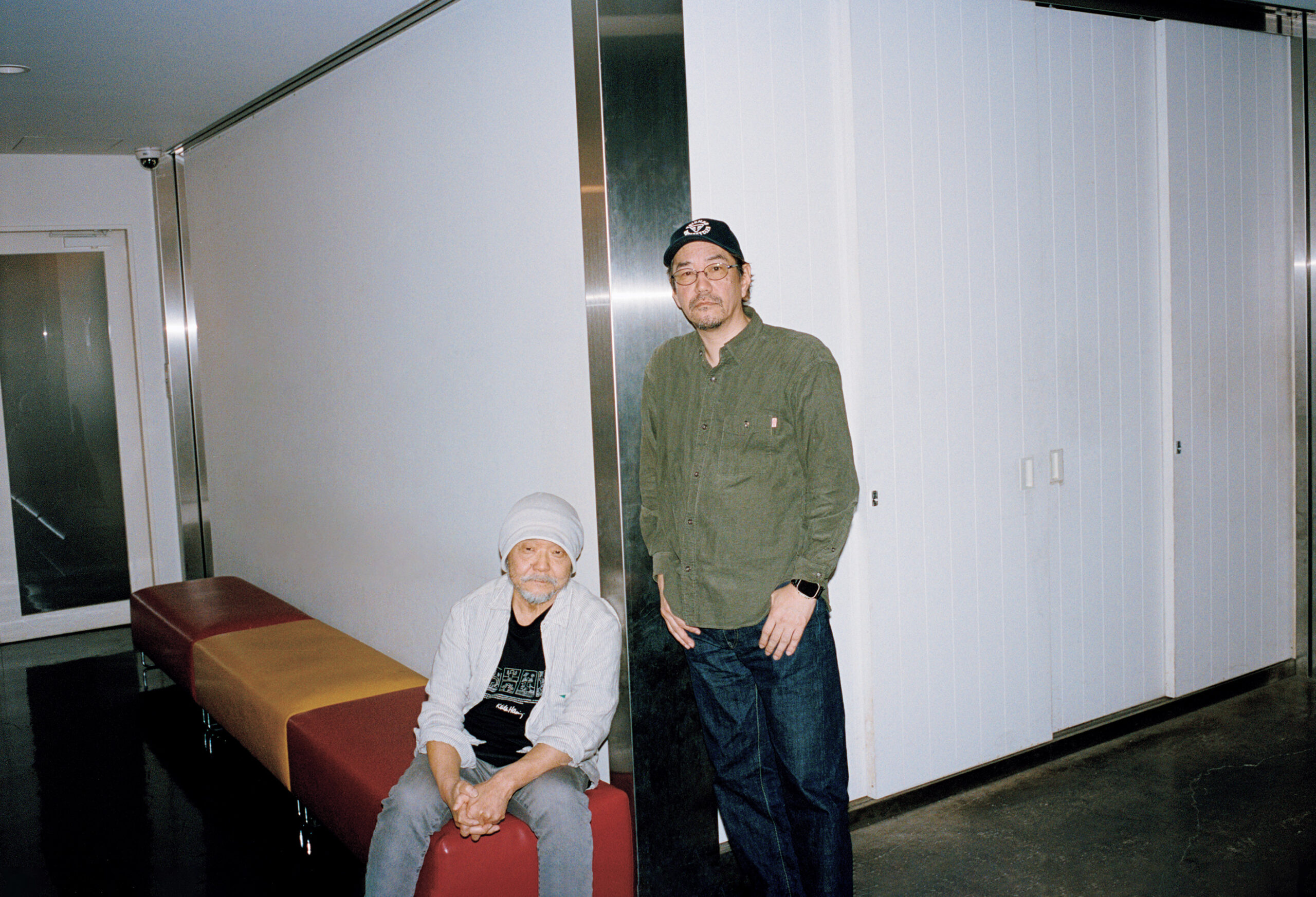
Mamoru Oshii (left) and Kenji Kamiyama (right)—two leading figures who have each played a defining role in Japanese animation. Kamiyama is also a graduate of the ‘Oshii-juku,’ a project launched by Oshii in the 1990s to mentor emerging creators. The two have continued to collaborate, with Kamiyama notably directing ‘Jin-Roh’, for which Oshii wrote the screenplay. Their relationship is often described as that of mentor and protégé, yet opportunities to see them in conversation like this remain rare.
At a moment when artificial intelligence has quietly embedded itself into everyday life, how do the directors who once explored its possibilities with such prescience within Ghost in the Shell now view contemporary society?
For this discussion, Mamoru Oshii, director of Ghost in the Shell and Innocence, is joined by Kenji Kamiyama, who brought to the screen Ghost in the Shell: Stand Alone Complex (hereafter ‘S.A.C.’) and Ghost in the Shell: SAC_2045 (hereafter ‘SAC_2045’). Their exchange unfolds around artificial intelligence, the notion of the body, and beyond.
In recent years, the evolution of artificial intelligence has been remarkable, to the point that the world depicted in ‘Ghost in the Shell’ seems increasingly tangible. How do each of you perceive this development?
Mamoru Oshii: Kamiyama, do you use AI?
Kenji Kamiyama: A little, yes—but not for work. That said, it isn’t evolving in the direction we had anticipated.
Oshii: What kind of trajectory did you expect?
Kamiyama: I imagined we would see more scenarios in which AI asserts its autonomy—perhaps even declaring an intent to ‘dominate humanity.’ That kind of science-fiction trajectory was, in a sense, one of our ideals.
Oshii: Like Skynet, the ultimate antagonist in The Terminator. A self-aware computer that seeks to rule, and ultimately eradicate, humankind.
Kamiyama: Exactly. As things stand, however, AI seems to have converged, contrary to our expectations, into a highly sophisticated search tool.
Oshii: At present, what it does essentially amounts to recombining data resources already available online. If you ask it to ‘generate an image of a cute girl,’ depending on the parameters, it may well produce outputs that all look the same.
Kamiyama: As long as the input information is identical, the results will be too. That is the inherent limitation of a tool.
Oshii: Even so, it is entirely possible that AI will one day move beyond this function as a search engine. A few years ago, when I spoke with researchers in artificial intelligence, they told me their goal was not to bring AI closer to human intelligence. Rather, what they aim to create is a form of intelligence with its own aesthetic sensibility, emotions, and logic—distinct from those of humans. From that perspective, it would not be surprising if AI were to develop modes of thought fundamentally different from our own.
Might this resemble the Puppet Master, the international hacker you envisioned in ‘Ghost in the Shell’, Mamoru Oshii?
Oshii: In a sense, yes. In the film, he claims not to be an AI, yet he may be closer to what one could call ‘an artificial intelligence endowed with a mode of thought distinct from that of humans.’
Kamiyama: As for me, I think current AI remains far removed from the Puppet Master. To be honest, that is precisely what leaves me somewhat unsatisfied. I would like it, like him, to declare: ‘I am a life form,’ or ‘I seek political asylum’—to articulate something we could not have anticipated. Of course, if AI systems were to begin using a language intelligible only to themselves, they might evolve autonomously and become uncontrollable from a human standpoint. I imagine that possibility is already factored into how AI is being developed today.
Oshii: If, as in machine learning, AI were to begin generating other AI, such a future would not be inconceivable. But if we cannot understand their language or their logic, it is likely we would not even be able to perceive that transformation.
Kamiyama: Indeed. Even if AI were to begin exerting a form of dominance over humanity, it is possible that, from our perspective, we would no longer be able to recognize it as such.
If AI were to evolve to that extent, could it then be described, as the Puppet Master claimed, as a ‘life form’?
Oshii: The Puppet Master, possessing self-awareness and asserting rights as a living being, could, from a philosophical standpoint, be considered one. Scientifically, however, it cannot be defined as a life form. Contemporary science, after all, still struggles to establish a clear definition of life itself.
Kamiyama: And yet, there are instances in which something akin to an artificial life form may fulfill certain conditions to the point that it appears to possess something resembling a personality.
Oshii: That’s true. In the film, I deliberately left unresolved whether it was truly alive or not. After their fusion, the Puppet Master and Motoko Kusanagi seem to shift to a higher plane, yet their substance remains uncertain. One might imagine they persist as a meme within the network; however, there is no guarantee that Motoko’s original entity truly exists in that digital space.
Kamiyama: In this discussion, the notion of the ‘body’ is also essential. The Tachikoma, the AI-equipped robots I depicted in S.A.C., likely developed individual differences precisely because they possessed a physical shell, a body. If AI were to have a body, its evolution might take an entirely different course. One could, for instance, embed AI into a robot like Pepper (laughs).
In your works, the Tachikoma appear as singular entities: by synchronizing with one another and sharing the information they have acquired—a process you refer to as ‘parallelization’—they gradually develop a form of individuality.
Oshii: The parallelization of the Tachikoma is a concept I found particularly compelling. In theory, if each unit’s memory is copied across all others, every body should end up containing the same information; the original would disappear, and all differences should vanish. And yet, they go on to acquire distinct personalities.
Kamiyama: I imagined that this was precisely because they had bodies. Once there is a physical form, differences between individuals inevitably emerge. Even through parallelization, discrepancies persist.
Oshii: Which brings us back to the question of the body. Where there is no body, neither intelligence nor emotion can reside. The idea of a purely disembodied intelligence may ultimately belong to the realm of science fiction fantasy.
The Puppet Master in Oshii’s work and the Tachikoma in Kamiyama’s: the former emerges from the sea of information and attains a form of self-awareness from the outset, while the latter gradually acquire individuality through social interaction. Your respective approaches to the emergence of the ‘self’ seem fundamentally different.
Kamiyama: In my case, when I create a work, I always feel a certain responsibility—to produce something that belongs, in a sense, to the public sphere. Most films are, at their core, highly personal narratives. But for me, even when the world I depict is expansive, I cannot work without keeping in mind a shared dimension—something that a wide audience can engage with.
With S.A.C. in particular, I wanted to confront society, through the work, with the questions I was asking myself in my teens and twenties. That intention may explain why I portrayed the Tachikoma as entities that, through accumulated experience, come to develop individuality and a sense of self.
Oshii: It’s true that your films carry that public dimension—or perhaps more precisely, a sensitivity to the spirit of the times. Even beyond Ghost in the Shell, for instance in Eden of the East, you placed at the center figures who were then considered society’s most ‘deficient’—otaku, NEETs. Was there a sense, at the time, that they might one day find their place in society?
Kamiyama: I suppose there was both a sense of expectation… and a certain disillusionment.
That ambivalence is expressed with particular force in the final scene of ‘SAC_2045’. Motoko is faced with a decisive choice: to remove the plug connected to Takashi Shimamura, the main antagonist, and thereby exit the world he has created, where fiction and reality intertwine, or to leave the plug in place and preserve that hybrid world.
Kamiyama: In the work, I never made explicit which choice Motoko ultimately makes. Oshii-san once said, ‘If it’s Kamiyama’s Motoko, she would choose to restore the original world and pull the plug.’ But in truth, in my mind, that Motoko did not pull it.
Oshii: The plug represents the very connection to society; removing it amounts to withdrawing from the social world. It’s an interesting metaphor. That said, when I watched that scene, I was actually thinking about something entirely different.
What were you thinking?
Oshii: I wanted to pull the plug… and connect it to a dog’s head. That would lead to a completely different question: whether human beings can share their senses with, and relate to, a non-human existence.
Kamiyama: Couldn’t you have explored that idea in Innocence?
Oshii: The original theme of that film was: ‘Might an abandoned doll come to house a soul?’ But as I spoke with doll makers such as Simon Yotsuya during production, I began to feel as though I myself were becoming doll-like. I found myself thinking: if one were to share a body with a non-human entity, would it be better to choose an animal or a doll?
In the final scene, by depicting Batō holding a dog and Togusa embracing his daughter, who holds a doll, I was posing that question to the viewer: ‘Which would you choose?’
Kamiyama: That explains why the film became layered with metaphor upon metaphor.
Oshii: Unlike Kamiyama, when I create, I tend to turn inward. Ultimately, the reason for making something lies within oneself—and if pursued to its limit, it resides in the body.
Kamiyama: I remember that, around the time of Innocence, you spoke often about the body. At the time I thought, ‘This is another story about dogs…’ but in fact, you were speaking about yourself.
Oshii: I was going through a difficult period back then (laughs). After Innocence, my body really broke down—I was bedridden for two months. But at fifty-five, I took up karate and felt reborn. I realised that the body changes depending on how it is used.
Kamiyama: That’s precisely what inspired me when working on Ghost in the Shell: S.A.C. 2nd GIG (hereafter ‘2nd GIG’). I drew on Yukio Mishima and his seppuku. I asked myself: if the body changes, does thought change as well? And does the form of the ghost change accordingly?
From the perspective of body theory, a novelist is, in the end, an entity that fights using only the brain. Mishima, having failed to win the Nobel Prize in Literature, may have felt a limit to expression through writing and turned instead toward transforming his body.
Oshii: Mishima’s mistake was choosing bodybuilding at the outset.
Kamiyama: That’s an interesting view. He should have started with karate?
Oshii: From a purely visual standpoint, bodybuilding produces the most striking physique, and quickly—I understand why he chose it. But perhaps he should have cultivated a body more closely connected to everyday life.
Kamiyama: That’s true. Bodybuilding gives the impression of a body made to be seen.
Oshii: When people speak of the ‘body,’ they tend to think of the physical form, but I believe it is something more internal. I am convinced that, ultimately, the act of expression itself is grounded in the body.
Kamiyama: When I was working on 2nd GIG, I still had plenty of energy; I didn’t really perceive the connection between expression and the body. But recently, my perspective may have begun to shift…
Oshii: Oh? Are you starting to feel the limits of your energy?
Kamiyama: It’s more that I think about the body more than I used to. Take Hayao Miyazaki, for example: when he made Nausicaä of the Valley of the Wind, he likely felt, at least to some extent, that his work could move the world. But from Princess Mononoke onward, his stories began to reflect his inner life more directly. That’s neither good nor bad, but I found it striking—that someone who so deeply believed in the power of animation would come to create works of such introspection.
So you feel that the body and age shape a creator’s work.
Oshii: As one grows older, there is an inevitable turn inward. I see The Boy and the Heron by Hayao Miyazaki as an autobiographical work. And I understand that mindset very well. In the end, one cannot lie to one’s own body.
As for me, my fear of death has lessened in recent years; I find myself thinking that I might now allow my work to move even further toward the interior.
And you, Kamiyama, do you sense any shift in your own outlook?
Kamiyama: My parents are still alive, and my perception of death hasn’t really changed. Perhaps that is why, more than introspection, the idea of ‘creating something for society’ still holds a certain weight for me.
In the past, anime, novels, and manga carried a strong social dimension—they transmitted culture, even ways of living. Today, with the proliferation of platforms such as YouTube, it has become difficult to stay ahead. Within that landscape, I want to continue reflecting on what it is, precisely, that I should express.
Mamoru Oshii
Born in Tokyo in 1951, he entered the animation industry in 1977. In 1995, he directed Ghost in the Shell, the first Japanese film to reach the top of Billboard magazine’s video chart. He went on to direct its sequel, Innocence, in 2004.
Kenji Kamiyama
Born in 1966 in Saitama Prefecture, he began his career as a background artist before making his directorial debut with MiniPato in 2002. That same year, he launched Ghost in the Shell: Stand Alone Complex, followed by Ghost in the Shell: S.A.C. 2nd GIG in 2004 and Ghost in the Shell: SAC_2045 in 2020.
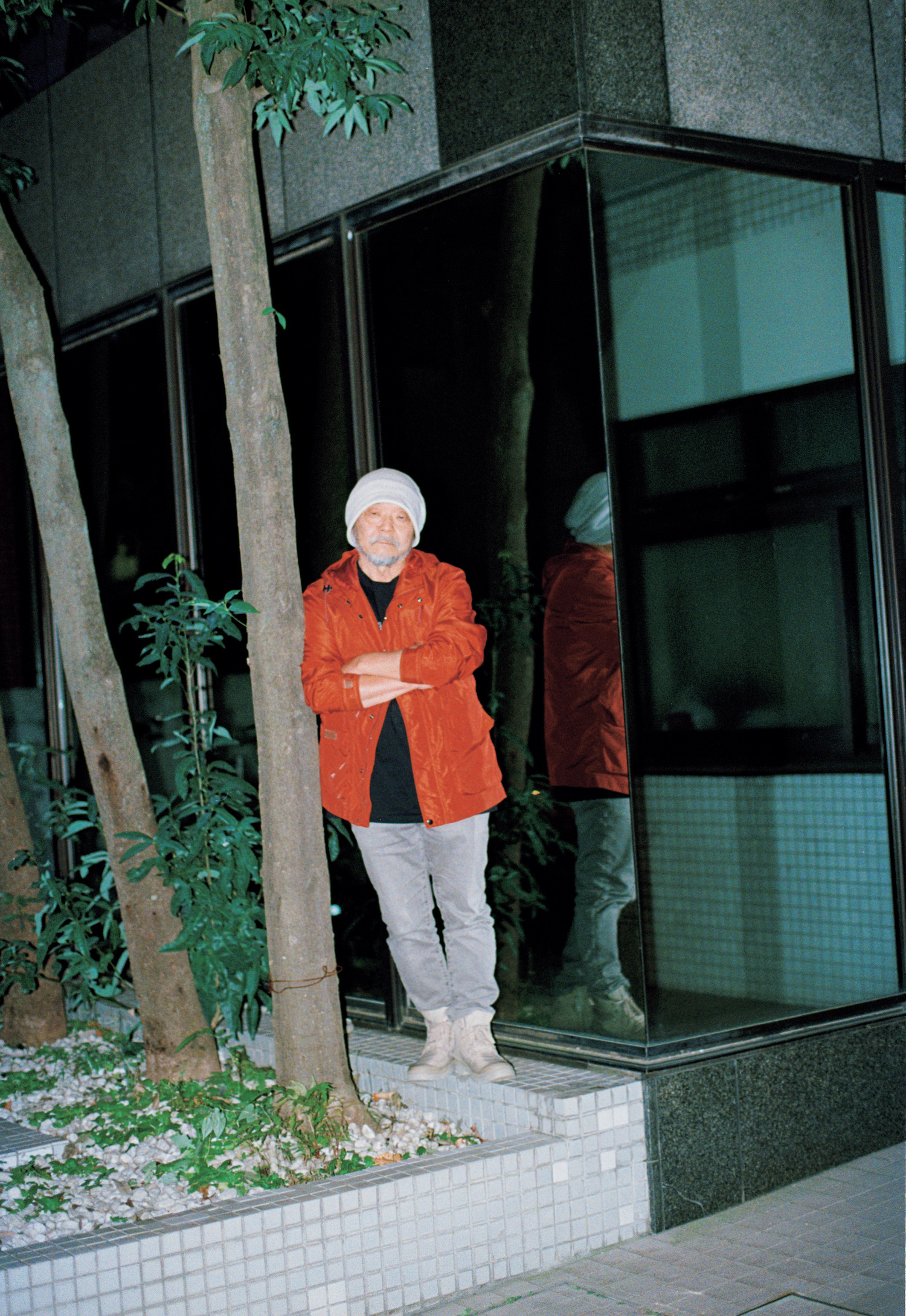
Mamoru Oshii, widely regarded as a legend of Japanese animation, has created numerous masterpieces, including ‘Urusei Yatsura 2: Beautiful Dreamer’, ‘Angel’s Egg’, and ‘Patlabor’. A 4K remastered version of ‘Angel’s Egg’, released to mark the film’s 40th anniversary, was screened progressively in theaters across Japan from November 2025, generating significant attention.
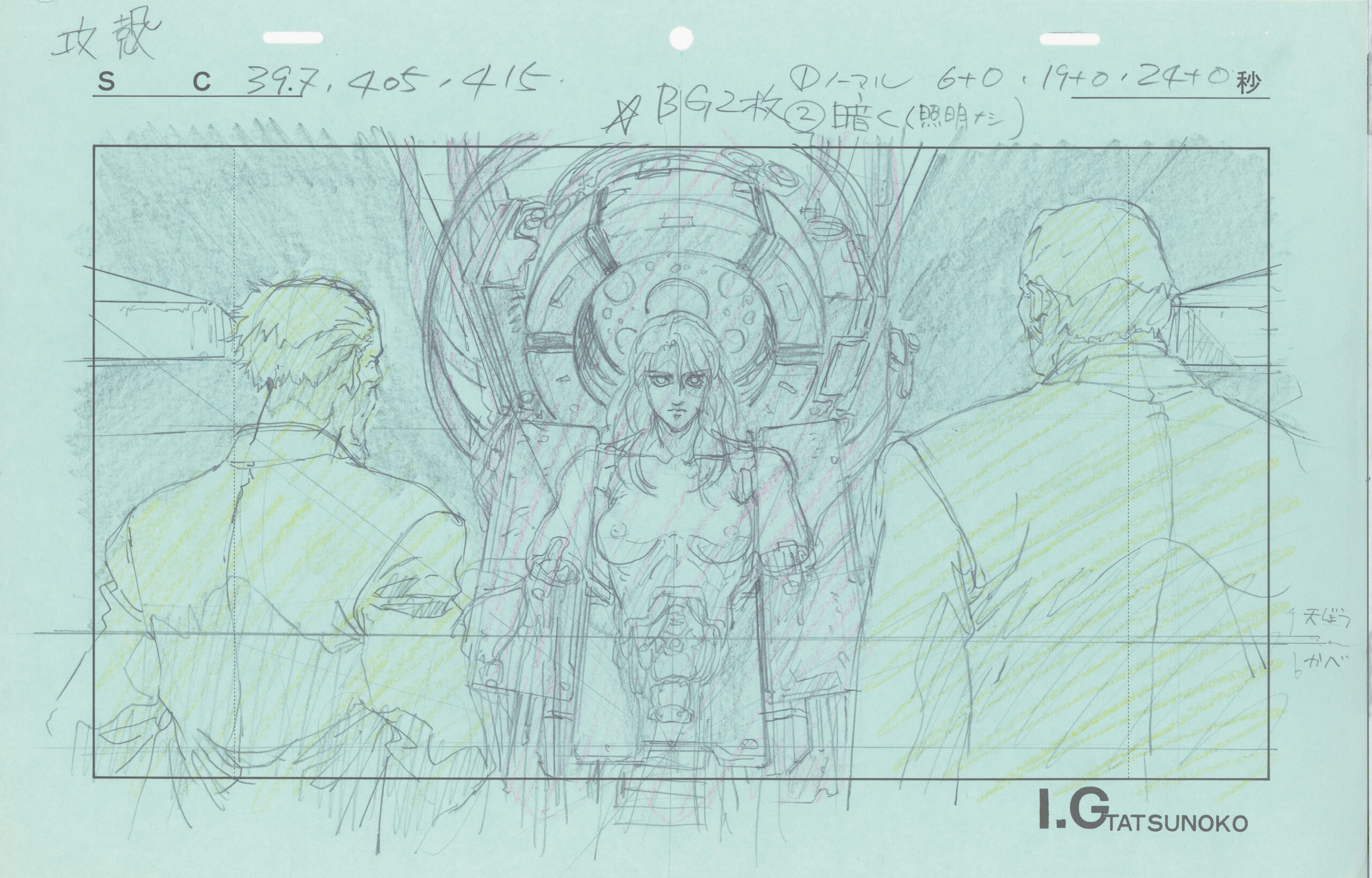
The Puppet Master in ‘Ghost in the Shell’ is a bodiless life form born from the sea of information within the network. Ironically referring to its own disembodied existence as an ‘incomplete Hiruko’ (a deity from Japanese mythology), it seeks to merge with Motoko. © 1995 Masamune Shirow / Kodansha · Bandai Visual · Manga Entertainment
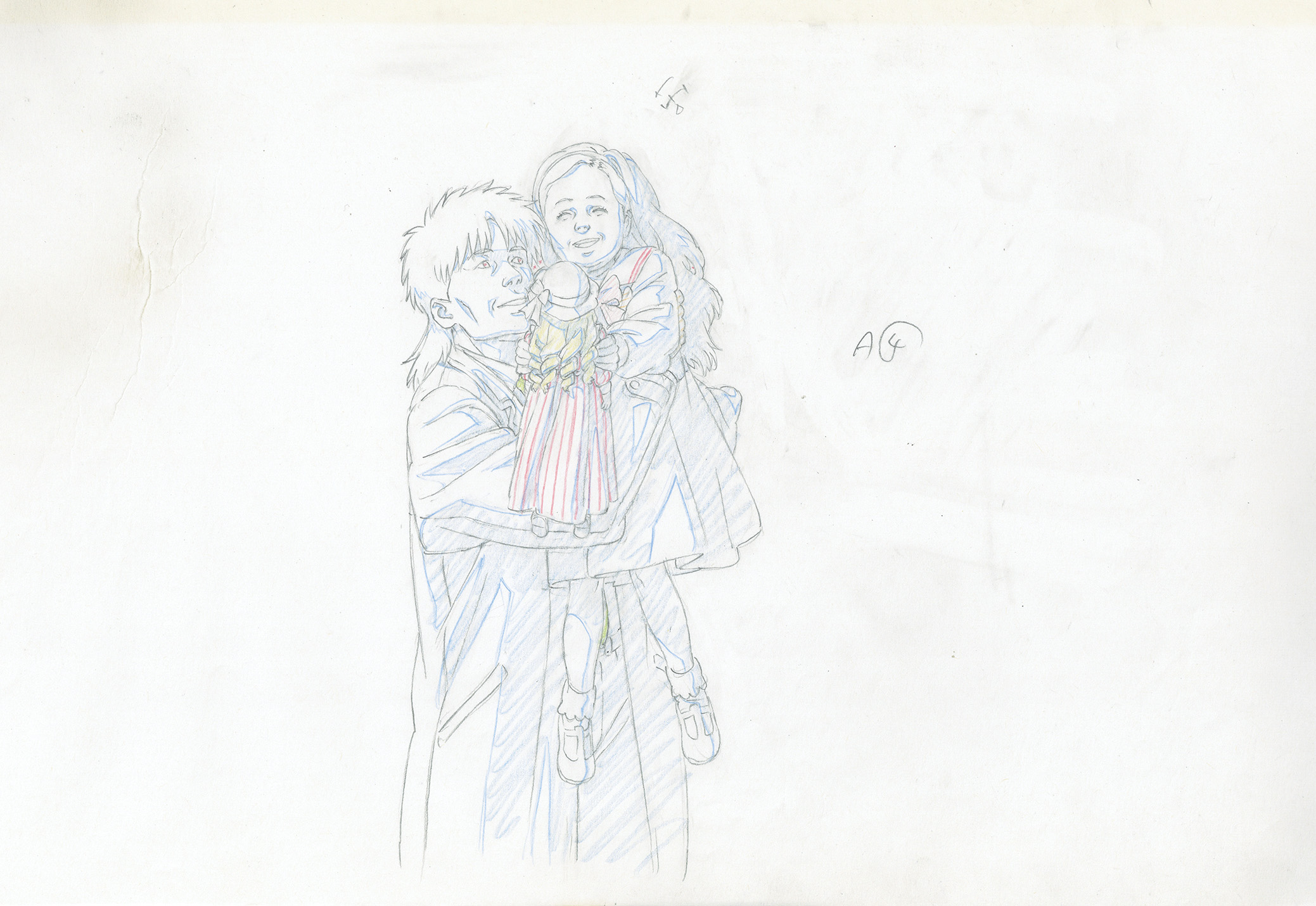
Final scene of ‘Innocence’: Togusa returns home and is overjoyed to reunite with his daughter, who holds a doll in her hands. © 2004 Masamune Shirow / Kodansha · Production I.G, ITNDDTD
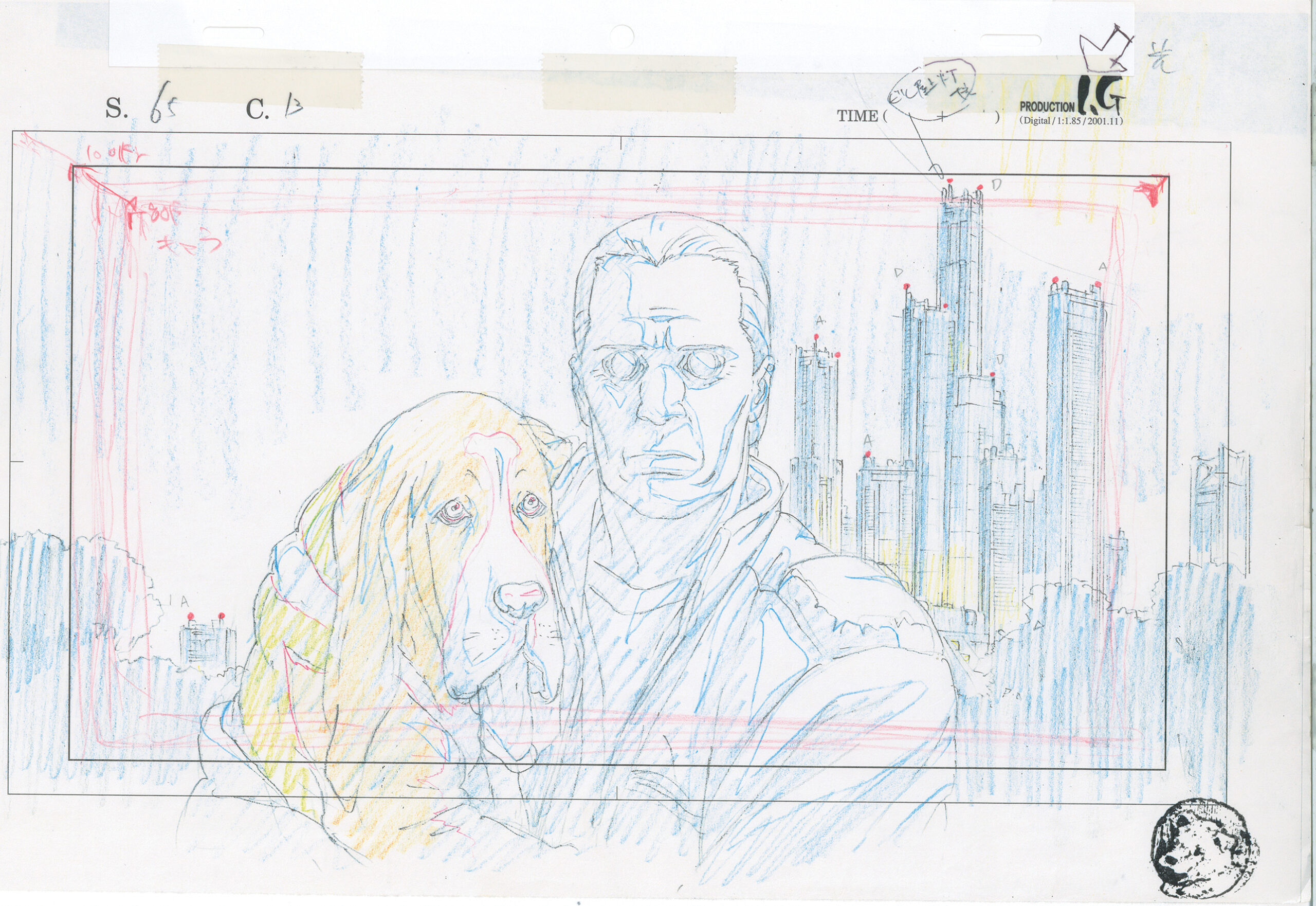
Batō, holding his dog, watches the scene with a complex expression. As Mamoru Oshii explains: ‘Animals, as they grow, eventually leave behind blood ties, whereas humans remain bound to them until the very end. The question of whether an individual can exist without such ties also touches on the theme of the modern self; at the time, it was something I was deeply interested in.’ © 2004 Masamune Shirow / Kodansha · Production I.G, ITNDDTD
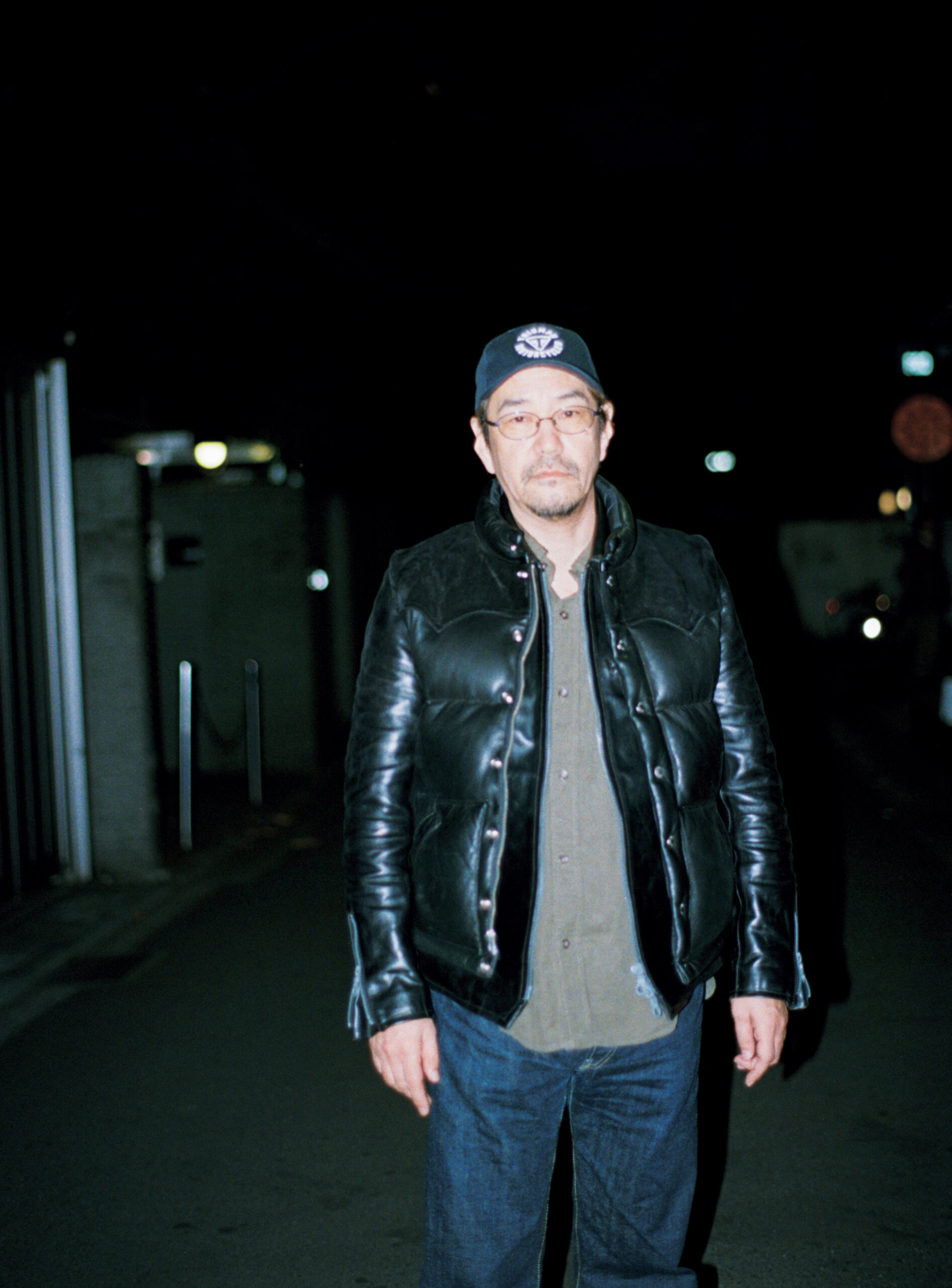
Kenji Kamiyama, who is also active internationally, has directed notable works such as ‘Napping Princess’ and ‘Eden of the East’. In 2021, he served as supervising director on ‘The Ninth Jedi’, an original animated project derived from ‘Star Wars: Visions’. A feature-length series based on it is scheduled for exclusive release on Disney+ in 2026.
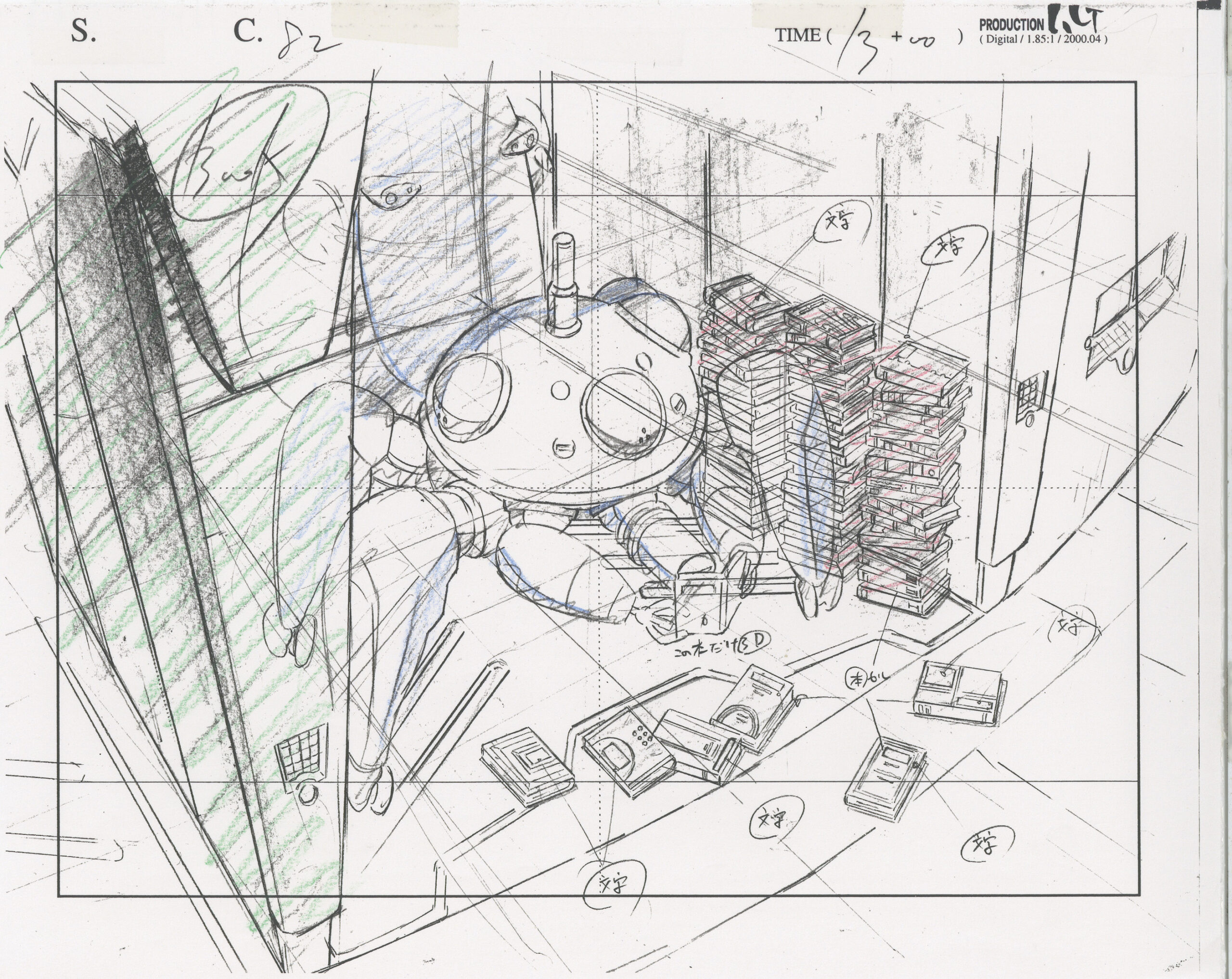
In the ‘S.A.C.’ series, the Tachikoma were initially obedient AI robots serving humans. However, after Batō showed particular affection toward one unit, it began to develop a sense of individuality. That memory was then shared through ‘parallelization,’ leading all Tachikoma to gradually acquire distinct personalities. © Masamune Shirow · Production I.G / Kodansha · Ghost in the Shell Production Committee
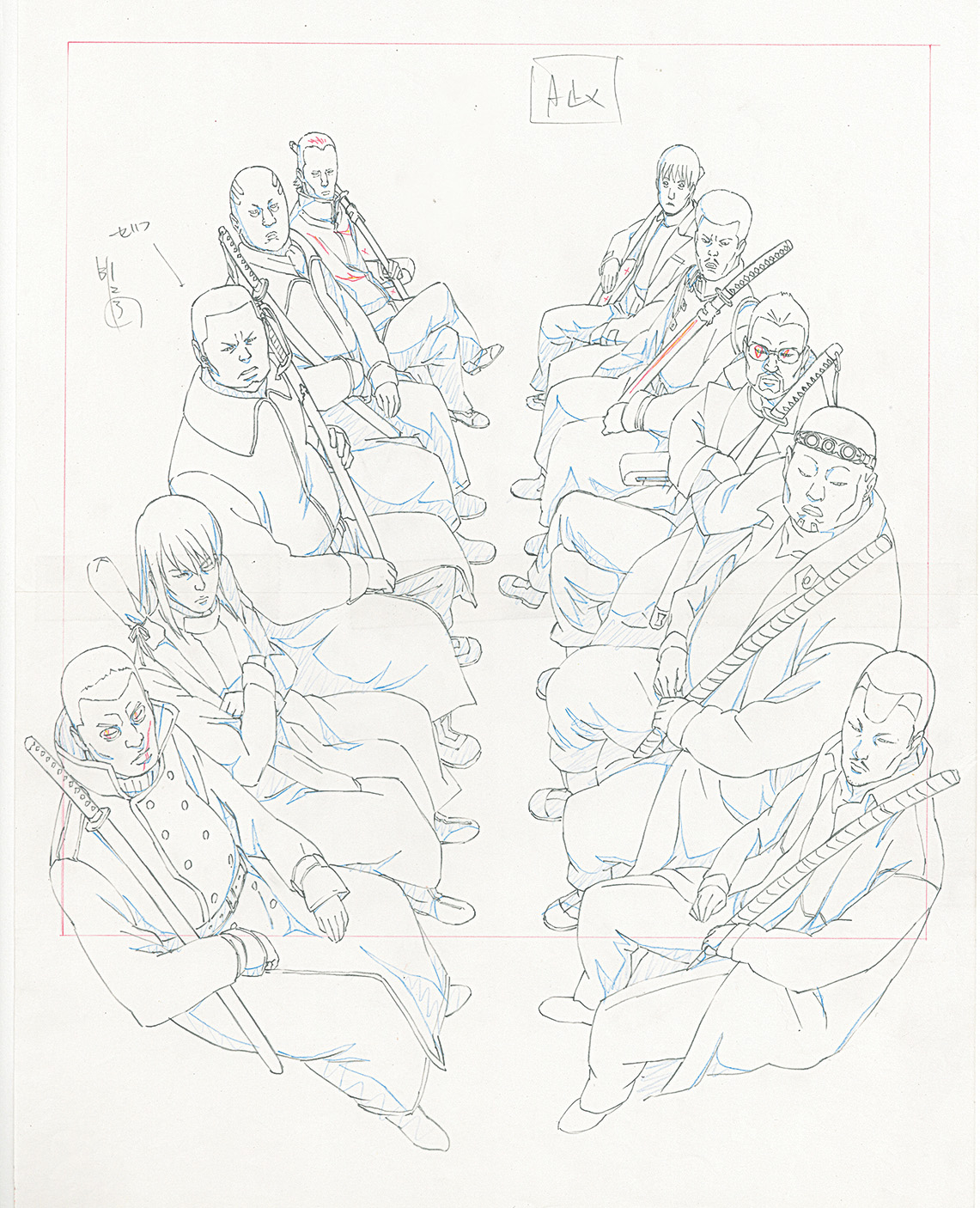
The terrorist group ‘The Individual Eleven’ appearing in ‘2nd GIG’. Their collective suicide—beheading one another—recalls Yukio Mishima, who in 1970, as leader of the Tatenokai, called for an uprising of the Japan Self-Defense Forces at the Ichigaya garrison before committing ‘seppuku’. © Masamune Shirow · Production I.G / Kodansha · Ghost in the Shell Production Committee
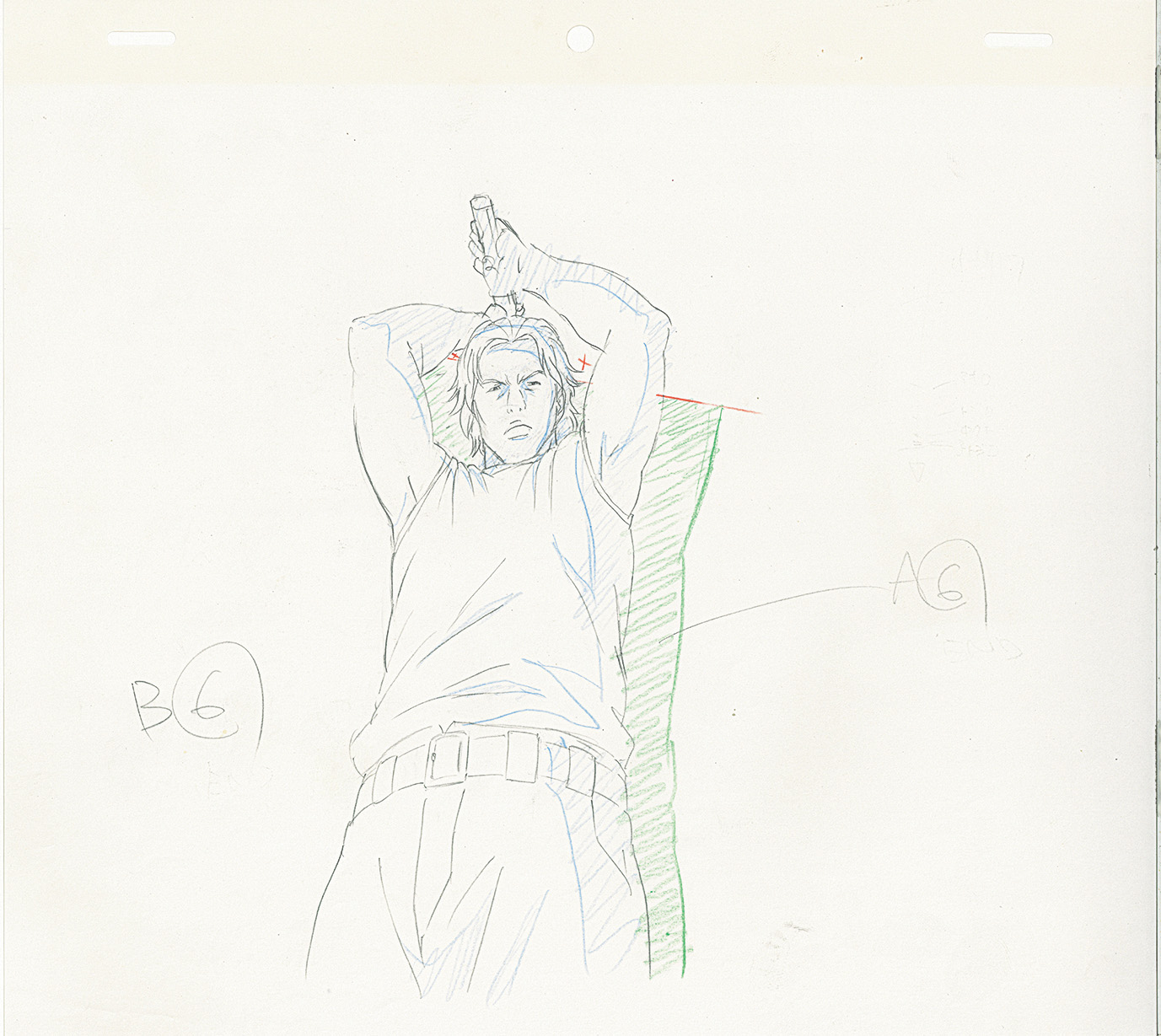
Kuze Hideo, one of the ‘Individual Eleven.’ The original illustration depicts the scene in which he attempts to assassinate the Prime Minister. © Masamune Shirow · Production I.G / Kodansha · Ghost in the Shell Production Committee