The Future City as Imagined by Animated Films
Blending reality and fiction, the ‘Ghost in the Shell’ series presents urban landscapes that shift markedly in accordance with the themes of each installment.
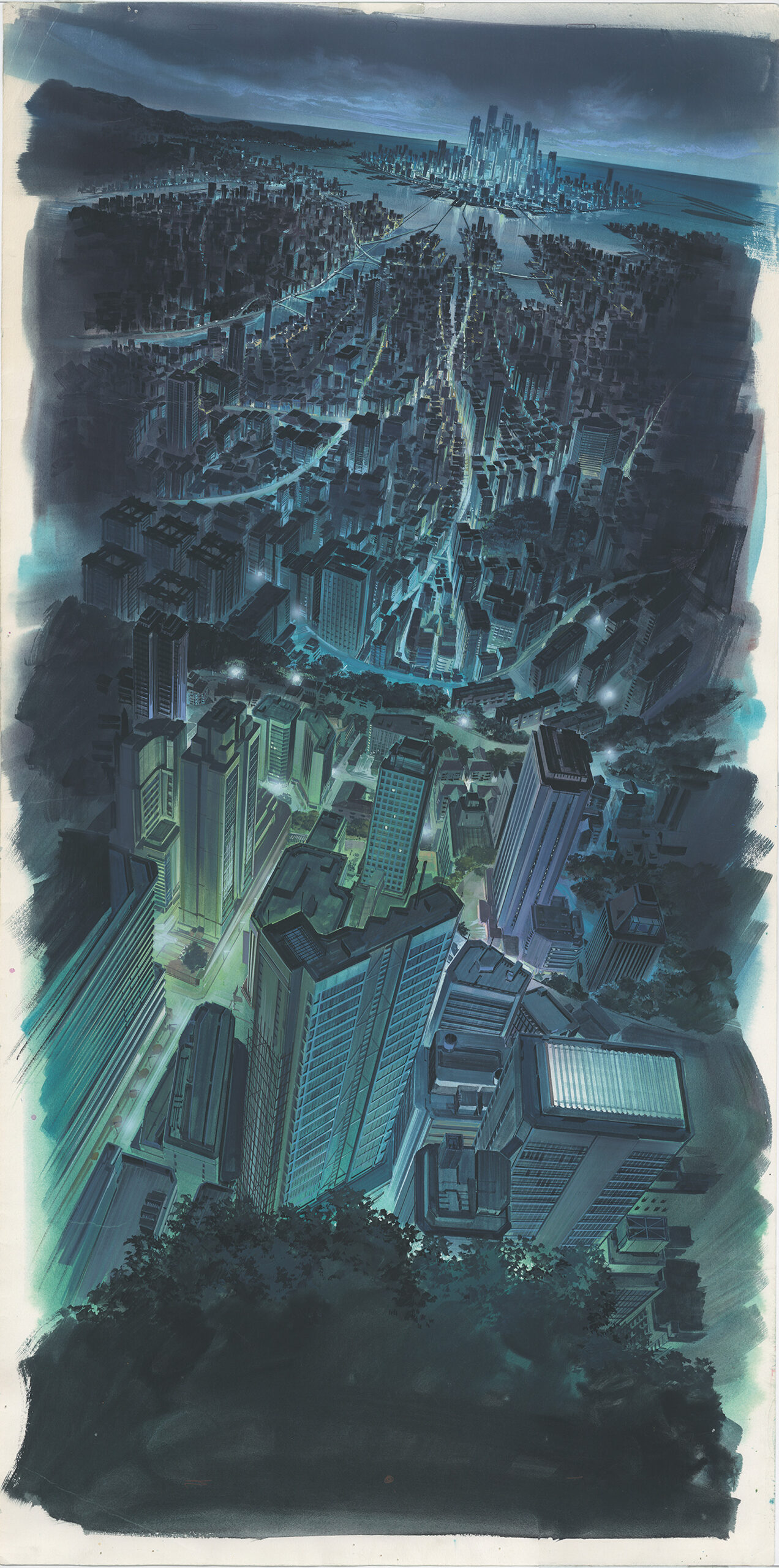
‘Ghost in the Shell’ © 1995 Masamune Shirow / Kodansha · Bandai Visual · MANGA ENTERTAINMENT
Taro Igashi
Architectural historian
Born in 1967 in Paris. A graduate of the Department of Architecture at the Faculty of Engineering, University of Tokyo, where he also completed a master’s degree. PhD in engineering. Professor at the Graduate School of Tohoku University since 2009. He curated the exhibition Cities as Depicted in Animation Background Art (2023).
In rendering worlds removed from reality with credibility, background art plays a decisive role. This function is all the more crucial in animation, where every element must be constructed from the ground up, unlike in live-action cinema.
In Ghost in the Shell (1995) and Innocence (2004), directed by Mamoru Oshii, the urban environments of a near future—set respectively in 2029 and 2032—evoke Asian metropolises. The former draws on photographs taken in Hong Kong, the latter on images captured in Taiwan, Shanghai, and Italy. Whereas Oshii’s earlier films, such as Patlabor: The Movie (1989) and Patlabor 2: The Movie (1993), offered a faithful depiction of contemporary Tokyo, Ghost in the Shell introduces an Asian visual register to underscore the emergence of a society shaped by cybernation and network technologies.
It is worth noting that the original manga by Masamune Shirow (1991) did not necessarily rely on such an aesthetic. The association between cyberspace and an Asian imaginary—what might be described as a form of techno-orientalism—thus stems from a deliberate choice on Oshii’s part.
Within the history of science fiction cinema, visions of the future long tended toward clean, streamlined environments. A decisive shift occurs with Blade Runner (1982), which, without precedent in its source material, introduces an urban crowd marked by Asian references, thereby reshaping the visual language of future cities. In Ghost in the Shell, this imagery may appear markedly unfamiliar from a Western perspective, while for Japanese audiences it produces a more subtle sense of dissonance with the everyday.
The New Port City conceived by Oshii unfolds as an urban extension built over the waters of a bay, connected to the mainland by multiple routes. At its center rises a dense cluster of administrative high-rises, while the surrounding areas are composed of lower structures. The transportation network, designed with considerable complexity, calls to mind the architecture of an integrated circuit.
In Innocence, the Etorofu Special Economic Zone appears. Overlooking a forest of slender, needle-like skyscrapers, Batō reflects: ‘If the essence of life lies in the information transmitted through genes, then society and culture are nothing other than vast memory systems. And the city, in that sense, is a gigantic external memory.’ As bodies become mechanized and minds are digitized, blurring the very grounds of what defines the human, the city seems to compensate for this loss, covering itself in human traces to the point of saturation and impurity.
By contrast, the S.A.C. series directed by Kenji Kamiyama reanchors its narrative in an urban landscape continuous with contemporary Japan. Set in the fictional city of Niihama, off the coast of Kobe, it draws in particular on the facilities of Harima Science Garden City and the Akashi Bridge. It also depicts refugee reception zones reminiscent of the historical model of Dejima. Meanwhile, the ARISE series, overseen by Kazuchika Kise, extends this approach while incorporating buildings marked by wartime destruction as well as architectural forms recalling the Shōwa era.
As these works engage with contemporary issues—cybercrime, migration, and post-truth—the Asian imaginary, as mobilized in Oshii’s films, may no longer be required in the same way.
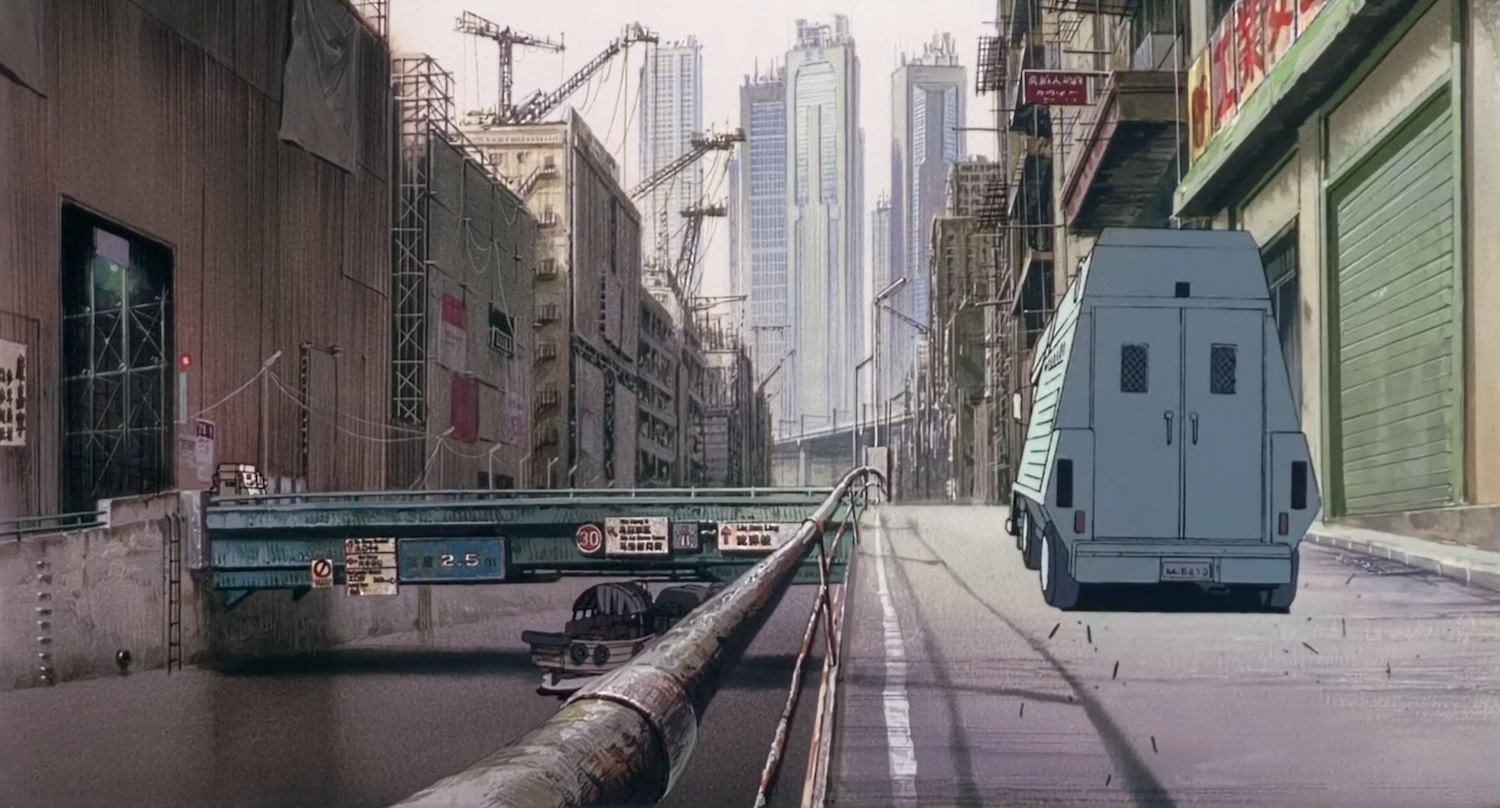
‘Ghost in the Shell’: a dense urban landscape saturated with protruding signboards reminiscent of Kowloon in Hong Kong is layered with elevated expressways evoking Tokyo, clusters of high-rise buildings, and canals inspired by Venice. © 1995 Masamune Shirow / Kodansha · Bandai Visual · MANGA ENTERTAINMENT
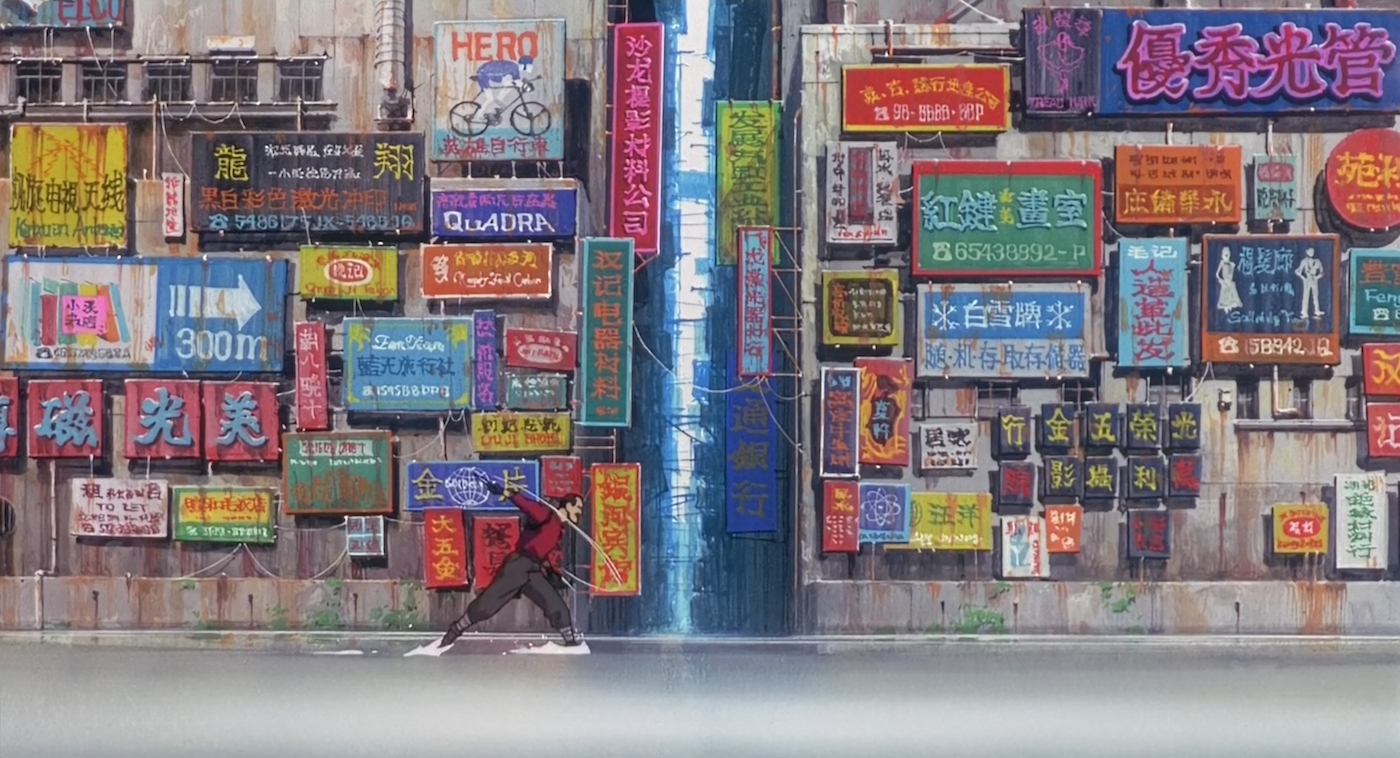
‘Ghost in the Shell’: heterogeneous signage, waterways, aging architecture, and cutting-edge infrastructure coexist within a single space, giving form, through an artificial landscape, to a world in which the boundaries between body and network, individual and state, dissolve. © 1995 Masamune Shirow / Kodansha · Bandai Visual · MANGA ENTERTAINMENT
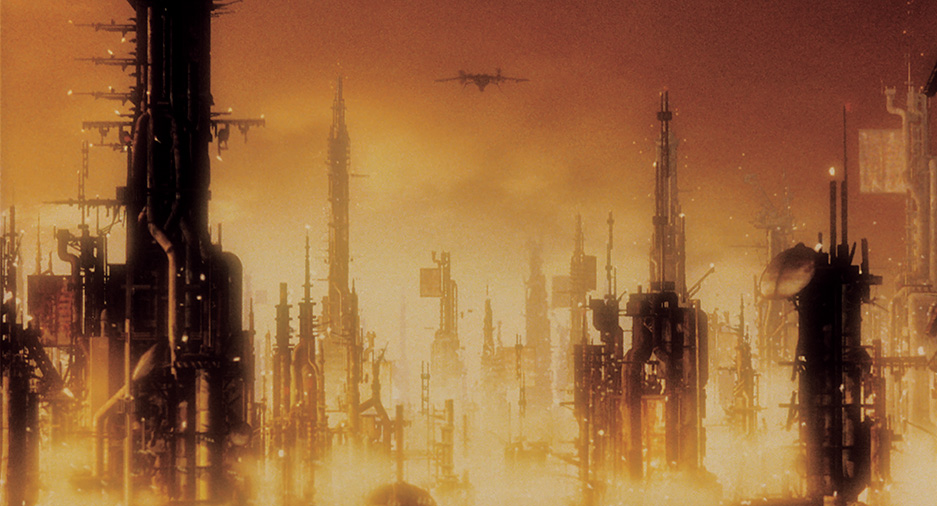
‘Innocence’: the ‘Etorofu Special Economic Zone’, where slender, spire-like skyscrapers rise in dense formation. The work is structured around a key term coined for the occasion: ‘Chinese Gothic’. © 2004 Masamune Shirow / Kodansha · IG, ITNDDTD
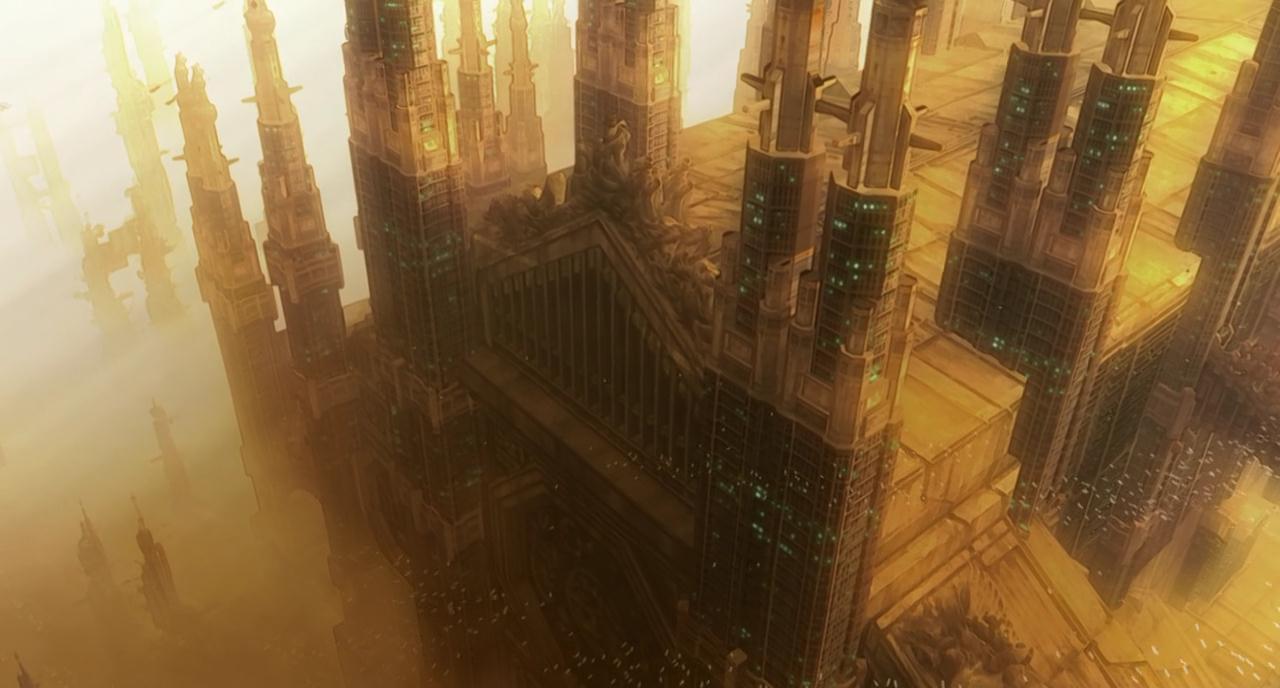
‘Innocence’: a design that merges medieval styles from Asia and Western Europe; certain buildings draw in particular on the Milan Cathedral. During production, research was conducted in Chinese coastal cities such as Shanghai and Macao, from which stone alleyways, arcade-like architectural forms, and hybrid ornaments blending European and Chinese influences were derived. © 2004 Masamune Shirow / Kodansha · IG, ITNDDTD
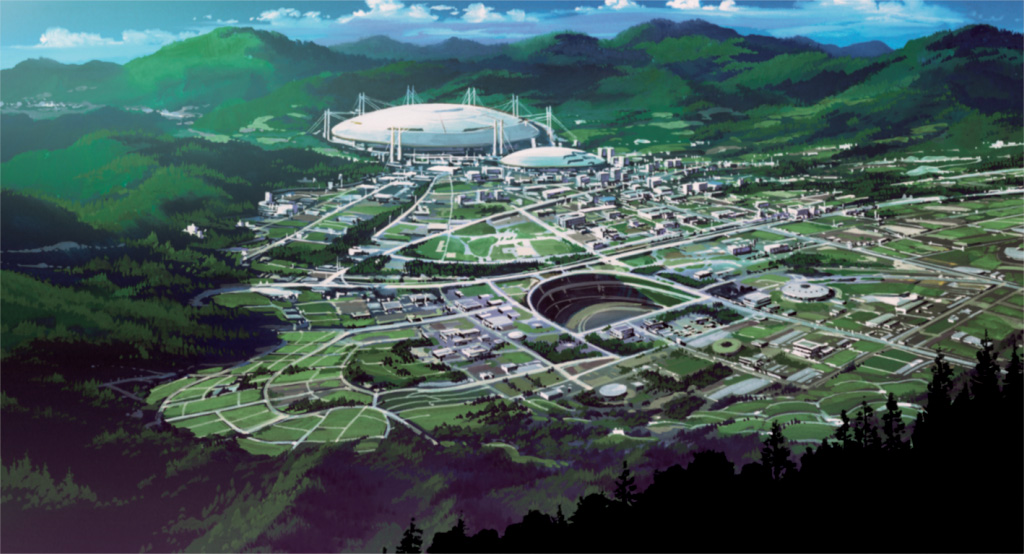
‘Ghost in the Shell: Stand Alone Complex’ and ‘Ghost in the Shell: S.A.C. 2nd GIG’: a city inspired by Harima Science Garden City, located in the southwestern part of Hyōgo Prefecture, as depicted in ‘Stand Alone Complex’. © Masamune Shirow · Production I.G / Kodansha · Comité de production Ghost in the Shell
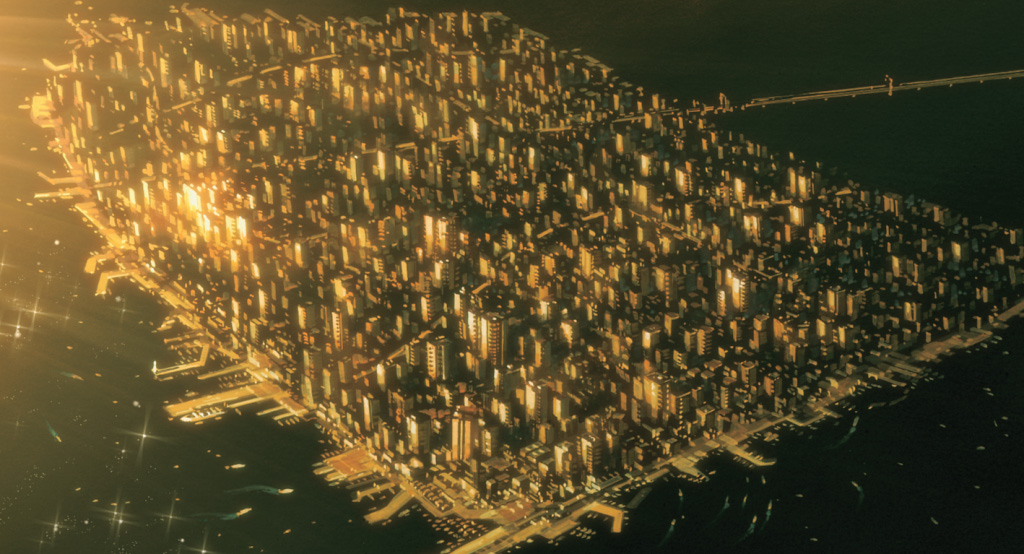
‘Ghost in the Shell: Stand Alone Complex’ and ‘Ghost in the Shell: S.A.C. 2nd GIG’: in ‘2nd GIG’, an administered district recalling Dejima serves as a reference, shaping an urban space in which administrative and military spheres intersect in layered ways. In both cases, the structure of real cities, designed for functionality, is strongly reflected, with settings conceived as stages for political conflict and information warfare. © Masamune Shirow · Production I.G / Kodansha · Comité de production Ghost in the Shell
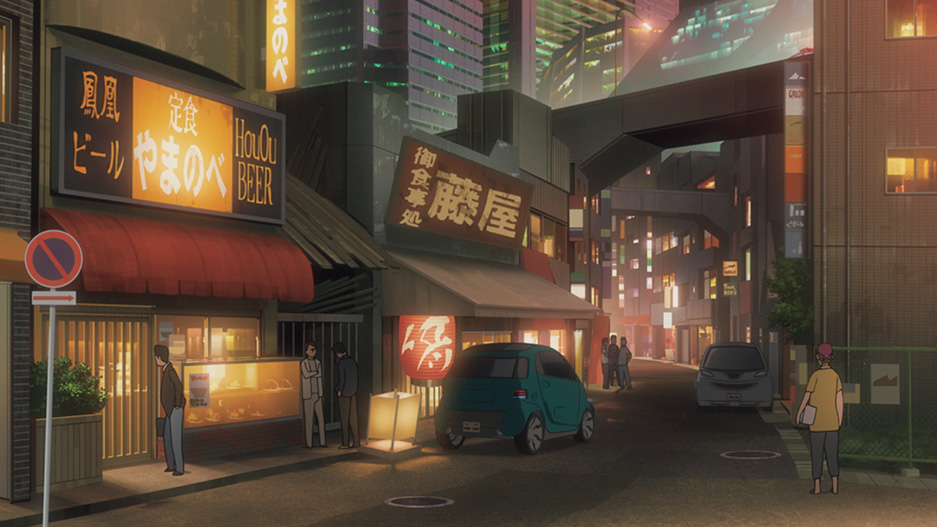
‘Ghost in the Shell: Arise’: the work adopts as its backdrop a contemporary Japanese urban landscape, stripped of overt exoticism. Redeveloping waterfront areas, mixed-use buildings, and highway networks—these ordinary urban elements anchor the narrative in a tangible reality, while expressing, at an architectural scale, the instability preceding the formation of Section 9. © S ・P / K・GAPS