Gaudí’s Influence on the Creation of Niki de Saint Phalle’s Tarot Garden in Italy
After visiting Park Güell in 1955, the Franco-American artist began dreaming of a place where her monumental ambitions could run free.
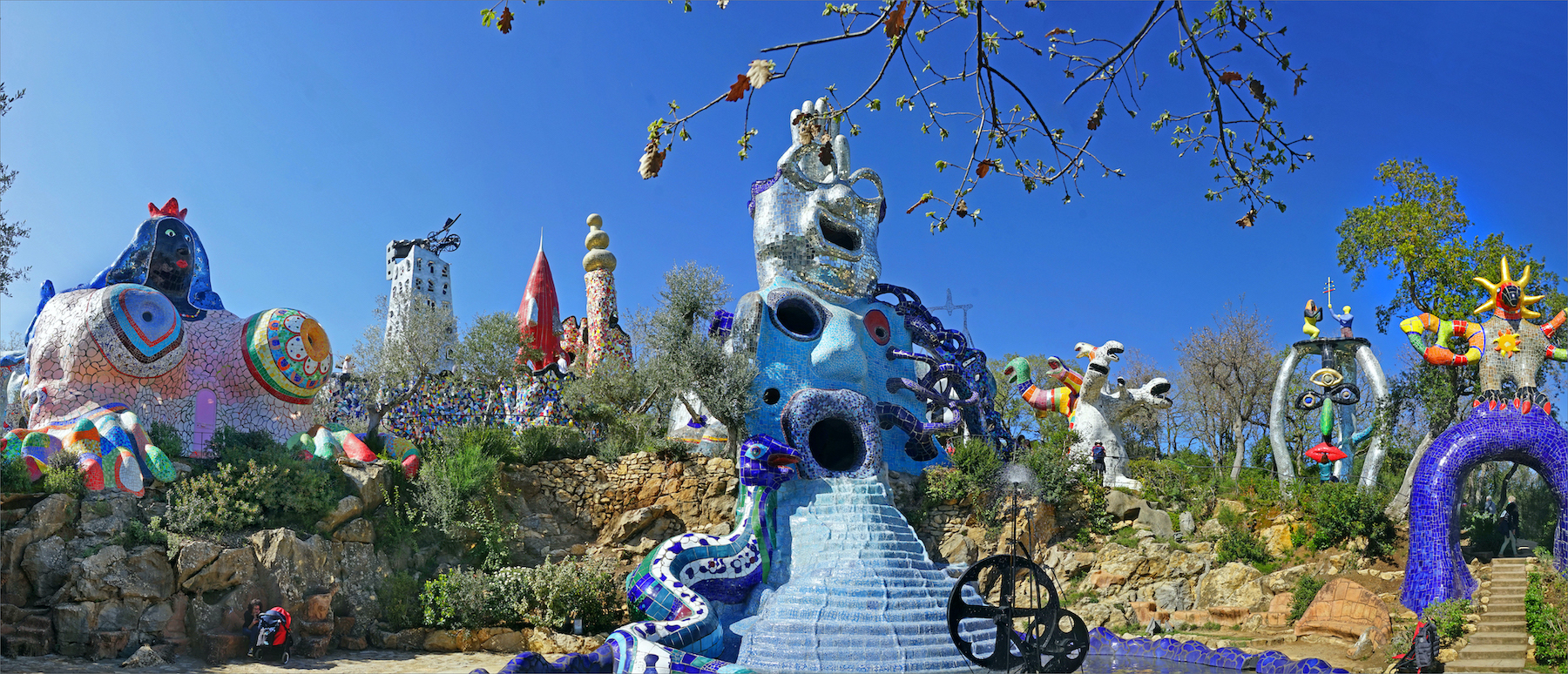
View of the Tarot Garden as visitors arrive on site. At the centre, the ‘High Priestess’ topped by the ‘Magician’. To the left, the ‘Empress’. In the background, the ‘Tower’, alongside one of the ‘Emperor’’s towers and a rocket. To the right, the arch of the ‘Sun’, with the ‘Pope’ to its left © “Le ‘Jardin des Tarots’ de Niki de Saint Phalle (Capalbio, Italy)” by Jean-Pierre Dalbéra, CC BY 2.0
‘A revelation.’ ‘Love at first sight with this genius architect.’ That is how Niki de Saint Phalle described the sense of wonder she experienced after visiting Barcelona’s Park Güell in 1955, the fantastical public park designed by Antoni Gaudí. At the time, she was only twenty-five years old and still at the very beginning of her artistic career, which was then limited to painting. In the 1960s, she would rise to international fame with her Tirs series—performances in which she shot at paintings with a rifle—and with her Nanas, monumental sculptures of exuberant, dancing female figures.
It would take another two decades before she could realise her dream of creating a garden, a place she associated with both paradise and childhood. Yet even then, Niki de Saint Phalle had already become fascinated by Gaudí’s use of trencadís, the Catalan mosaic technique she quickly began experimenting with in her own collages. The method consists of assembling fragments of broken ceramic to create new patterns. Ceramic itself allows for an immense variety of colours, while its smooth surface gives it a striking luminosity. By combining irregular pieces, the technique also creates trompe-l’œil effects and a sense of depth—something that particularly appealed to Niki de Saint Phalle, who had never received formal academic training and did not master traditional perspective.
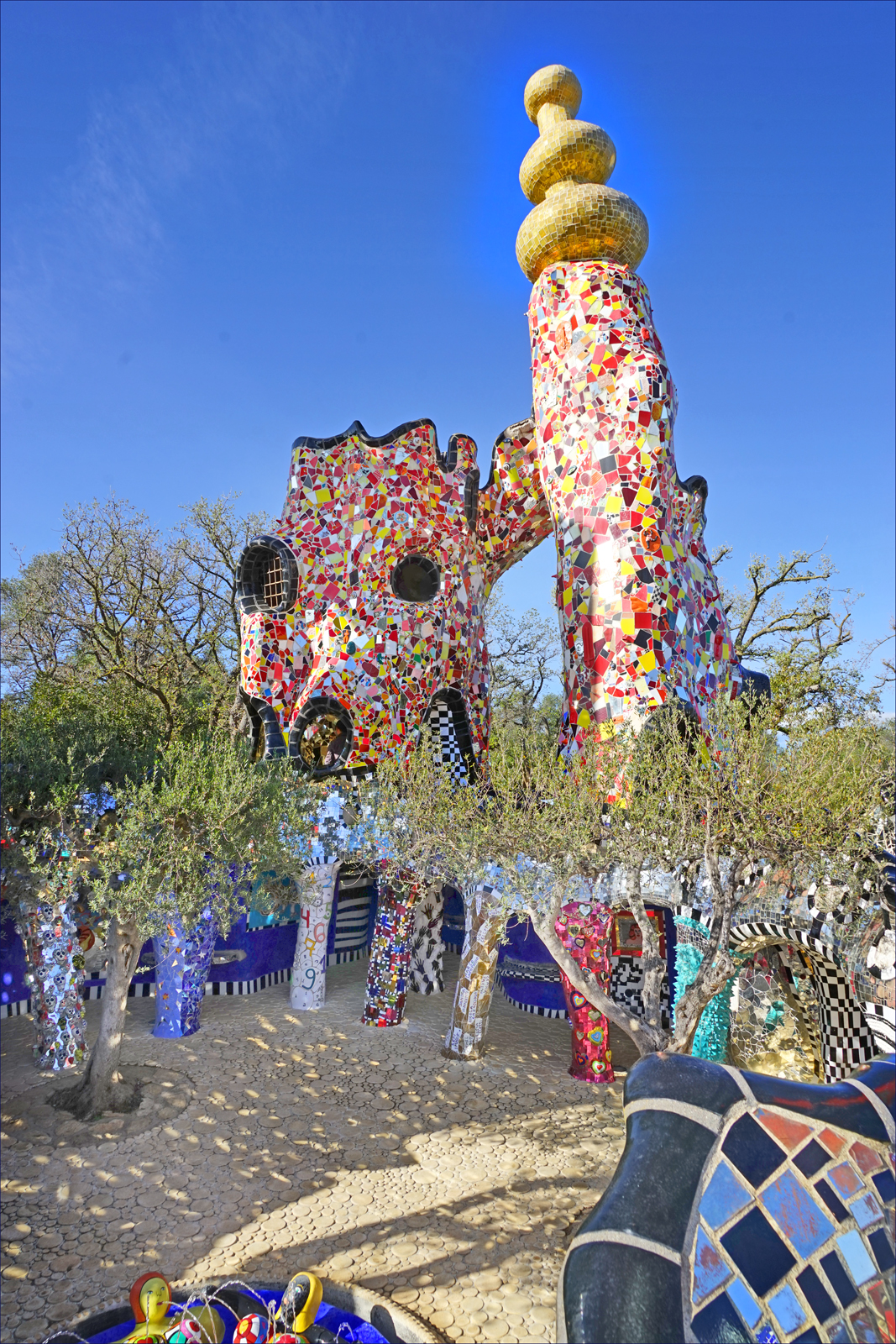
The ‘Emperor’, clad in ‘trencadís’ mosaic © “L’empereur (Le Jardin des Tarots de Niki de Saint Phalle à Capalbio, Italy)” by Jean-Pierre Dalbéra, CC BY 2.0
Art beyond museum walls
According to Mélanie Gourarier, an anthropologist at the French National Centre for Scientific Research (CNRS) and author of Niki de Saint Phalle, Le jardin des Tarots (Actes Sud, 2010), Niki de Saint Phalle was particularly drawn to the way Gaudí ‘seemed to free himself from geometric rules in architecture while creating monumental works.’ The Franco-American artist had been captivated by curved forms since childhood. Gradually, she began to dream of architecture itself. Reflecting on her visit to Park Güell, she later said: ‘I understood that art was not something you hang on a wall.’ Longing to free herself from the constraints of museum exhibitions and the commodification of art, she spent years imagining what she would eventually call ‘the dream of my life.’
In 1978, the opportunity finally arose. Niki de Saint Phalle found the ideal site for her garden in Tuscany, on land lent to her by a friend’s brother. There, she began work on what would become the Tarot Garden, a theme that emerged naturally after much reflection, given her longstanding fascination with divination and esoteric practices. Each of the twenty-two Major Arcana cards would be represented by a sculpture dispersed throughout the grounds. Wandering through the pathways, visitors are invited to compose their own tarot reading through their encounters with the different arcana.
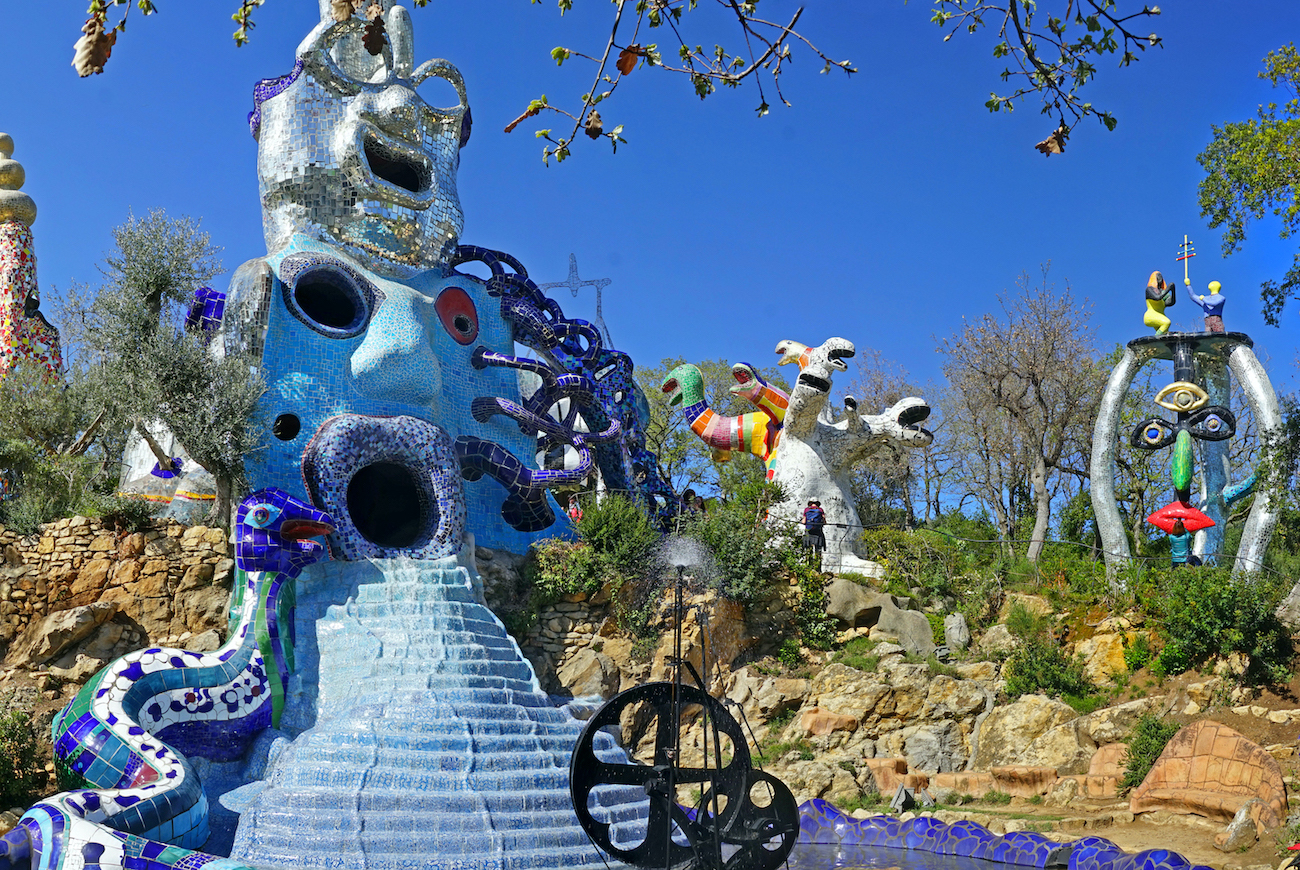
The ‘High Priestess’, surmounted by the ‘Magician’. To the left of the staircase leading to the entrance from the pool, a snake recalls Gaudí’s salamander in Park Güell. At the bottom right of the image, a bench carved directly into the rock © Detail of “Le ‘Jardin des Tarots’ de Niki de Saint Phalle (Capalbio, Italy)” by Jean-Pierre Dalbéra, CC BY 2.0
Erasing the boundary between nature and architecture
The first figure to greet visitors is the High Priestess, her gaping mouth recalling the monstrous stone head found in the Gardens of Bomarzo. She stands at the top of a staircase lined with a long snake—a tribute to the salamander of Gaudí’s Park Güell. This organic sculpture was cast in concrete before being covered in ceramic fragments in varying shades of blue using the trencadís technique. Borrowed from Gaudí, the method was relatively inexpensive and allowed vast surfaces to be covered quickly. Niki de Saint Phalle added shards of mirror, sometimes covering entire sculptures with them, reflecting the surrounding vegetation and dissolving the boundary between architecture and nature.
‘By integrating the environment into her work, she succeeded in giving movement to her sculptures,’ Mélanie Gourarier explains. This achievement becomes even more poetic in the artist’s Skinnies, lightweight hollow sculptures reduced to their skeletal forms. One such work is the Moon, a woman’s face turned toward the sky whose appearance shifts with the passing clouds behind it.
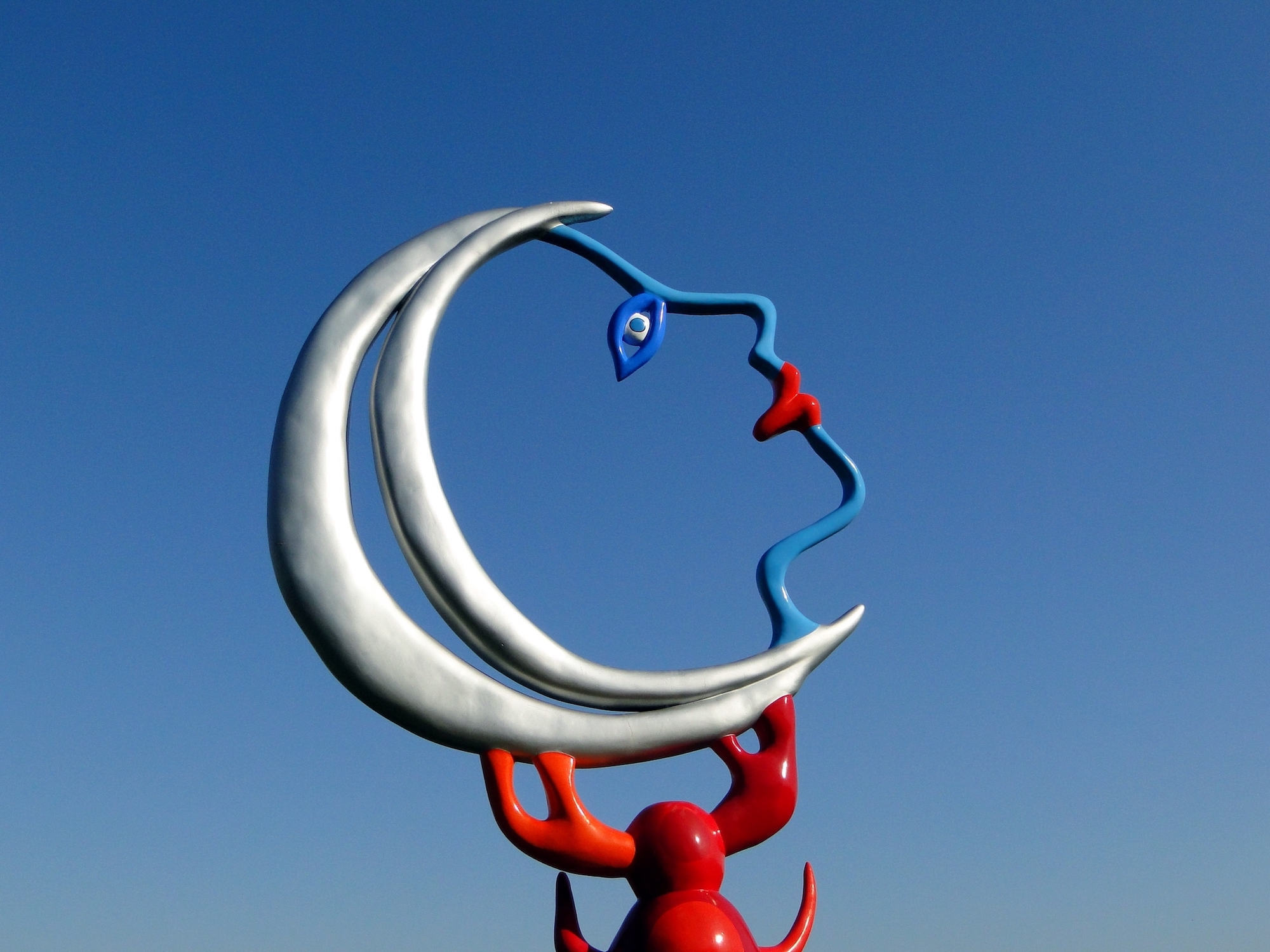
The ‘Moon’, one of the Tarot Garden’s ‘Skinnies’—hollowed-out sculptures by Niki de Saint Phalle. Its perception shifts with the movement of the clouds in the background © ‘Giardino dei Tarocchi (Tarot Garden) - La Luna (The Moon)’ by Stefano F, CC BY-NC-SA 2.0
This attentiveness to the environment was another trait Niki de Saint Phalle shared with Gaudí. Like him, she designed the site in accordance with the terrain’s natural topography—a former quarry shaped like a horseshoe or an Italian theatre—and chose to work with Tuscan vegetation rather than import exotic species. From Park Güell, she also retained Gaudí’s concern for the visitor experience from the very conception of the space. Gaudí had integrated numerous benches directly into the architecture of the park, as though they had emerged organically from the structures themselves. In turn, Niki de Saint Phalle concealed seating areas within the rocks surrounding her sculptures.
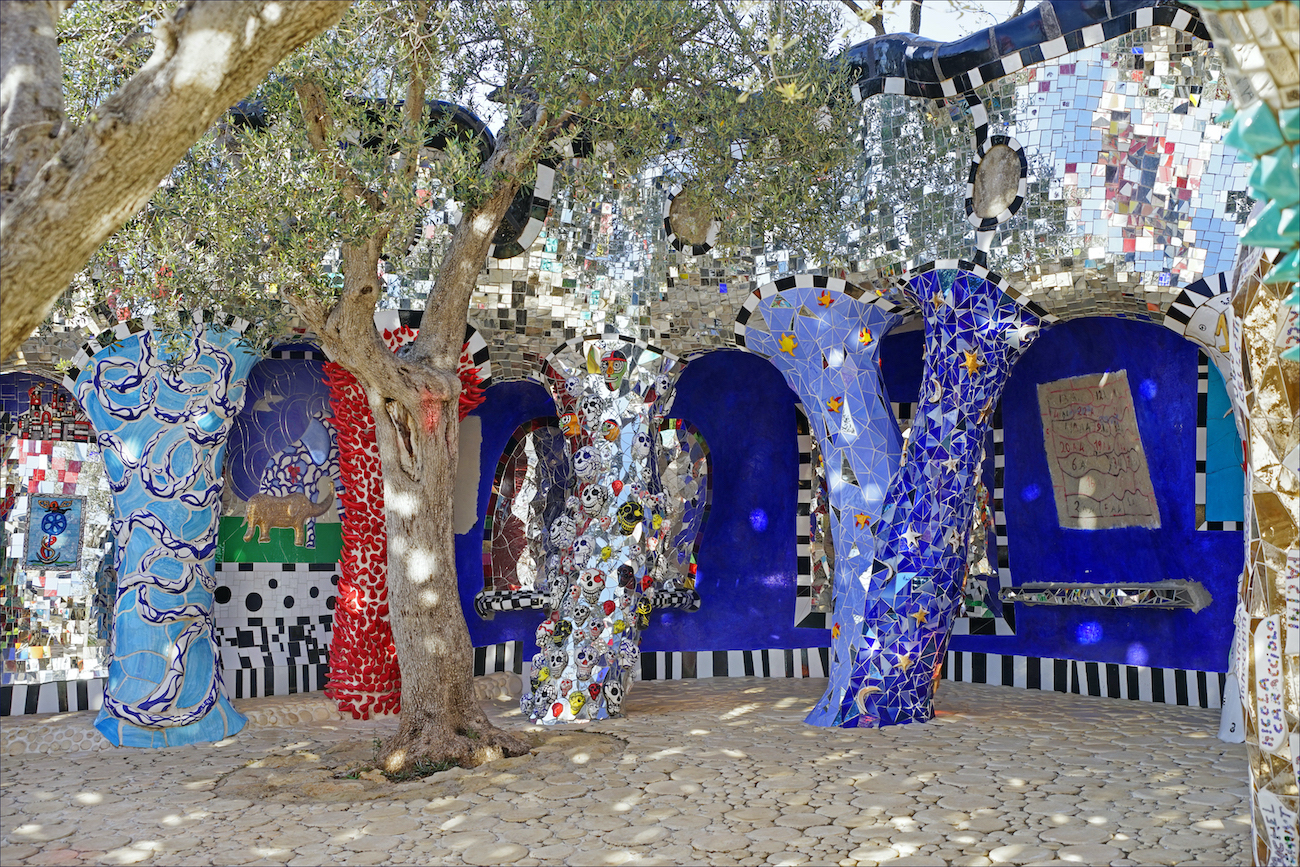
The ‘Emperor’ castle is composed on its first level of a terrace lined with arcades reminiscent of the hypostyle hall in Gaudí’s Park Güell © “Le ‘Jardin des Tarots’ de Niki de Saint Phalle (Capalbio, Italy)” by Jean-Pierre Dalbéra, CC BY 2.0
Blurring the lines between art forms
Other echoes of the Catalan architect can be found throughout the Tarot Garden. The structure of the Emperor, a fortress-like construction with a rampart walkway and an arcade passage below, recalls the terrace above Park Güell’s hypostyle hall. Like Gaudí, Niki de Saint Phalle wielded colour with remarkable virtuosity. Vivid hues—from bright yellow to Klein blue—immediately capture the eye, like a scattering of sour candies one instinctively wants to touch. Her art is an ode to joy, one that also speaks directly to children.
‘Niki de Saint Phalle was fascinated by childhood—both her own and her relationship to motherhood,’ says Mélanie Gourarier. ‘Through works that are meant to be experienced physically, she rediscovered a youthful relationship to art. Fun was fundamental to her conception of artistic practice.’
It is perhaps in addressing an unconventional art audience that Niki de Saint Phalle comes closest to Gaudí. Both sought, in opposite directions, to bring art into architecture and architecture into art, with extraordinary creative freedom. ‘They shared a way of breaking down the boundaries between art forms,’ Gourarier continues. ‘They focused on the public—and not necessarily a public already familiar with art. There was a democratic impulse in Gaudí’s projects; he wanted them to be accessible to people who were not the usual audience for major architectural works.’
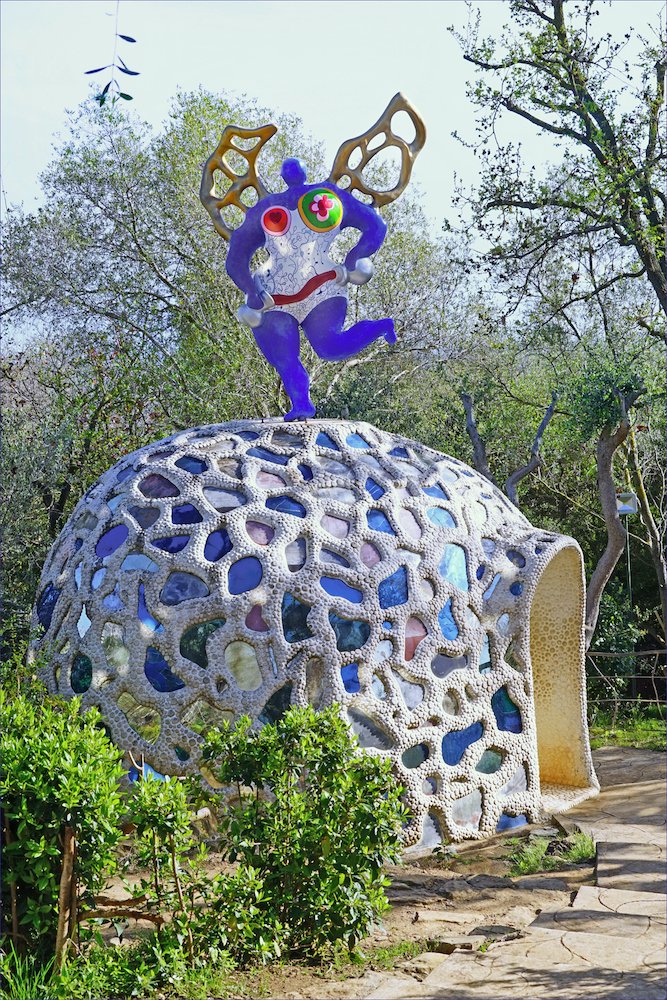
‘Temperance’ stands above a small organically shaped chapel © “La Tempérance (Le Jardin des Tarots de Niki de Saint Phalle à Capalbio, Italy)” by Jean-Pierre Dalbéra, CC BY 2.0
‘A new version of cathedrals
This ambition is particularly evident in Gaudí’s masterpiece, the Sagrada Família, which deeply impressed Niki de Saint Phalle, herself obsessed with religious architecture. After visiting Park Güell, she said to herself: ‘I thought we needed to find a new version of cathedrals.’ For Niki de Saint Phalle, however, such structures represented less a religious reference than the fulfilment of human genius—the work of an entire lifetime. In many ways, the Tarot Garden became her own cathedral. Its construction lasted nearly twenty years before opening to the public in May 1998. To realise her vision, the artist surrounded herself with a multidisciplinary team that included ceramicists, metalworkers and landscape designers. Much like the great cathedral building sites of the past, she relished escaping the solitude of artistic creation and leading a collective endeavour.
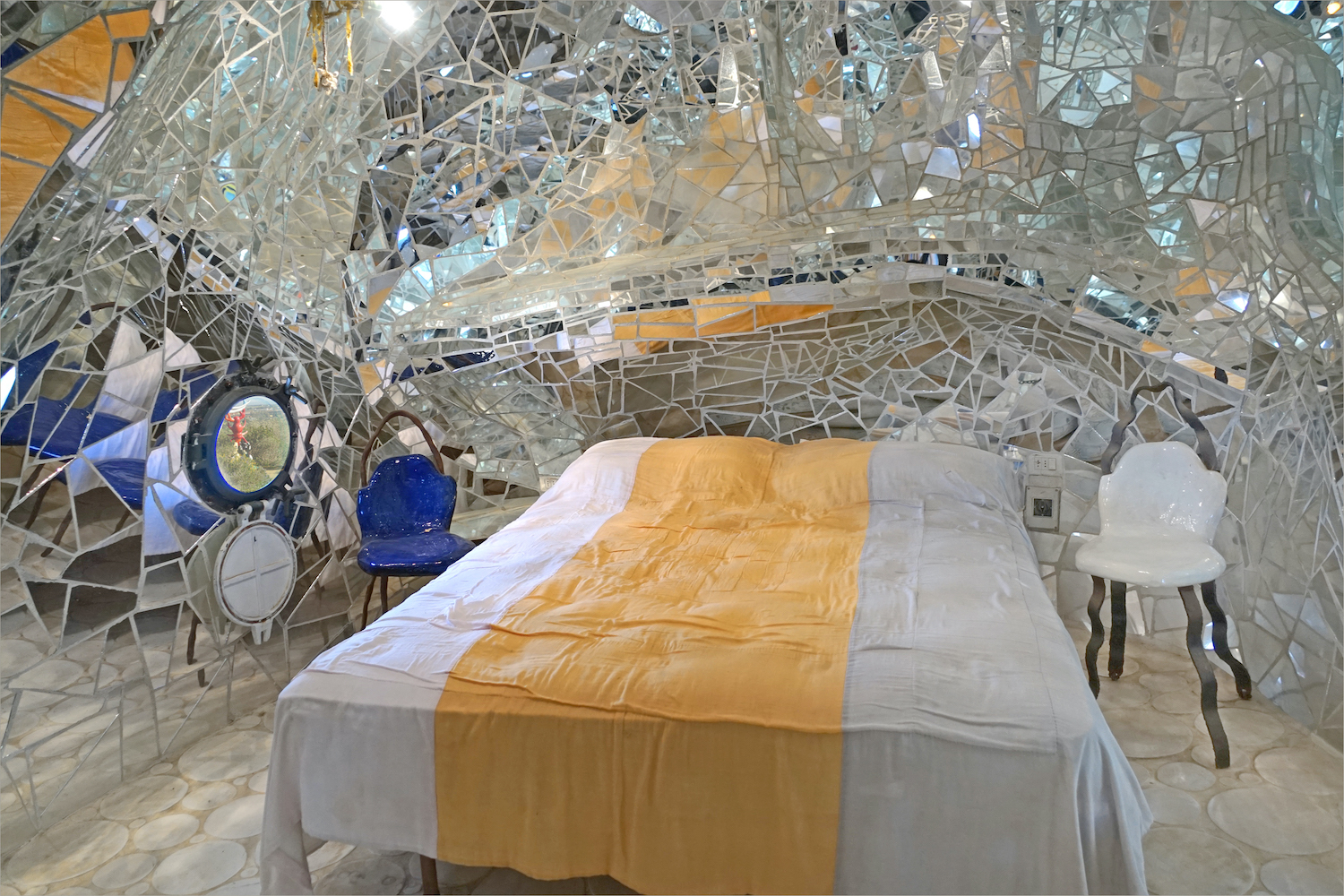
The bedroom created by Niki de Saint Phalle inside the right breast of the ‘Empress’. Through the porthole on the left, the lower part of the ‘Moon’ can be seen © “L’appartement (Le Jardin des Tarots de Niki de Saint Phalle à Capalbio, Italy)” by Jean-Pierre Dalbéra, CC BY 2.0
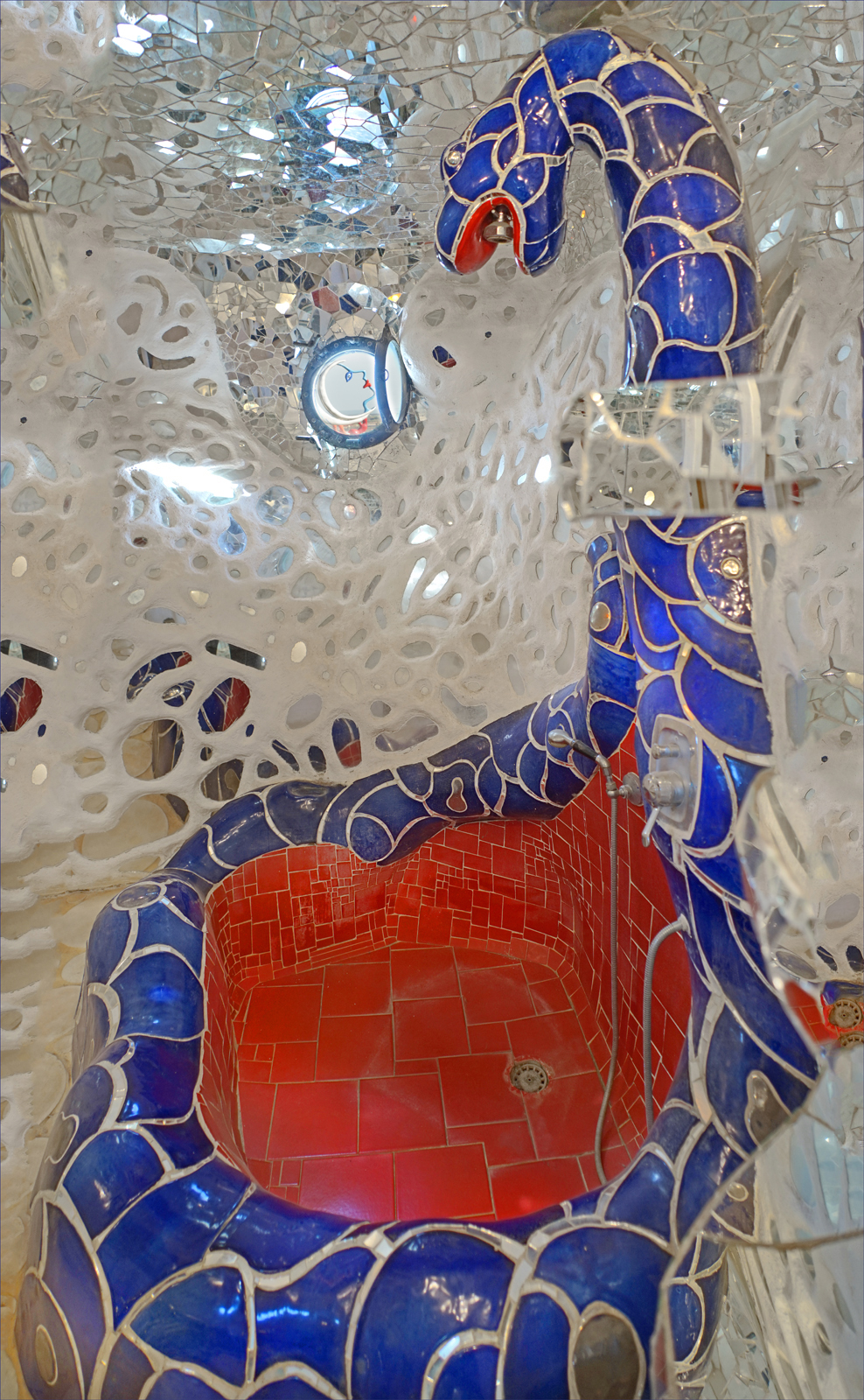
Niki de Saint Phalle’s bathroom inside the ‘Empress’, located beneath her bedroom. The shower is shaped like a snake, the artist’s totem animal. Through the window in the background, the ‘Moon’ is visible © “L’appartement (Le Jardin des Tarots de Niki de Saint Phalle à Capalbio, Italy)” by Jean-Pierre Dalbéra, CC BY 2.0
Like Antoni Gaudí, who spent the final years of his life in a workshop at the Sagrada Família construction site, Niki de Saint Phalle lived in the Tarot Garden for more than a decade, until 1990. She installed a bedroom inside the right breast of the Empress, with a bathroom below and a kitchen entirely covered in mirrors—all of which remain intact today. Consumed by their work, both figures shared the desire to ‘inhabit their dream,’ concludes Mélanie Gourarier. Their lives testify to an immense creative freedom, fiercely defended in the case of Niki de Saint Phalle, who insisted on remaining entirely in control of her garden and sought funding independently, without relying on major patrons. Today, the site is managed by a foundation that continues to uphold the artist’s wishes regarding visitor access and preservation.
More than a century after the death of its creator, Gaudí’s Sagrada Família remains unfinished—a testament to the enduring power of his legacy. The future of the Tarot Garden is less certain. Though monumental, Niki de Saint Phalle’s works are made from fragile materials, and their preservation is far from simple. Perhaps one day, as happened with the Gardens of Bomarzo, nature will reclaim the Tarot Garden entirely.
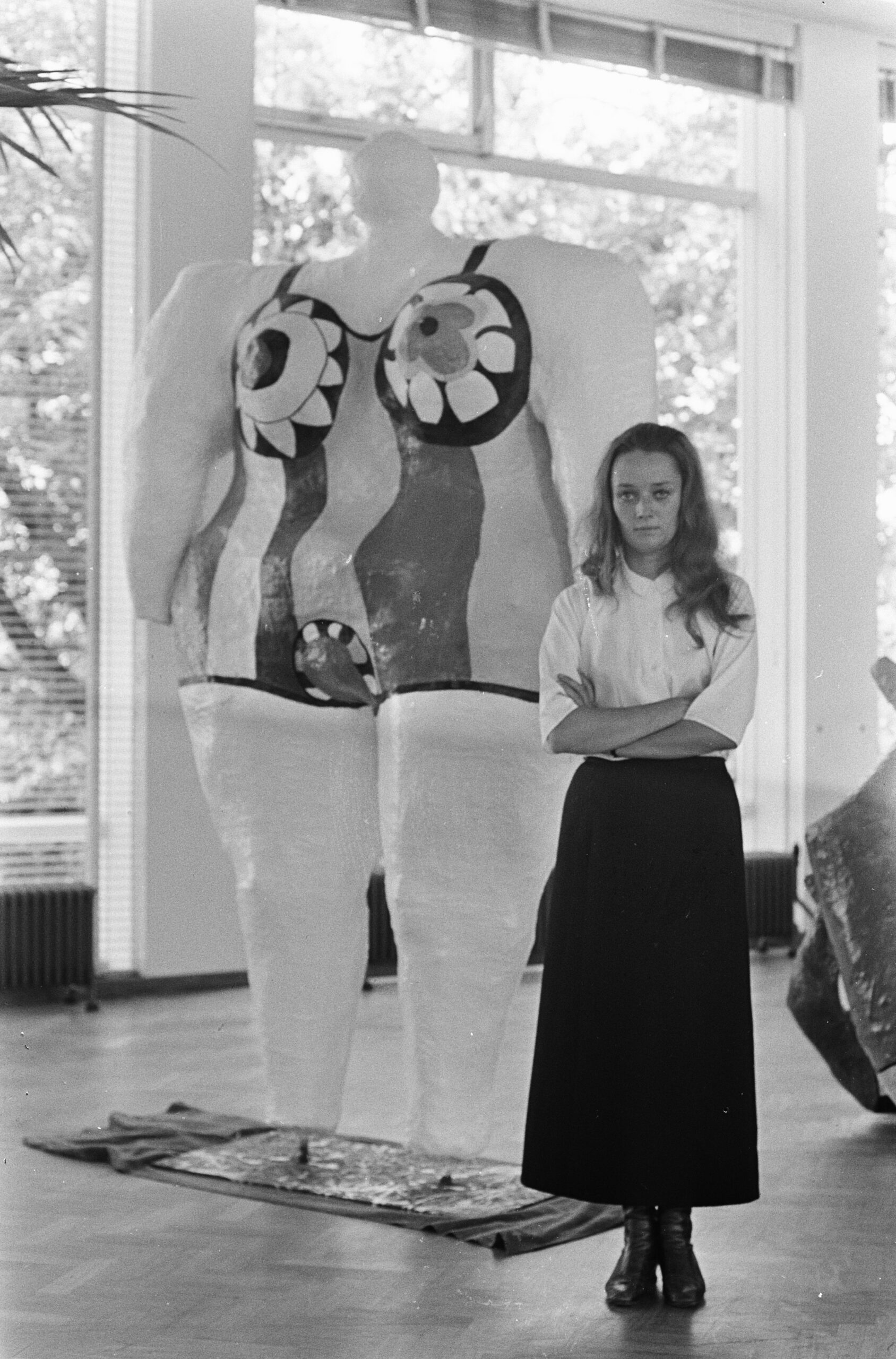
Niki de Saint Phalle at the Stedelijk Museum in Amsterdam in 1967, standing in front of one of her ‘Nanas’ © Jack de Nijs for Anefo