Haruka Ayase, ‘I Want to Capture Every Emotion in Everyday Life and Fully Embrace the Present Moment’
The actress reunites with director Hirokazu Kore-eda in ‘Sheep in the Box’, now playing in cinemas.

Haruka Ayase ● Born in 1985 in Hiroshima Prefecture, she made her debut in 2001 and rose to widespread recognition with the television drama ‘Sekai no Chūshin de, Ai o Sakebu’ (‘Crying Out Love in the Center of the World’, 2004). Her recent film credits include ‘Okusama wa, Toriatsukai Chūi’ (‘Caution, Hazardous Wife’, 2021), ‘Yes, I Can’t Swim’ (2022), ‘The Legend and Butterfly’, ‘Revolver Lily’ (both 2023), ‘Route 29’ (2024), and ‘Hito wa Naze Love Letter wo Kakunoka’ (‘Why Do People Write Love Letters?’, 2026).
Nearly eleven years after Our Little Sister (Umimachi Diary), Haruka Ayase reunites with Hirokazu Kore-eda, whose films have long explored the complexities of family relationships. His latest feature, Sheep in the Box (Hako no Naka no Hitsuji), an original screenplay written by the director himself, is set in the near future. Ayase stars as Otone, a mother who welcomes into her family a humanoid bearing the exact likeness of her late son.

‘Otone gradually becomes absorbed by the presence of this humanoid. When I first read the script, I actually found myself relating more to her husband Ken, who keeps wondering, ‘Is this really the right thing to do?’ But when Kore-eda told me that businesses already exist in China that use AI to ‘bring back’ the deceased, it really made me think. If someone I loved suddenly appeared before me looking exactly the same, how would I react? Otone wants to build a new future with the son who has returned to her, while knowing deep down that something is different. Portraying that constant tension between those two feelings was the greatest challenge.’
To bring this emotionally complex character—caught between grief and healing—to life, Ayase says she drew heavily on both her relationship with Daigo, one half of the comedy duo Chidori, who plays her husband, and the distinctive atmosphere that defines Kore-eda‘s film sets.
‘Before filming began, the director arranged for Daigo, Rimu Kuwaki, who plays our humanoid son, and me to spend time together. Daigo is incredible. Even when the cameras weren’t rolling, he would naturally speak to Rimu as though he were already his father. I was the one who needed a little more time to break the ice and build that closeness. But once filming started, the three of us talked and laughed together so naturally that the same atmosphere carried over in front of the camera. Spending time in the gentle, peaceful environment that Kore-eda creates on set made a huge difference. It may sound presumptuous, but seeing him again after all these years, I felt he had become even calmer and more assured in his vision.’
‘At My Age, I Want to Portray Emotions I Can Only Feel Now’

Top: ¥369,600 (reference price). Trousers: ¥291,500. Shoes: ¥188,100. All pieces by Louis Vuitton.
Otone’s profession as an architect, along with the family’s home built around a central courtyard, adds another layer of depth to the film.
‘I learned how to build architectural models and produce sketches, which I thoroughly enjoyed. An architect’s job is to listen to a client’s wishes and gradually give shape to something that is initially invisible. That inevitably requires time to think. There’s a scene where Otone says, ‘I want to take the time to think.’ Even when we understand something intellectually, we can’t always remain rational or organise our thoughts. I feel that imperfection—that deeply human complexity—is precisely what sets us apart from AI, which can instantly produce answers to almost any problem.’
This spring also saw the release of Hito wa Naze Love Letter wo Kakunoka (Why Do People Write Love Letters?), a film inspired by a true story in which Ayase plays the lead role. Today, when choosing a new project, what matters most to her is the lasting impression a story leaves within her.
‘Of course, wanting to work with a particular director can be a strong motivation. But I always begin by reading the script and asking myself how I feel about the character I’m going to play, how that character moves me. More recently, I’ve also found myself thinking more carefully about what the role might ultimately convey to audiences. I don’t do anything special to sharpen my sensitivity, but perhaps I simply try not to let the emotions I experience in everyday life pass me by. Whether it’s the moment I open a window and the light pours in, or a seemingly ordinary conversation, I have the feeling that something truly meaningful can reveal itself.’
Asked what challenges she would like to take on next, Ayase first says she hopes to ‘play fascinating roles that allow me to express the emotions and concerns that come with this stage of life,’ before adding, with a smile, a far more personal ambition. ‘I’d also like to become a better cook and really learn how to make the most of good ingredients. Eating is living, isn’t it? I often think a little extra effort would make my cooking much better, but I’m rather lazy and usually settle for the simplest option. I’d love to learn how to cook in a way that really lets the ingredients shine. I realise I’m no longer talking about my work… It’s a much smaller goal! (laughs)’
Whether speaking about the challenges that lie ahead or the quiet pleasures of everyday life, Haruka Ayase approaches both with the same understated sincerity. Unassuming words, a gentle smile—if only for a moment, the true character of one of Japan’s most beloved actresses quietly came into focus.
WORKS
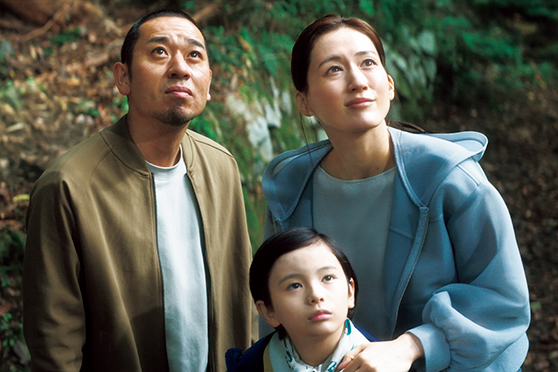
© 2026 Fuji Television, Gaga, Toho, AOI Pro.
Film ‘Sheep in the Box’
Two years after losing their son, architect Otone Komoto and her husband Kensuke, the head of a construction company, welcome into their home a humanoid that looks exactly like him. Gradually, time begins to move again for the grieving family. An original story written and directed by Hirokazu Kore-eda. Scheduled for release in the United States by NEON on July 24, 2026.

© 2026 ‘Hito wa Naze Love Letter wo Kakunoka’ Production Committee
Film ‘Hito wa Naze Love Letter wo Kakunoka’ (‘Why Do People Write Love Letters?’)
At the age of 17, Nazuna falls in love with Shinsuke, a high school student she sees every day on the train. When he dies in a subway derailment, her feelings remain unspoken. Twenty-four years later, Nazuna decides to write a letter to the family he left behind. Based on a true story and directed by Yūya Ishii, the film is currently screening in Japan.
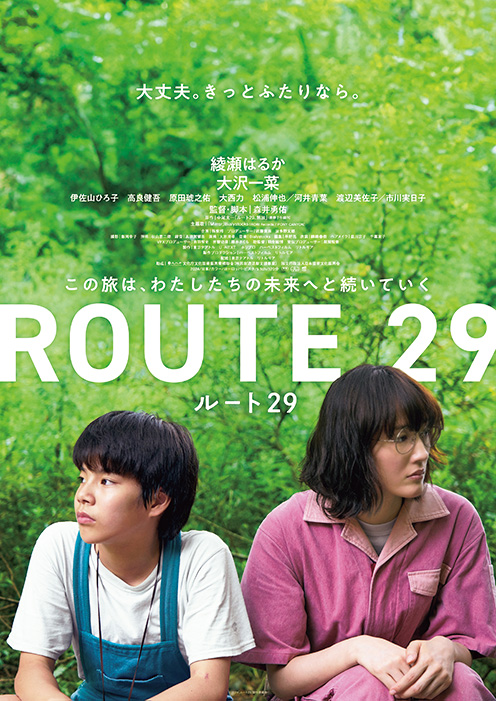
© 2024 ‘Route 29’ Production Committee
Film ‘Route 29’ (2025)
Inspired by poet Taichi Nakao’s collection Route 29, Kaihō, Yūsuke Morii’s road movie follows a woman who struggles to connect with others as she gradually forms an unlikely bond with an eccentric young girl. Available to stream, as well as on Blu-ray and DVD.